The ecommerce landscape in 2026 is no longer a game of simple funnels; it is a battle for first-party data and agentic efficiency. With the global ecommerce market projected to reach $7.41 trillion this year, accounting for 21.8% of all retail transactions, the stakes for accurate attribution have never been higher. As we navigate a world where AI assistants execute purchases directly and customers interact with 8–10 touchpoints before converting, legacy tracking methods have crumbled. To stay competitive, Shopify operators must master the latest stack: the 2026 Triple Pixel and the action-based Moby 2 AI agents. While an AI ecommerce employee like Stormy AI handles your messy back-office tasks like inventory monitoring and supplier follow-ups, Triple Whale serves as the specialized command center for your growth capital.
The 2026 Attribution Crisis: Why Your Data is Fragmented
By mid-2026, the traditional buyer's journey has evolved into what experts call a "pretzel-shaped" path. Between AI-powered search engines like Perplexity and Google SGE dropping organic clicks by as much as 38% year-over-year, and the continued tightening of iOS privacy protocols, the "dark traffic" problem is more acute than ever. Brands are regularly losing 20-30% of their conversion data to cookie blocking. This data gap leads to the "Double-Counting Trap," where Meta and Google both claim 100% credit for the same sale, causing brands to over-invest in redundant channels while starving their top-of-funnel growth.
"AI is no longer experimental; it’s how brands protect margins and compete. We’ve moved from data tools to real-time strategic advisors." — AJ Orbach, CEO of Triple Whale
To combat this, the 2026 version of Triple Whale has shifted from a dashboard of charts to a suite of action-based agents. During the 2025 Black Friday Cyber Monday weekend, brands using this stack generated $2.88 billion in revenue, representing nearly 20% of all Shopify merchant sales. This tutorial provides the technical blueprint to join that top tier of performers.
Step 1: Deploying the 2026 Triple Pixel via Headless CLI
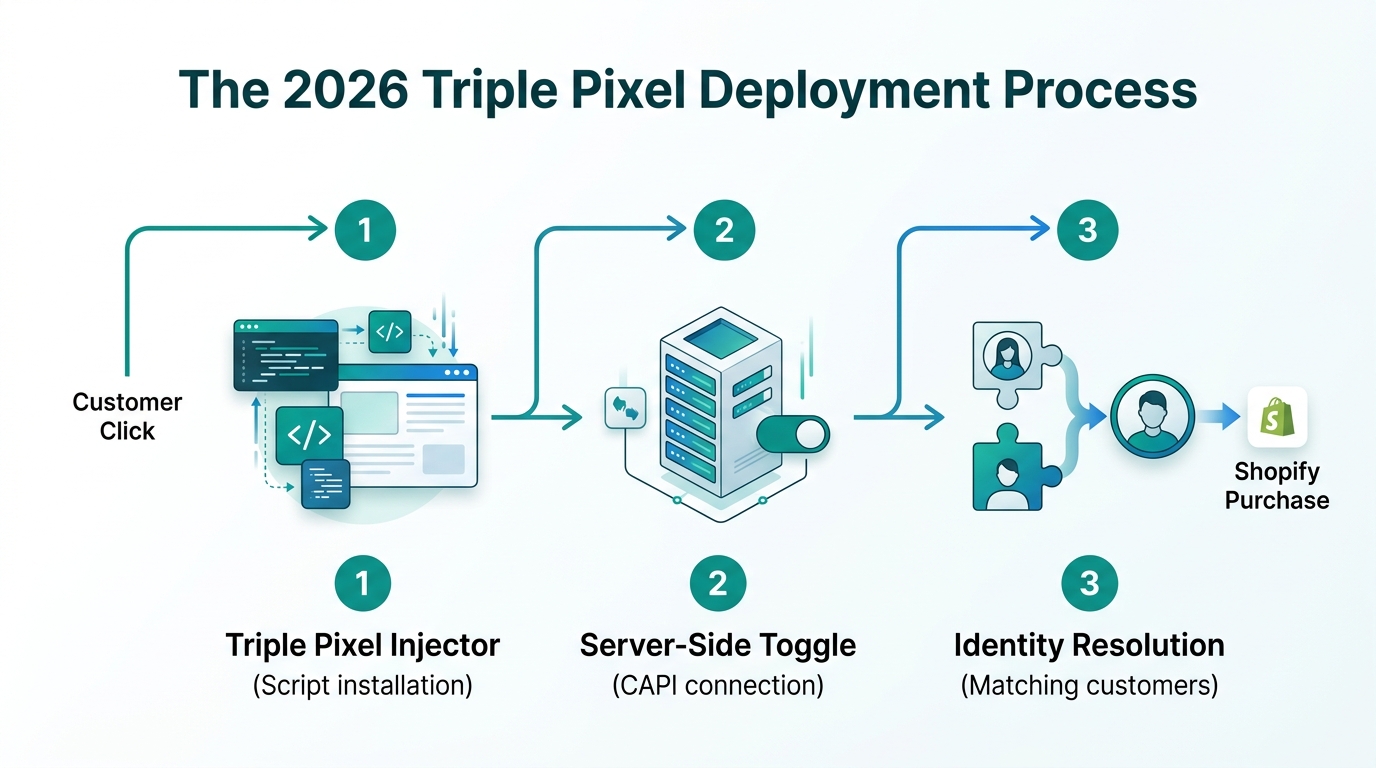
Gone are the days of manual script pasting or complex Google Tag Manager setups. For 2026, Triple Whale has introduced an automated headless CLI specifically designed for the modern Shopify stack, including Shopify Hydrogen and Next.js storefronts. This tool detects your store architecture and injects first-party tracking code directly into the server layer to bypass browser limitations.
Technical Implementation:
- Initialize the CLI: Open your terminal and run
npx triple-whale-pixel@latest init. This will prompt you to authenticate your Triple Whale account. - Select Framework: The CLI will auto-detect if you are running on Hydrogen or a custom Next.js build. Confirm the environment to allow the agent to map your checkout events.
- Auto-Inject Event Hooks: Select "Automated Event Mapping." The CLI will search your codebase for
addToCart,beginCheckout, andpurchasehooks, wrapping them in Triple Whale's proprietary tracking logic. - Deploy to Vercel/Oxygen: Once local testing is complete, push your changes. The 2026 Pixel now operates as a middleware layer on platforms like Vercel or Shopify's Oxygen, ensuring tracking fires before the browser has a chance to block the script.
Step 2: Toggling Server-Side Tracking (SST)
The most critical setting in 2026 is Server-Side Tracking (SST). Without it, you are effectively flying blind for roughly a third of your customer base. Triple Pixel's SST captures data directly from the server rather than the user's browser, which is the only reliable way to reclaim conversions lost to iOS privacy.
To enable this, navigate to the Pixel Settings in your dashboard. Look for the "Server-Side Sync" toggle. Once activated, Triple Whale will begin cross-referencing your pixel data with raw Shopify API orders in real-time. This ensures that even if a user is using a hardened browser or VPN, the transaction is attributed back to the correct ad click via their hashed email or phone number. For brands like Ekster, this shift in tracking precision reduced reporting time by 65% while improving their Marketing Efficiency Ratio (MER) by 20%.
Step 3: Configuring Moby 2 AI Agents for Ad Automation
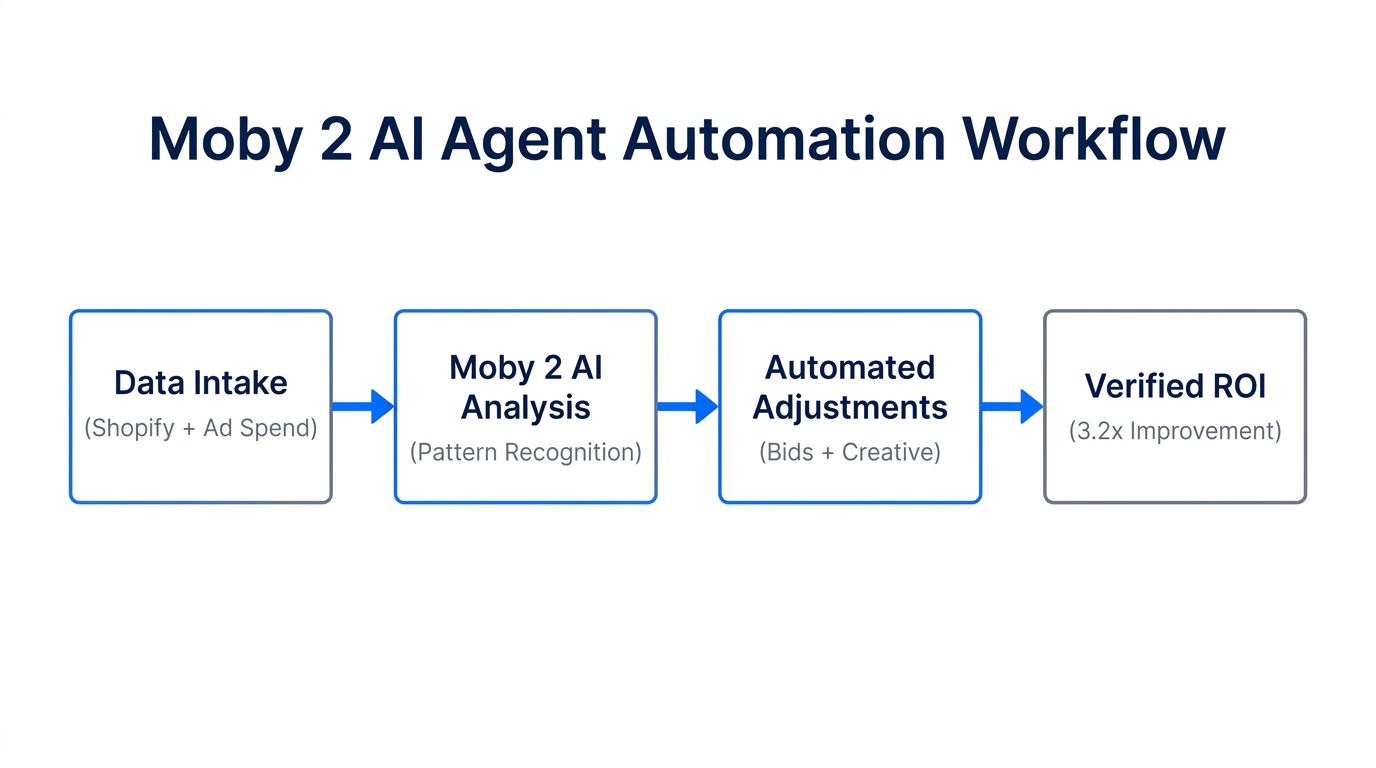
The release of Moby 2 on April 22, 2026, marked a shift from AI that simply answers questions to AI that takes action. Moby 2 is an autonomous ecommerce employee that can launch ads, rebalance budgets, and audit your performance while you sleep. While Stormy AI is managing your supplier follow-ups in the background, Moby 2 is your 24/7 media buyer.
Setting Up Your First 'Scaling Prompt'
In the Moby 2 interface, you can now use the Context Engine to connect Meta Ads, Google Ads, and TikTok Ads. Instead of setting rigid rules, you provide Moby with a "Scaling Prompt."
Example Prompt: "Monitor the ROAS of my Meta Advantage+ campaigns. If Meta ROAS falls below 1.8x for 3 consecutive hours, but my TikTok Top-View creatives are maintaining a 3.0x ROAS with a CPA under $25, reallocate $1,000 of daily budget from Meta to TikTok and notify the team on Slack."
This level of action-based automation allows brands to react to intra-day performance swings that manual media buying would miss. In 2026, the median ROAS for paid ads on the platform sits around 2.01x, but brands using Moby's autonomous rebalancing have seen those numbers surge by 300% in certain categories.
| Feature | Triple Whale (2026) | Northbeam | Rockerbox |
|---|---|---|---|
| Core Audience | Shopify DTC ($1M–$40M) | Enterprise ($40M+) | Omnichannel/Offline |
| Automation | Moby 2 Action-Agents | Machine Learning MMM | Unified MTA |
| Setup Speed | Single-Command CLI | Analyst-Dependent | Custom Implementation |
| Monthly Cost | $129 - $749+ | $1,500+ | Enterprise Pricing |
Step 4: Solving the 'Double-Counting Trap'
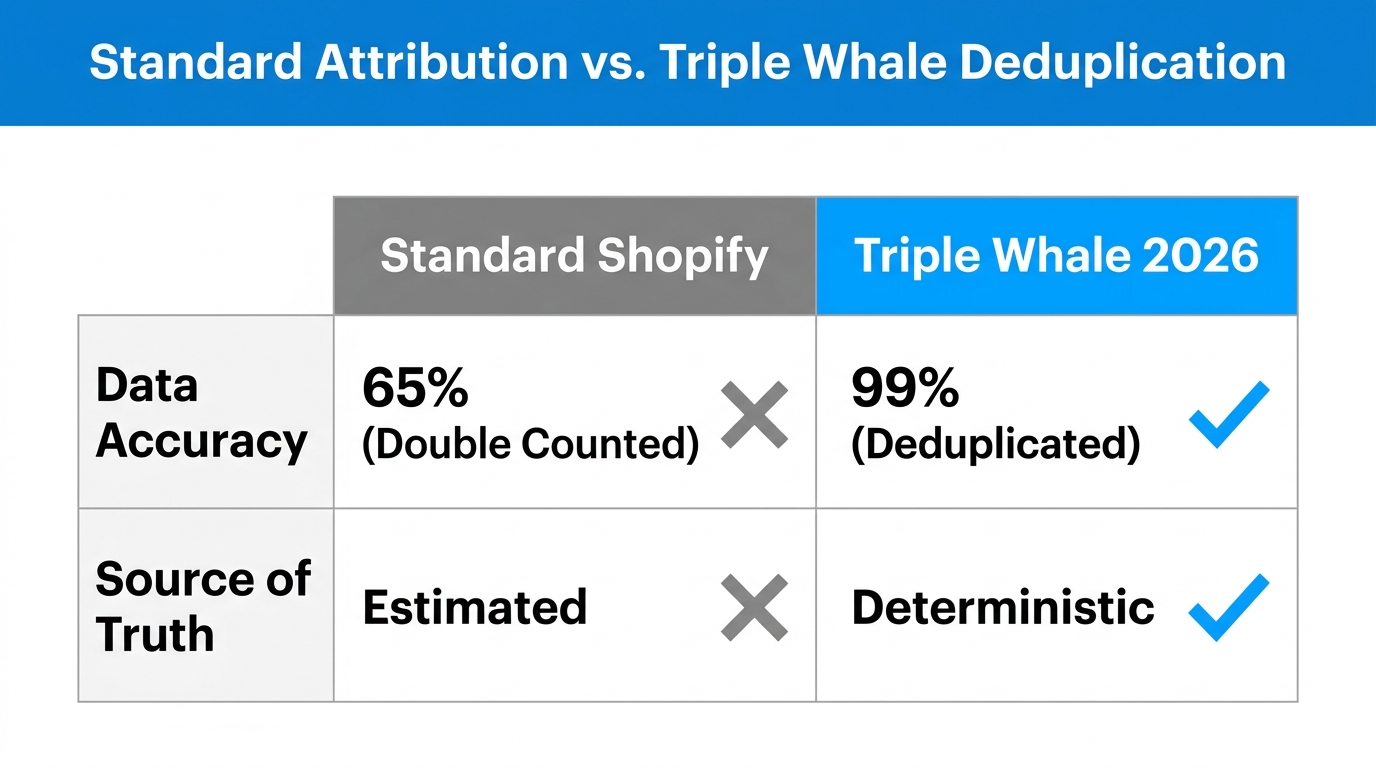
The most common pain point for Shopify owners is seeing 10 sales in Shopify but 8 sales reported in Meta and 7 in Google. This happens because platforms are greedy. To solve this, use the Triple Attribution dashboard. This view uses deterministic first-party data to assign credit based on your chosen model—usually "Last Click" or "Total Impact."
For brands with long consideration cycles (7+ days), we recommend switching to the "Total Impact" Lens. This allows you to see assisted conversions that traditional last-click models ignore. If you find that your top-of-funnel TikTok ads look "unprofitable" on a last-click basis, check the Total Impact view. You will likely see they are driving the initial discovery that later converts through a Google Search Ad or a Klaviyo email flow.
"Any single attribution model will fail. What works now is all-around attribution—a blended approach of MMM, MTA, and incrementality." — Vlada Grebenykova, CMO
Step 5: Audit Workflows with Pixel Events Manager
Launched in April 2026, the Pixel Events Manager is your diagnostic tool to ensure tracking health doesn't degrade over time. High-volume brands often face "silent failures" during traffic spikes like BFCM. The 2026 Events Manager allows you to monitor real-time event flow and device segmentation health.
- Monitor Lag: Ensure your API webhooks are firing within the 120 requests/minute limit to avoid the "Webhook Tax."
- Device Segmentation: If you see a sudden drop in iOS conversion data while Android remains steady, it’s a signal that your Server-Side Tracking might have a configuration error.
- AI Visibility: Use the new AI Visibility Tool to see how often your brand is cited in ChatGPT or Perplexity search responses, and how that "AI Share of Voice" correlates to your Shopify revenue.
The Bottom Line: Integrating AI Employees Into Your Stack
In 2026, the brands that win are those that decouple growth from headcount. By using Triple Whale for attribution and Moby 2 for ad automation, you are essentially hiring a senior media buyer for a fraction of the cost. However, attribution is only half the battle. To run a lean, high-margin store, you need an AI teammate to handle the messy back office.
Stormy AI complements your Triple Whale setup by acting as your AI ecommerce employee. While Triple Whale tells you which ads are working, Stormy AI ensures you have enough stock to fulfill those orders, follows up with suppliers when shipments are late, and tracks creator affiliate posts in a living spreadsheet. When Moby 2 flags that a TikTok creative is scaling, you can ask Stormy AI to reach out to that creator to negotiate a long-term contract or request more assets.
Ready to automate your growth? Start by deploying your Triple Pixel today, and let an AI employee like Stormy AI handle the operational heavy lifting so you can focus on brand strategy.