In 2026, the era of the manual CSV export is officially dead. For years, Shopify operators spent their Monday mornings like digital archaeologists, digging through disparate data silos to piece together a coherent picture of the previous week. Research from Improvado shows that scaling brands were losing 10 to 15 hours every single week just stitching files together. Today, that overhead has been eliminated by the rise of agentic commerce. In this playbook, we will walk through the exact technical stack required to move from manual labor to a fully automated Shopify reporting automation 2026 strategy, using AI to not just see your data, but to understand the 'why' behind every fluctuation.
The High Cost of Manual Reporting in 2026
In 2025, many brands were still operating on a 'reactive' basis, looking at reports that were already 48 hours old. By the time a drop in Contribution Margin was spotted, thousands in ad spend had already been wasted. According to Triple Whale, merchants using AI-powered attribution reduce wasted ad spend by 12% to 22% compared to those relying on native Shopify reporting alone. The bottleneck isn't just the data; it's the human time required to process it.
This is where an AI ecommerce employee like Stormy AI becomes essential. Unlike a static dashboard, Stormy acts as a teammate that can wake up every Monday, import arbitrary CSVs from Shopify, Meta Ads, and Google Ads, and generate a cohesive performance report before you've even had your first cup of coffee.
Step 1: Centralizing Data via First-Party Pixels
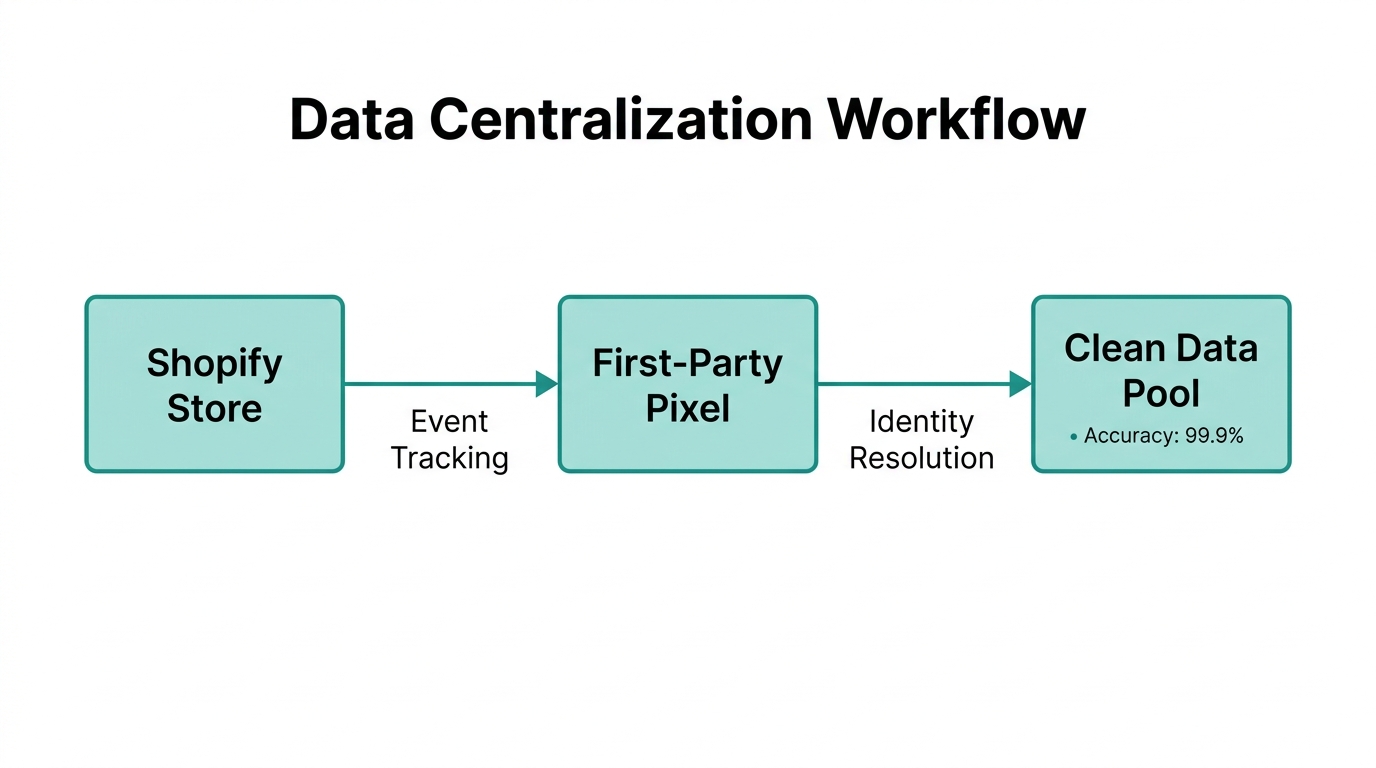
The first hurdle in 2026 reporting is the attribution gap. Standard tracking often misses up to 30% of social traffic due to modern privacy restrictions. To build a reliable AI profit tracker for e-commerce, you must bypass third-party cookie limitations using a first-party tracking solution like Triple Pixel or Polar Pixel.
By installing a first-party pixel from Polar Analytics, you ensure that every click and conversion is tied to a persistent internal ID. This creates the 'clean' data foundation that AI agents require. Without this, your automated sales report Shopify output will suffer from what experts call the 'Cold Start' problem—where the AI provides irrelevant advice based on incomplete data sets.
"The transition from vanity metrics like ROAS to operational efficiency metrics like Contribution Margin is the hallmark of the 2026 Shopify operator."
Step 2: Configuring the Shopify 2026-01 GraphQL API
To feed your Shopify AI analytics dashboard, you need a faster data pipeline. Shopify has deprecated several older REST APIs in favor of the 2026-01 GraphQL API. This version is critical because it allows for 3x faster retrieval of Metafields and Metaobjects, which store the custom store context your AI needs to understand your business.
Technical Setup:
- Enable Shopify Flow: Go to your Shopify Admin and ensure Shopify Flow is active. This will trigger webhooks for every order, allowing your reporting tools to update in real-time.
- Map Store Context: Upload your 2025 and 2026 marketing calendars into Shopify Metaobjects. This allows tools like Stormy AI to see that a 20% spike in traffic wasn't random—it was tied to a specific influencer campaign.
- Grant API Scopes: Ensure your integration has
read_reportsandread_all_ordersscopes enabled to capture the full financial picture, including refunds and shipping surcharges.
| Feature | Manual Reporting | AI-Driven Reporting (2026) | 10–15 hours / week | < 30 mins / week | 15–30% Attribution Gap | 90%+ (First-Party Data) | Descriptive ("What happened") | Predictive ("What will happen") | Static Dashboards | Autonomous AI Agents |
|---|
Step 3: Automating the 'Master Sheet' Export
Even with advanced AI, many founders prefer a Master Sheet for high-level oversight. To automate this, use tools like Coupler.io or Report Pundit to sync your store data directly to a spreadsheet every Monday at 8:00 AM. This prevents the 'data sprawl' where insights are buried across five different browser tabs.
An AI ecommerce employee like Stormy AI can manage this spreadsheet for you. You can ask Stormy to 'Create a dynamic spreadsheet from my Shopify and Meta spend,' and it will build the workbook, add rows on the fly, and even set row-level reminders to alert you if a specific product's ROAS falls below your target threshold. This automated sales report Shopify workflow ensures you are always looking at the most current numbers without lifting a finger.
"2026 is the year of the builders... we’ll be powering them from first sale to full scale with AI." — Harley Finkelstein, President of Shopify
Step 4: Layering the AI Narrative Summary
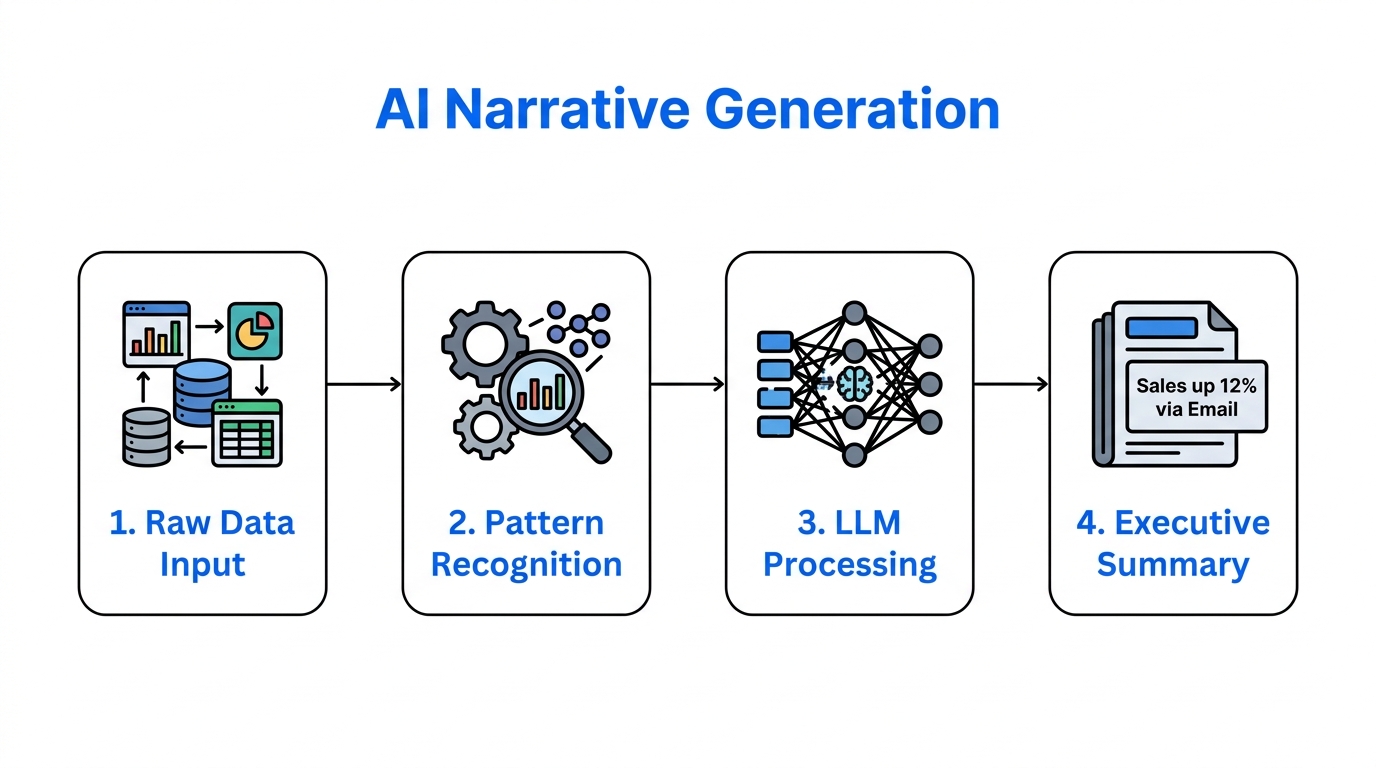
Data without context is just noise. The final step in the 2026 playbook is converting rows of data into a narrative summary. Tools like Sidekick Pulse and Stormy AI provide 'proactive reporting.' Instead of you asking for a report, the AI alerts you to trends before you even notice them.
For example, Stormy AI can monitor your inventory levels across TikTok Shop and Amazon, compare it to your Shopify sales velocity, and draft a restock PO to your supplier in Gmail. It doesn't just show you a chart; it takes the next logical business step.
Conclusion: The Autonomous Future of Shopify Ops
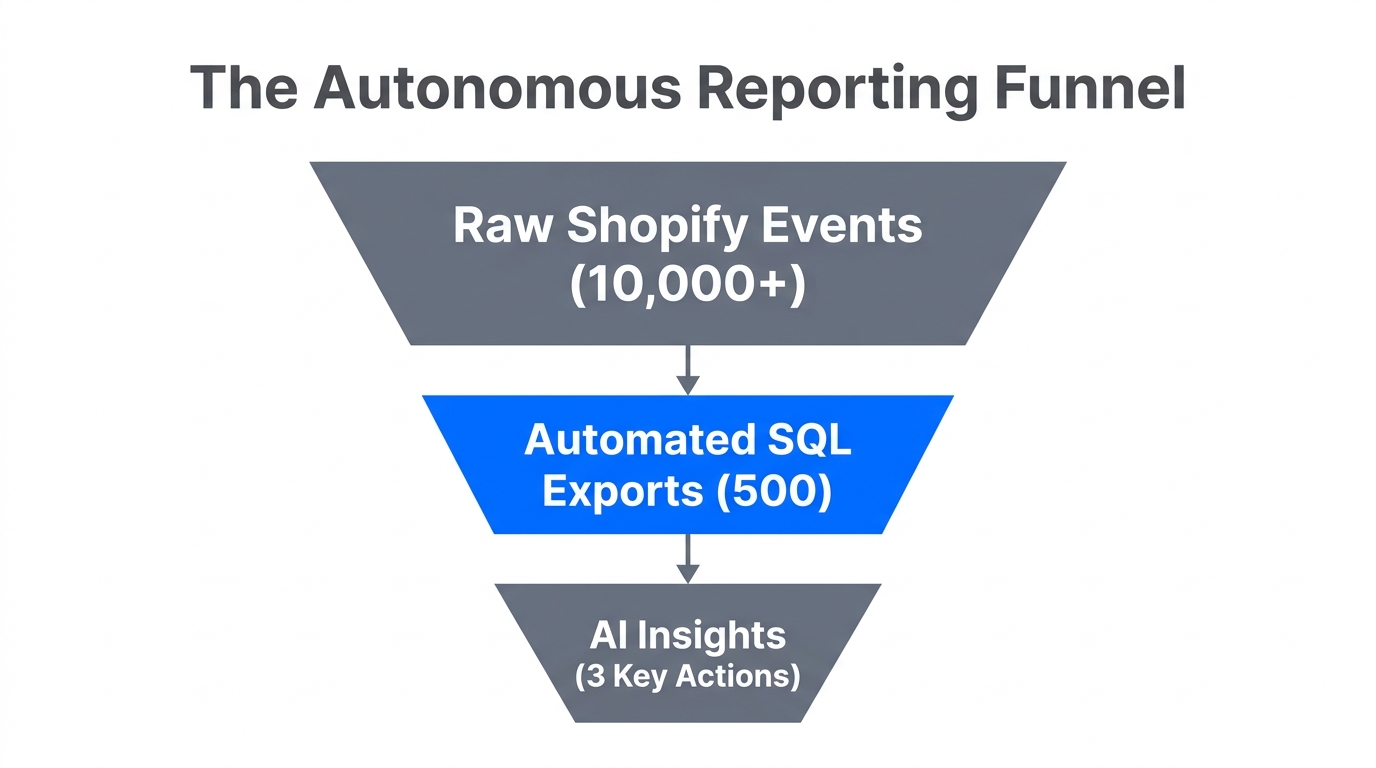
The transition to Shopify reporting automation 2026 is not about replacing the human operator; it's about elevating them. By moving from manual CSV exports to an agentic reporting stack, you reclaim 40-60 hours of high-level strategic time every month. Start by centralizing your data with a first-party pixel, automate your pipelines via the 2026-01 GraphQL API, and deploy an AI employee like Stormy AI to act as the glue between your tools. In a market where conversion rates are hovering between 1.4% and 1.8%, those using agentic commerce to hit 4.7% conversion will be the only ones left standing.