The 2026 Playbook for Scaling Creator Commerce with the OpenClaw Influencer Order Tracking System
Master influencer marketing automation 2026 with our guide to OpenClaw. Scale creator commerce using AI agents, Stormy AI, and autonomous seeding strategies.
In the rapidly shifting landscape of digital retail, 2026 has marked the definitive end of the ‘spreadsheet era.’ As the global influencer marketing market climbs toward a staggering $34.1 billion, according to data from Charle Agency, the gap between brands that scale and those that stagnate is defined by one factor: automation. Manual outreach, once the backbone of creator relations, is now an obsolete bottleneck. Today, the most aggressive e-commerce brands are pivoting to autonomous influencer seeding pipelines that run 24/7 without human fatigue.
This growth strategy isn’t just about sending more emails; it’s about building an ‘always-on’ engine using the OpenClaw Influencer Order Tracking System. By leveraging an AI agent marketing pipeline, brands are moving from reactive campaign bursts to a continuous flow of product seeding, content generation, and revenue attribution. In this playbook, we will detail how to implement this framework to achieve the kind of 4x revenue growth seen by industry leaders like Alchemy London.
Why Manual Influencer Outreach is Obsolete in 2026
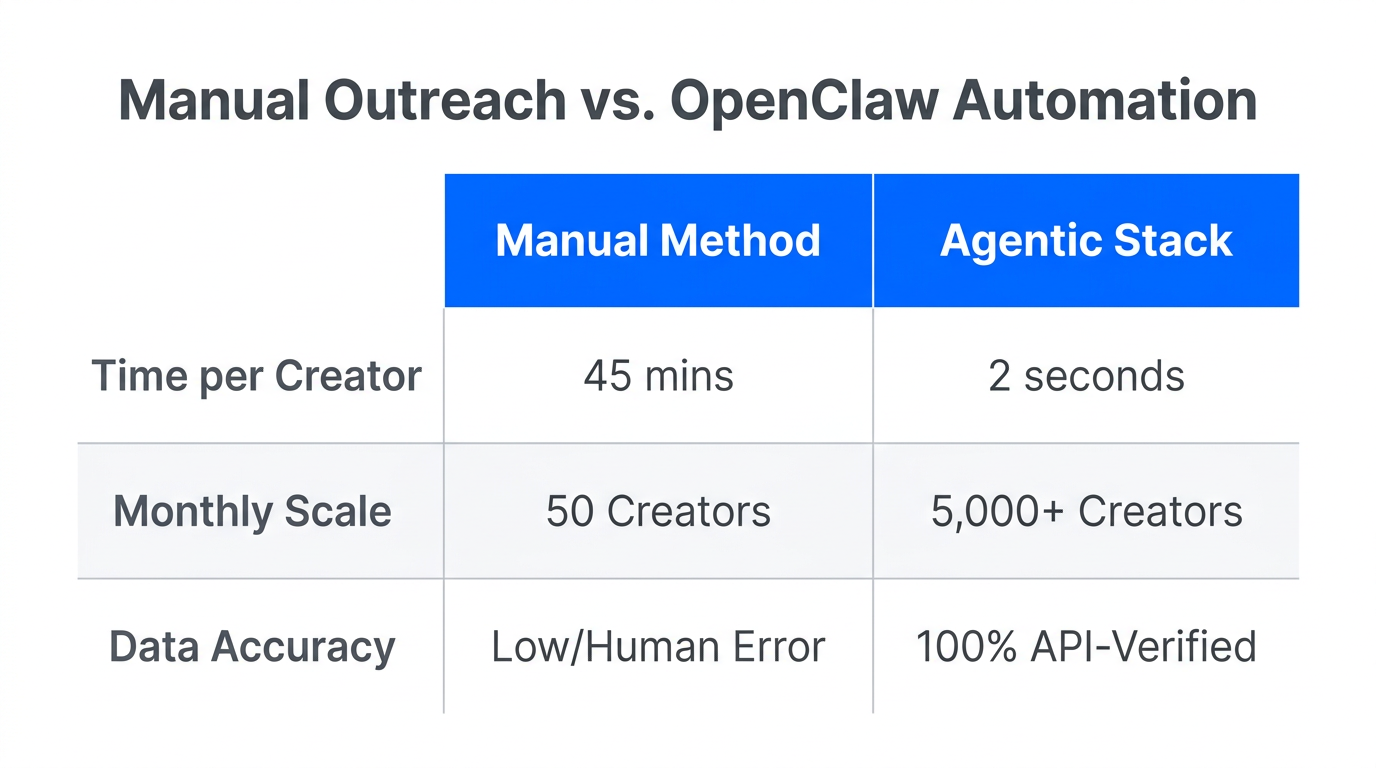
The sheer scale of the 2026 creator economy makes manual management a mathematical impossibility for growing brands. With millions of micro-creators acting as decentralized storefronts, a human marketing manager can no longer track the thousands of touchpoints required for a high-performance campaign. Industry reports from Stormy AI indicate that companies adopting ‘agentic GTM’ (Go-To-Market) platforms have seen a 55% increase in operational efficiency and a 35% reduction in overall marketing costs.
"The shift from manual outreach to autonomous execution is no longer a luxury; it is the baseline requirement for survival in a $34.1 billion creator economy."
Furthermore, the ROI of modern influencer marketing has reached a tipping point. While the average brand sees a return of $5.78 for every $1 spent, top-tier campaigns utilizing automated attribution and tracking are reporting astronomical returns as high as $18–$20, as noted by Archive. This discrepancy is largely due to attribution accuracy; manual systems lose track of the ‘halo effect’ of influencer posts, whereas autonomous systems like OpenClaw capture every data point from discovery to delivery.
Building the Infrastructure: Stormy AI, Apify, and OpenClaw
Scaling creator commerce requires a robust tech stack that can discover, vet, and track thousands of creators simultaneously. The modern ‘agentic’ stack consists of three core layers: discovery, data extraction, and tracking. For discovery, platforms like Stormy AI allow brands to find creators through natural language prompts, instantly filtering for niche relevance and engagement quality. Once creators are identified, data scrapers like Apify extract real-time social data to ensure the creator’s audience is authentic and growing.
The connective tissue of this operation is OpenClaw. Formerly known as Clawdbot, this open-source framework has exploded in popularity, surpassing 270,000 GitHub stars by early 2026 (Source: Marketing Interactive). OpenClaw isn't just a database; it is a system of AI agents that can ‘think’ and ‘act’ across different platforms.
| Feature | Traditional Manual Workflow | Autonomous Agentic Workflow |
|---|---|---|
| Discovery | Hours of manual searching on Instagram/TikTok | Stormy AI finds 500+ creators in seconds |
| Outreach | Individual, copy-paste emails | Hyper-personalized AI-agent emails & follow-ups |
| Tracking | Manual Google Sheets updates | OpenClaw real-time API sync with Shopify/WooCommerce |
| Attribution | Vague link clicks/Discount codes | Multi-touch attribution with Northbeam or Triple Whale |
This integration enables a Business-to-Agent (B2A) model. As Digiday reports, influencers are no longer just posters but active storefronts. An autonomous system manages the entire lifecycle—from the first DM to the final shipping confirmation—ensuring your brand remains ‘always-on’ in the eyes of the consumer.
The OpenClaw Implementation Playbook: Step-by-Step
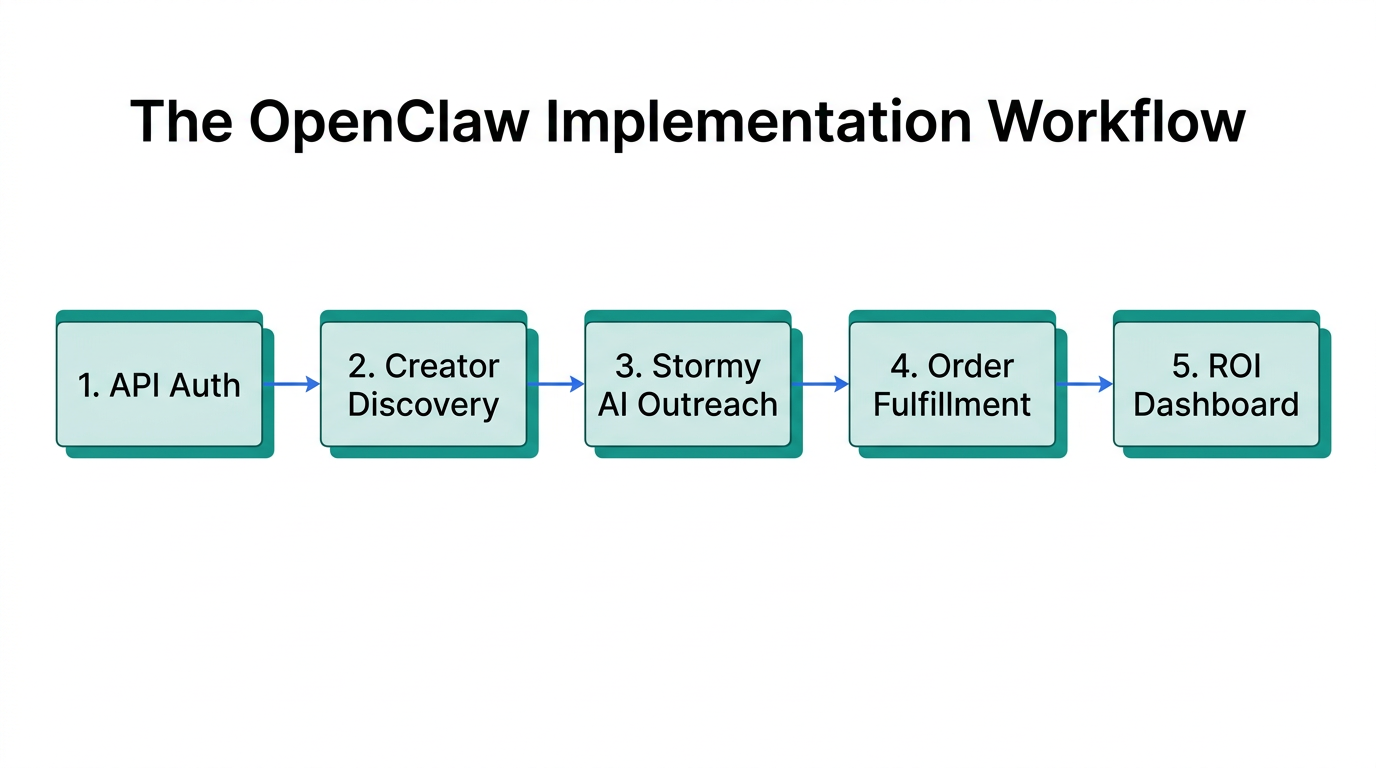
Implementing an autonomous influencer seeding pipeline requires a deliberate setup. Follow these steps to deploy your first agentic distribution system.
Step 1: Deployment on Persistent Infrastructure
Your AI agents must be online 24/7 to respond to creators across global time zones. Run your OpenClaw instance on a reliable server such as Tencent Cloud Lighthouse or a Hostinger VPS. This ensures your tracking scripts and communication bots never go offline, even if your local office power fails.
Step 2: Installing Creator Commerce 'Skills'
The power of OpenClaw lies in its Skill Registry. Using ClawHub, you can install pre-built skills for order tracking. Specifically, look for WooClaw-Lite (for WooCommerce) or custom Shopify API connectors. These skills allow your agent to query your store’s backend to see if an influencer's gifted order has been fulfilled or if it’s stuck in transit.
Step 3: Setting Up 'Gray Box' Human-in-the-Loop (HITL)
Marketing expert Dominique Rose Van-Winther suggests the Gray Box approach for safety. As reported by Marketing Interactive, while the AI runs the workflow for speed, humans should approve the final outreach or spend. Set up a Slack or Discord channel using the SOUL.md protocol. Your agent will draft its negotiations or responses in this channel, and a manager simply provides a ‘thumbs up’ emoji to trigger the action.
Step 4: Real-Time Performance Monitoring
Integrate your agents with Meta Ads Manager and TikTok Ads Manager. Your agent should be programmed to monitor creative fatigue. If an influencer’s content begins to see a drop in ROAS (Return on Ad Spend), the agent can automatically pause the ad spend and send a nudge to the creator via WhatsApp or Slack to request fresh content.
"Agentic distribution is the hidden engine behind the 4x revenue growth seen by the fastest-scaling e-commerce brands this year."
Monitoring Fulfillment Without Manual Spreadsheets
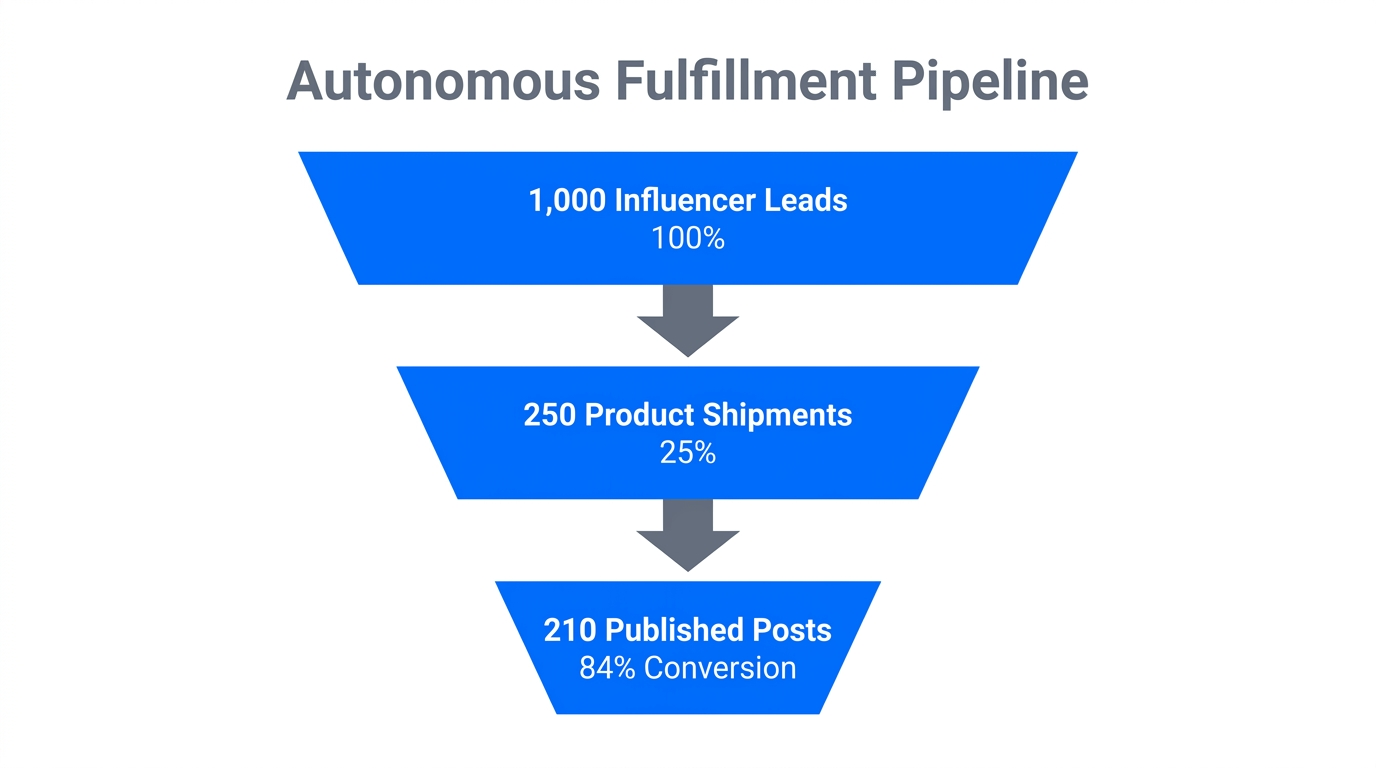
One of the biggest pain points in creator commerce is WISMO (‘Where Is My Order?’). When you are seeding products to hundreds of influencers a month, manual tracking becomes a nightmare. The OpenClaw tracking system solves this by integrating directly with your logistics provider.
For instance, an e-commerce store recently deployed a custom OpenClaw Order Tracking Bot on WhatsApp. This resulted in a 65% reduction in support tickets within the first month (Source: Tencent Cloud). Instead of the influencer emailing your team, the AI agent proactively messages the influencer with a tracking link and an estimated delivery date the moment the product leaves the warehouse.
Case Study Analysis: Alchemy London’s 4x Revenue Growth
Alchemy London serves as the primary blueprint for influencer marketing automation 2026. By moving away from manual influencer management and adopting an agentic distribution model, they managed to scale their creator network by 10x without hiring a single additional marketing manager.
The results were immediate: Alchemy London achieved a 4x revenue increase in just one quarter. They achieved this by automating the ‘boring’ administrative parts of the job—contracts, shipping, and follow-ups—allowing their creative team to focus exclusively on high-level strategy and brand storytelling. This case study, highlighted by Stormy AI, proves that automation isn’t about replacing creativity; it’s about providing creativity with a larger stage to perform on.
Security, Attribution, and Common Pitfalls
While the benefits are clear, moving to an autonomous model requires careful oversight. The ‘ClawJacked’ vulnerability, first reported by Mapify, highlighted the risks of running locally-hosted agents without proper security boundaries. Always use hardened server baselines and restricted API permissions to ensure your agents cannot be hijacked or mismanage your budgets.
Another common mistake is ‘Black Box’ autonomy. Giving an AI agent full access to spend budgets without a human-in-the-loop can lead to significant waste on underperforming creators. Always ensure that any spend over a certain threshold requires a manual sign-off in your Slack or Discord command center.
"Automation without attribution is just expensive guesswork. Connect your agents to the backend of your store to see the true impact of every post."
Finally, avoid poor attribution setups. Relying solely on ‘likes’ is a relic of 2024. In 2026, you must connect OpenClaw directly to your e-commerce backend via REST APIs. For enterprise-level brands, supplementing your tracking with Triple Whale or Northbeam provides the multi-touch modeling necessary to understand the full customer journey across TikTok Shop, Instagram, and your own website (Source: Cometly).
The Future of Creator Commerce is Agentic
The era of manual influencer management is over. As we move deeper into 2026, the brands that dominate will be those that treat their creator network like a high-performance machine rather than a series of one-off transactions. By implementing an autonomous influencer seeding model using OpenClaw and discovery tools like Stormy AI, you can build a marketing engine that never sleeps, never forgets to follow up, and always tracks its own ROI.
Start small: deploy a single agent to track your current seeding orders, then gradually expand its skills to include discovery and outreach. The technology is open-source, the data is available, and the market is waiting. It’s time to let the agents take the wheel.