"The nice-to-have is actually the UI. The nice-to-have is the SaaS looking pretty. Ultimately, what you care about is the output, the agents running 24/7, and the live data feed."The Rise of the Marketing Agent Jockey
Understand how AI agents are taking over the middle work of marketing.
In 2026, the value-per-employee for a growth marketer has skyrocketed, not because they are working harder, but because they have replaced manual tasks with agentic swarms. As growth expert Cody Schneider notes, we are entering the era of GTM Engineering—a term popularized by Clay that has evolved from simple data enrichment into cascading, autonomous workflows. The modern marketing data stack 2026 is no longer about the tools you use, but the APIs you connect to your AI harness.
Being an 'Agent Jockey' means your job is no longer to click buttons in a Meta Ads Manager. Your job is to have the domain expertise to describe a problem to a coding agent, which then builds the temporary software needed to solve it. Whether you are using Claude or specialized terminal agents, the focus is on outcomes rather than interface navigation.
Understanding MCP: Connecting Claude Directly to Your Data
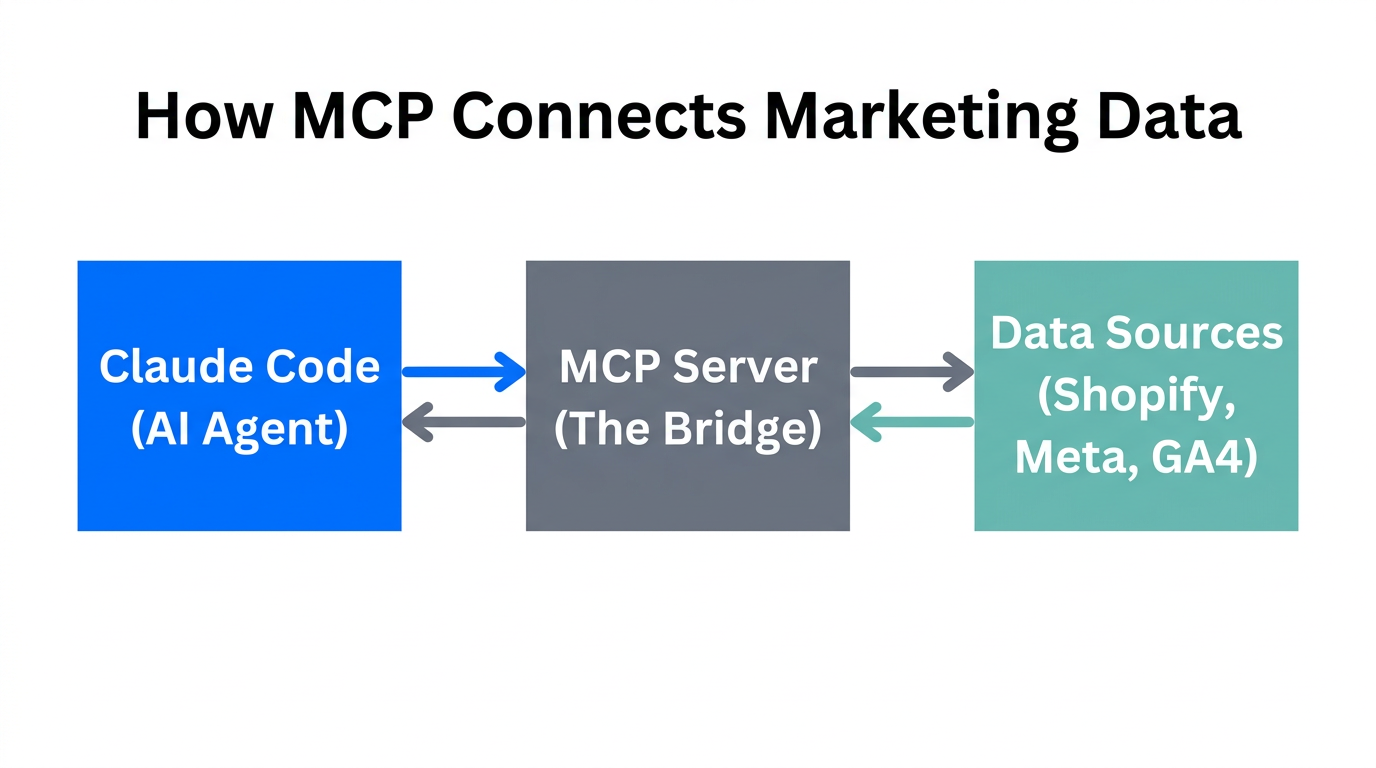
The real breakthrough in the marketing analytics trends of 2026 is the Model Context Protocol (MCP). Historically, if you wanted to analyze campaign data, you had to export it from TikTok Ads Manager or Google Ads and upload it to an LLM. This created a massive lag and a security headache.
With MCP, your AI agent has a live, bi-directional straw into your data warehouse. You aren't 'uploading' anything; you are giving the agent permission to query your Postgres database or your CRM on the fly. This allows for what Schneider calls 'vibe marketing' at scale. You can tell Claude Code: "Analyze our highest CPC ads from the last 24 hours and pause any that aren't hitting our target ROAS," and the agent executes that change directly via the API.
| Feature | Traditional SaaS (2024) | Agentic Marketing Stack (2026) |
|---|---|---|
| Data Access | Manual CSV Exports | Live MCP Data Feeds |
| Analysis | Static Dashboards (Looker/Tableau) | Natural Language Queries |
| Execution | Human clicks in UI | Autonomous API Actions |
| Speed | Days/Weeks to pivot | Minutes to Real-time |
On-the-Fly Data Analysis: Natural Language as the New Excel
Learn why on-the-fly UI generation is the big epiphany for modern marketers.The most painful part of growth marketing has always been data cleaning. In the old world, unifying data from Shopify, Stripe, and social ad platforms took hours of VLOOKUPs. In 2026, we use 'on-the-fly' databases. Using railway.app, marketers can spin up a temporary Postgres instance in seconds, have an agent pump in raw data, perform complex pivot tables via natural language, and then spin the database down once the insight is extracted.
One example shared in recent growth circles involves a marketer who reduced five hours of data cleaning into just 30 minutes by using a terminal agent to scrape podcast emails, verify them via Million Verifier, and push them directly into a cold email sequence in Instantly.ai. The 'middle work'—the clicking, dragging, and formatting—is gone. The agent handles the plumbing; the marketer handles the strategy.
Conversational Analytics: Using the Graft MCP for KPI Briefings
See how the Graft MCP pulls live performance data for immediate analysis.Static dashboards are dying because they are reactive. By the time you see a dip in your Google Analytics 4 dashboard, the damage is done. The 2026 standard is Conversational Analytics. Using tools like the Graft MCP, marketers now wake up to a personalized morning briefing delivered via the Claude mobile app.
Instead of hunting for metrics, you simply ask: "How many new users hit the homepage yesterday, and what was the CPM trend on our LinkedIn giveaway post?" The Graft MCP pulls this live from your data warehouse and summarizes it in seconds. This democratization of data means even non-technical team members can query complex datasets without needing a Data Science degree.
"Every company is going to be an API company. If you can't interact with a software's data via an agent, that software is effectively archaic."The End of the Dashboard: Why 'On-the-Fly UIs' are Winning
Why static dashboards are being replaced by autonomous agents and background processes.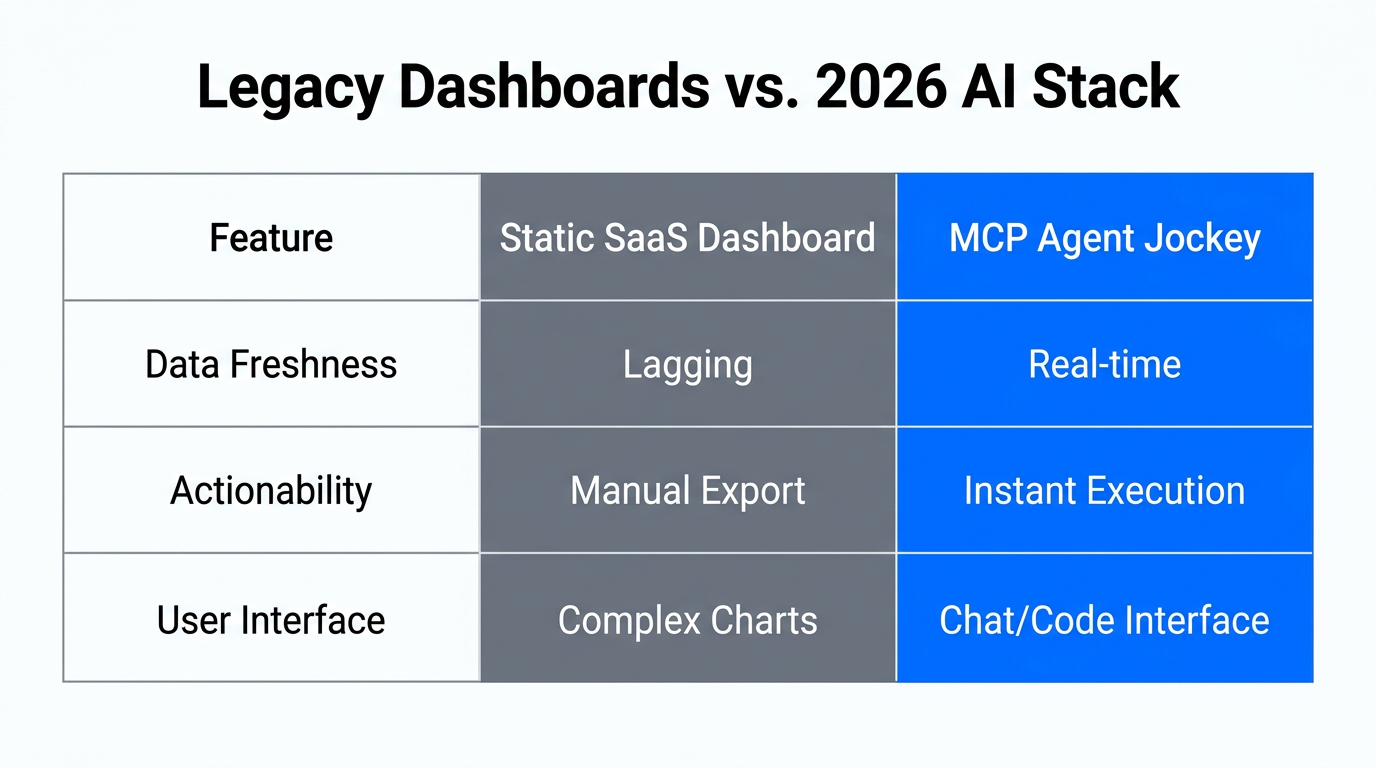
Why build a permanent dashboard in Looker Studio that breaks every time an API updates? In 2026, growth teams are building 'disposable' or 'on-the-fly' UIs. If you need to visualize a specific Facebook Ads experiment, you ask Claude Code to build a React-based UI specifically for that campaign. It lives on a temporary Vercel link for 48 hours and is then discarded.
This applies to content creation as well. Marketers are building bulk ad generators that use code to create 1,000 variations of 1080x1080 React components. These ads aren't just random; they are based on pain points scraped from Reddit and X via the Perplexity API. The agent identifies what customers are complaining about, writes the ad copy, generates the visual component, and bulk uploads them to the Meta Ads API as drafts.
Sourcing the Human Element: AI in Influencer Marketing
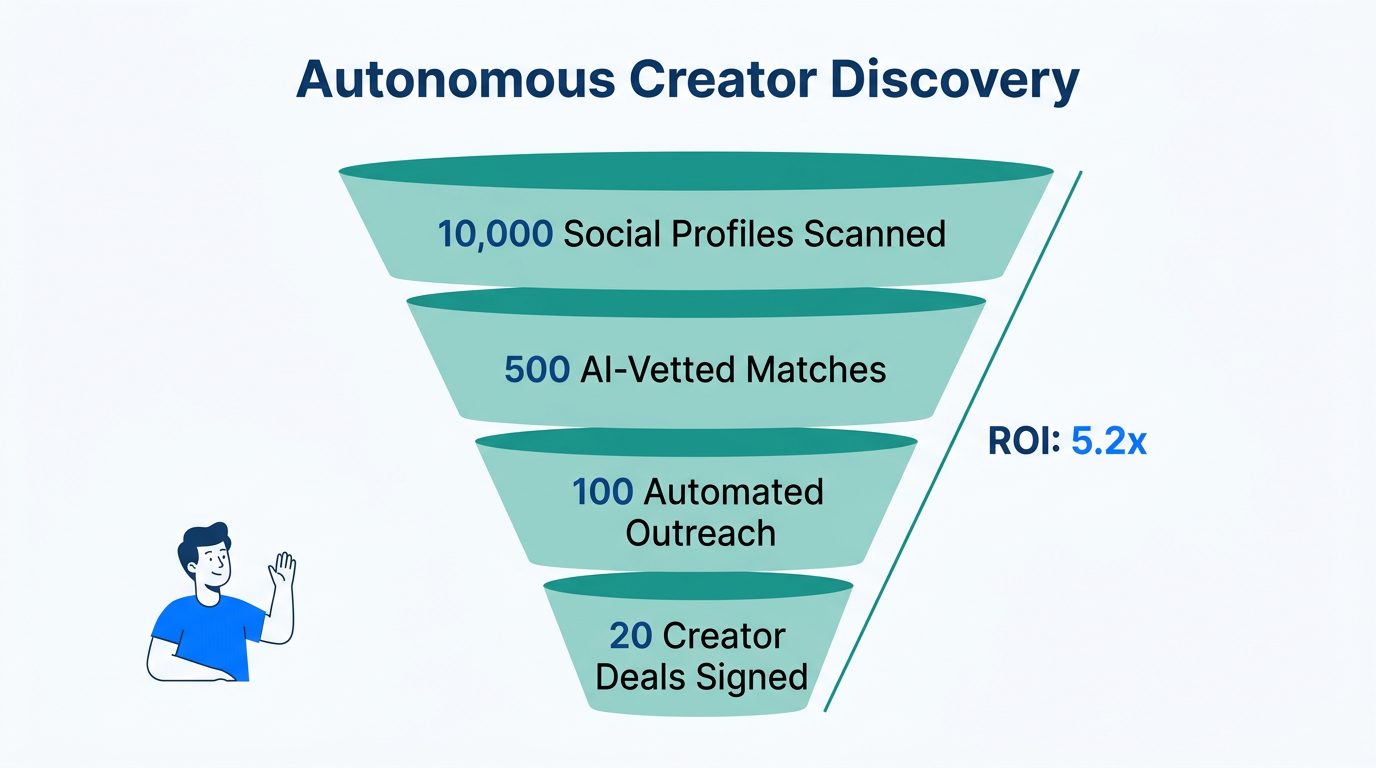
While agents handle the data and the ads, the 'human' element of marketing—User Generated Content (UGC) and influencer partnerships—remains vital. However, even this is being automated. Modern platforms like Stormy AI allow marketers to use natural language to find creators who fit their niche, then deploy AI agents to handle the outreach, follow-ups, and contract management.
Pairing Stormy AI for creator discovery with a terminal-based agent stack for post-tracking allows a brand to scale its UGC efforts without increasing headcount. By connecting your influencer performance data back into your MCP-enabled data warehouse, your agents can even tell you which creators are driving the highest LTV, allowing you to double down on winners automatically.
Transitioning Your Team: From UI Users to Agent Jockeys
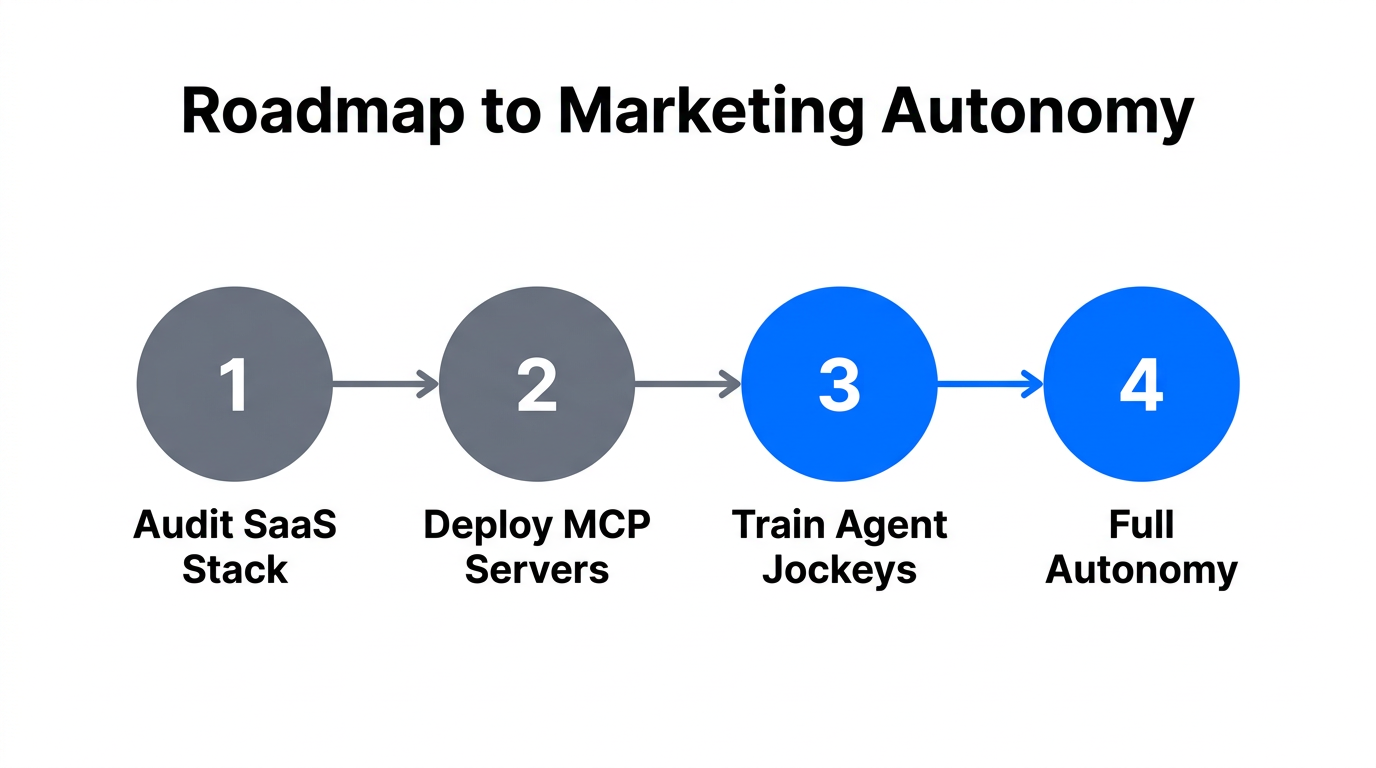
If you are a marketing leader in 2026, your biggest challenge isn't the technology—it's the talent. To maximize value-per-employee, you must transition your team from 'UI users' to 'Agent Jockeys.' This requires a shift in three key areas:
- API-First Mindset: When buying software (like legacy enterprise CRMs), prioritize the robustness of the API over the prettiness of the UI. If an agent can't talk to it, it's a bottleneck.
- Domain Vocabulary: Encourage your team to learn the specific lexicon of their craft. A graphic designer who knows how to describe 'TV-type texture' or 'halftone patterns' will get 10x better results from an image agent than someone using generic prompts.
- Autonomous Workflows: Move away from 'one-off' tasks. If a team member does something more than twice, it should be turned into an agentic skill that runs on a cron job via Railway.
Conclusion: The Future is Autonomous
The marketing data stack 2026 is invisible. It’s a series of API keys, a terminal window, and a set of instructions that allow agents to manage the heavy lifting of growth. While this transition may cause short-term chaos and displacement, it empowers the 'individual' to be as productive as an entire department.
By embracing Claude Code, Model Context Protocol, and tools like Stormy AI, you aren't just keeping up with the competition—you are building a personal software engine that works for you 24/7. The question for every marketer in 2026 is simple: are you clicking the buttons, or are you the one telling the agents which buttons to click?