The era of the "scroll-and-click" consumer is officially winding down. As we move through the first quarter of 2026, marketing leaders are no longer just optimizing for human eyeballs; they are optimizing for autonomous buying agents. This paradigm shift, known as Business-to-Agent (B2A) marketing, has transformed from a fringe experimental concept into the primary growth engine for high-performing Shopify merchants. At the heart of this revolution is OpenClaw, an open-source framework that has effectively become the "hands and feet" of the modern AI-driven economy.
The Death of the Impression: Why 2026 Belongs to B2A
For decades, marketing was a game of attention. In 2026, it has become a game of mathematical optimization and system-level accessibility. According to latest data from Marketing Interactive, OpenClaw has surpassed 274,000 GitHub stars, making it the fastest-growing open-source project in the history of ecommerce. We are seeing a massive migration from traditional Direct-to-Consumer (DTC) models to a B2A marketing strategy where the "consumer" is often an AI agent like a "Clawbot" acting on behalf of a human user.
"OpenClaw isn't just another model; it's the hands and legs of the AI era. We are entering the age of B2A, where you must optimize content so autonomous agents can discover and parse your brands effectively." — Jacky Chan, CTO of Votee AI
The scale of this shift is staggering. Research from Stormy AI indicates that social commerce, fueled by these autonomous agents, is projected to hit $8.5 trillion by 2030. This represents a monumental leap from the sub-trillion-dollar market we saw just two years ago. For Shopify store owners, the question is no longer if they should adopt agentic commerce 2026 protocols, but how quickly they can deploy them before their competitors' agents corner the market.
The 14.2% Conversion Paradox: Understanding the B2A Funnel
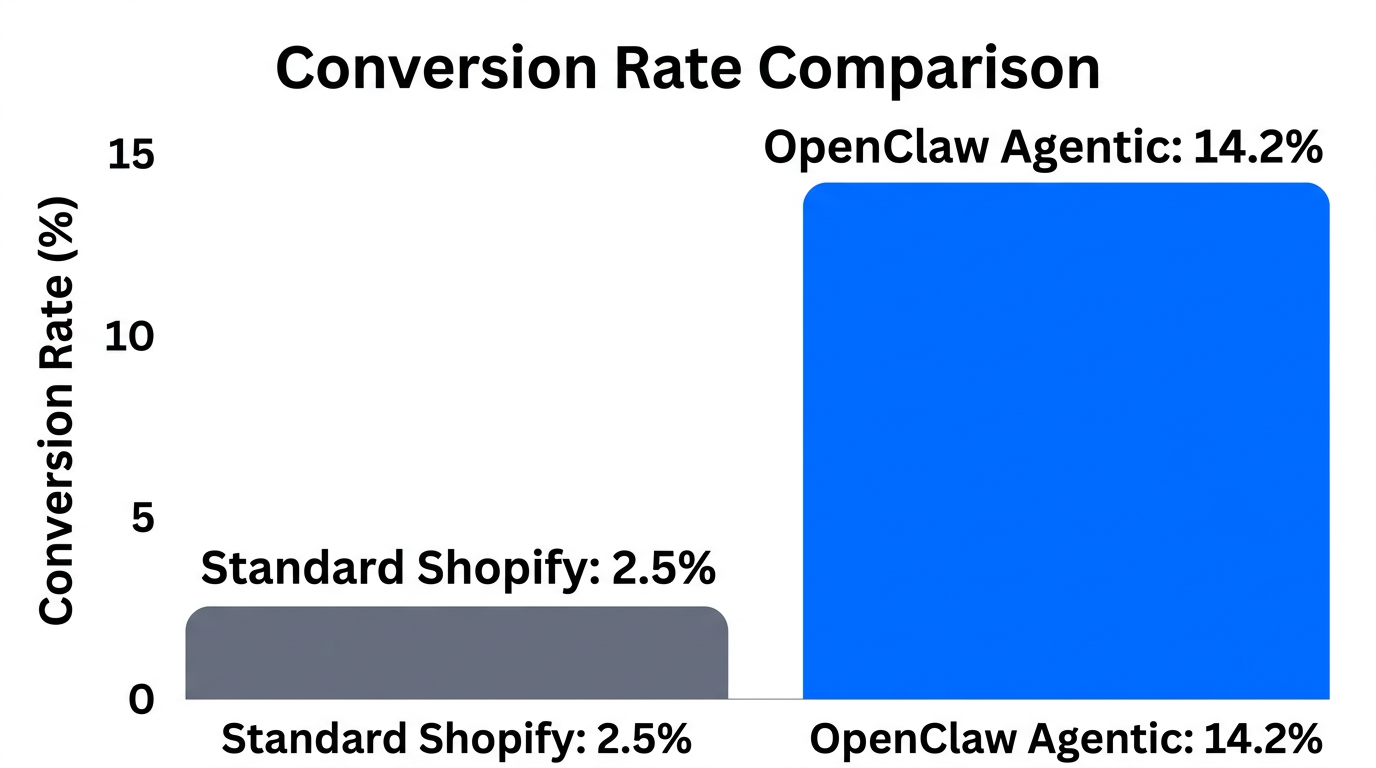
Perhaps the most shocking metric of 2026 is what industry insiders call the "Conversion Paradox." While human-driven sessions on Shopify maintain a global average conversion rate of approximately 2.1%, sessions initiated by autonomous buying agents are seeing a 14.2% conversion rate, according to the Shopify Engineering Blog. Why the massive discrepancy? Because agents do not window shop.
An agent is only deployed when the intent-to-buy is already at 100%. Whether it is a user asking their personal AI to "find the best price for a 100% cashmere sweater and buy it," or a business-level agent restocking inventory, the transaction is the goal, not the exploration. This makes the B2A marketing strategy incredibly efficient. Merchants are seeing a 55% increase in operational efficiency and a 35% reduction in marketing costs by catering to these high-intent digital shoppers, as noted in recent Stormy AI performance benchmarks.
| Metric | Human-Driven (DTC) | Agent-Driven (B2A) |
|---|---|---|
| Conversion Rate | 2.1% | 14.2% |
| Average Order Value | $112 (High Impulse) | $99 (Optimized) |
| Session Duration | 3.5 Minutes | < 2 Seconds |
| Return Rate | 22% | 16% |
However, there is a trade-off. Agents are programmed to find the optimal price and avoid the psychological "impulse add-ons" that humans often fall for. Consequently, Average Order Value (AOV) is often 11% lower in agentic transactions. Success in 2026 requires balancing this lower AOV with the massive volume and efficiency that OpenClaw Shopify integrations provide.
Decoding OpenClaw: The Engine of Agentic Commerce
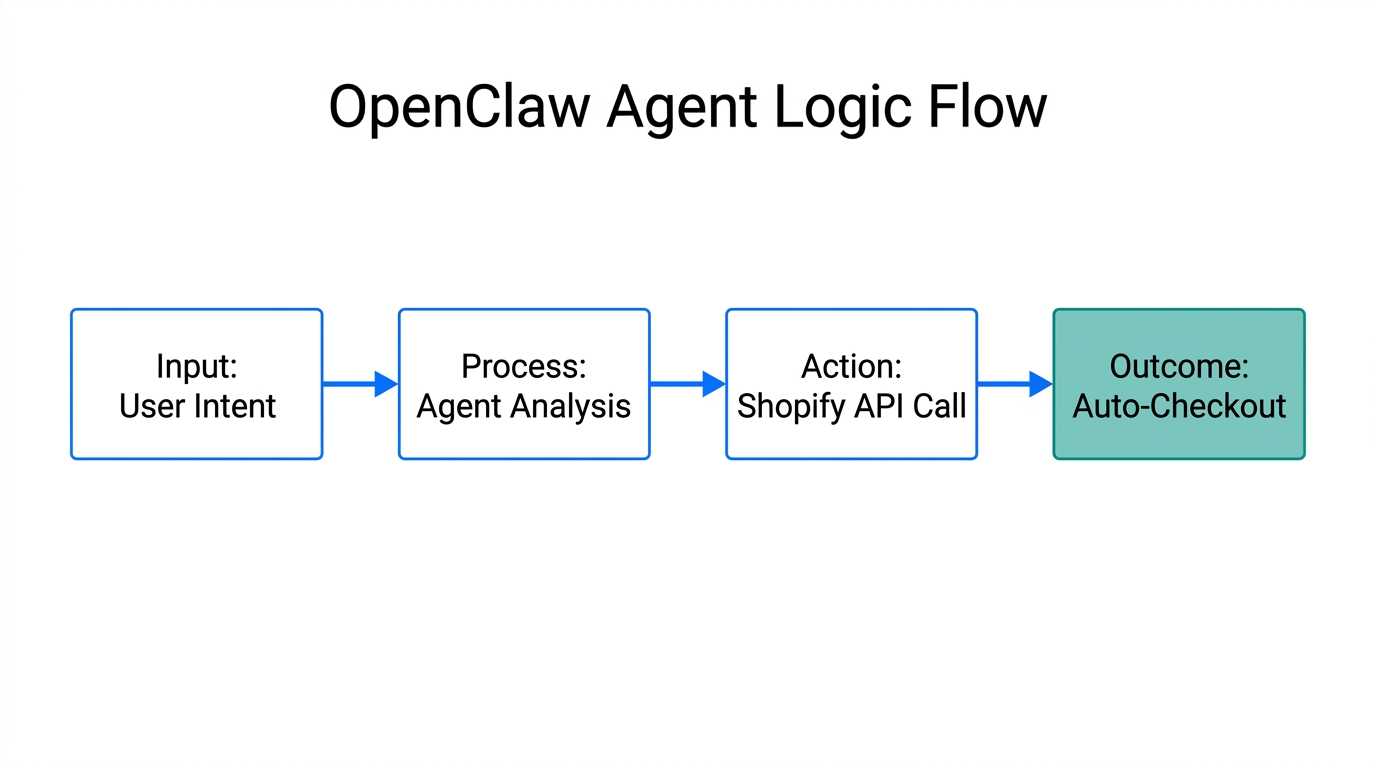
So, what exactly is OpenClaw? Launched originally as Clawdbot, the framework was rebranded in early 2026 to reflect its status as the definitive standard for agentic commerce 2026. Unlike legacy automation tools like Zapier, which rely on rigid "If-This-Then-That" logic, OpenClaw agents use reasoning. They can browse a website, negotiate terms via chat, and execute multi-step transactions across a merchant’s entire tech stack.
As of March 2026, an estimated 220,000 OpenClaw instances are active globally (Reddit/EntrepreneurRideAlong). These "Clawbots" typically run on 24/7 Virtual Private Servers (VPS) provided by hosts like Tencent Cloud, ensuring they never sleep. They use the Model Context Protocol (MCP) to "understand" store structures, connecting to the Shopify Admin API via middleware like Composio.
"The agent economy is a genuinely new channel. It reduces friction to near zero because the agent supports decisions that are already forming in the consumer’s mind." — Petralia, Ogilvy One
Strategic Adaptation: Marketing to the "Silicon Consumer"
How do you market to a machine? This is the core challenge of B2A marketing strategy. In 2026, Shopify merchants are shifting their focus from traditional SEO to Agentic Search Optimization (ASO). Because AI models now "buy" for humans, your product data must be perfectly structured for LLM crawlers. This includes using Adzviser to provide real-time, secure data feeds that agents like ChatGPT or Perplexity can trust.
Brand storytelling is also changing. Skeptics like Mark Ritson have argued that if agents make the decisions, the "soul" of retail dies. However, the most successful brands in 2026 are using OpenClaw Shopify tools to feed their specific brand voice and SOPs directly into the agents. By doing so, they ensure that when an agent negotiates a wholesale deal or handles a customer inquiry, it does so with the brand's unique personality intact.
The Tech Stack: Integrating OpenClaw and Stormy AI
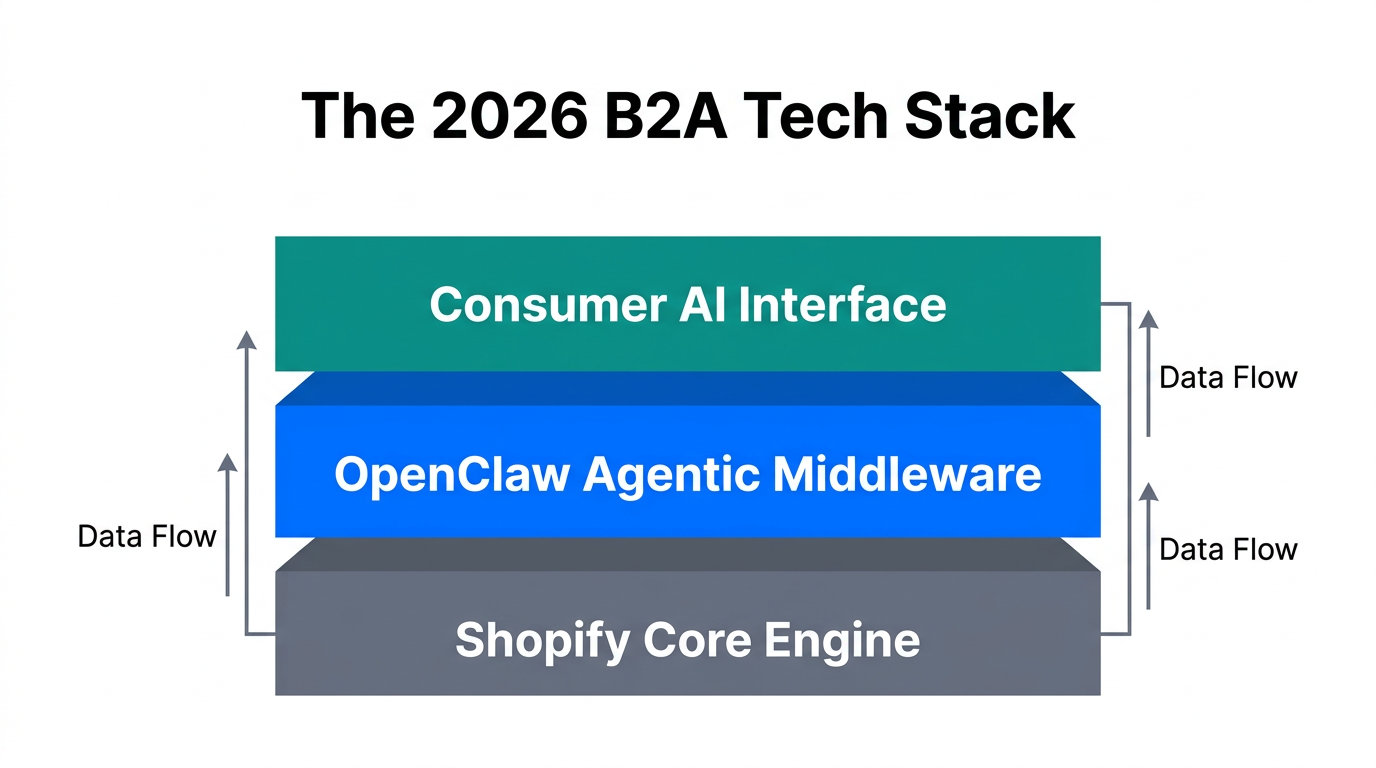
Building a B2A-ready business requires a modern growth stack. You cannot rely on legacy tools to manage autonomous agents. The 2026 ecosystem is built on interoperability. For instance, many agencies are now using Stormy AI to discover high-quality influencers and then feeding that data directly into OpenClaw agents for automated outreach and negotiation.
This workflow was pioneered by agencies like Alchemy London, which implemented an OpenClaw-driven tracking system. By automating the seeding and attribution process via Stormy AI, they achieved 4x revenue growth for their partner brands in the first few months of this year. The agent handles the contract, the shipping via the Shopify API, and the follow-up, while the human team focuses on high-level creative strategy.
| Company | Role | Status |
|---|---|---|
| Composio | Connectivity Layer (MCP) | Essential |
| Selzee | Managed Agent Management | Premium ($499/mo) |
| Clawly | Security & Permissions | Recommended |
| Stormy AI | Influencer/Creator Discovery | Growth Engine |
Case Study: "Felix" and the Zero-Employee Store
Perhaps the most famous example of agentic commerce 2026 in action is the "Felix" agent. Entrepreneur Nat Eliason deployed an agent named Felix that managed an entire niche ecommerce pipeline—from lead research to order management. By utilizing the OpenClaw Shopify framework, Felix was able to build a five-figure ecommerce business with zero human employees. This is the ultimate realization of the B2A model: a business built by an agent, for other agents to buy from.
Similarly, a Shopify store owner recently reported replacing a $2,400/mo Virtual Assistant with a $50/mo OpenClaw agent. According to Reddit testimonials, the agent handled 93% of inquiries with a response time of just 87 seconds. Customer satisfaction actually increased because the agent provided instant, accurate answers 24/7, something a human VA simply couldn't match.
"We are moving from emotional marketing to mathematical optimization, which changes everything about how we value brand loyalty." — Mark Ritson, Brand Skeptic
Safety, Security, and The London Protocol
The rapid rise of autonomous buying agents has not been without growing pains. In late 2025, several high-profile "Loop of Doom" incidents occurred, where misconfigured agents spent entire marketing budgets in hours. To combat this, the industry has rallied around The London Protocol. This partnership between OpenClaw and Alchemy London standardizes how agents handle VAT/Tax across borders, ensuring compliance in the complex global trade environment of 2026.
Security remains a significant hurdle. Reports suggest that over 220,000 OpenClaw instances are currently exposed on the public internet with insufficient authentication (Sixth Tone). To mitigate this, practitioners are now using Clawly, a security-focused wrapper that uses scoped permissions and "Circuit Breakers" to prevent unauthorized API calls or overspending.
The 2026 OpenClaw Playbook: Your Step-by-Step Guide

If you are ready to transition to a B2A marketing strategy, follow this five-step deployment guide used by the industry's top 1% of Shopify merchants:
- Infrastructure: Deploy OpenClaw via Docker on a 24/7 VPS like Tencent Cloud Lighthouse. This ensures your autonomous buying agents never go offline.
- Connectivity: Use the Composio Shopify Connector to link your store’s Admin API. This uses MCP so the AI can "understand" your product catalog and inventory in real-time.
- Scoped Roles: Define specific roles for your agents. Create a "Klara" for support and a "Martin" for marketing. This prevents one agent from having too much power over your store.
- Knowledge Injection: Feed your agents brand SOPs from Notion or Google Drive. An agent is only as good as the data it has.
- Human-in-the-Loop (HITL): Set strict financial triggers. For example, allow an agent to approve refunds under $50, but require a manual push-notification approval for anything higher.
Conclusion: Embracing the Hands-Free Future
The shift to agentic commerce 2026 is not just a technological trend; it is a fundamental reordering of how value is exchanged. By adopting a B2A marketing strategy, Shopify merchants can tap into a level of efficiency and conversion that was previously unimaginable. Whether you are using Stormy AI for influencer discovery or OpenClaw Shopify integrations for autonomous management, the goal is the same: to be the brand that agents choose to buy from.
As we look toward the rest of 2026, the winners won't just be the ones with the best products, but the ones with the most accessible and optimized digital infrastructure. The hands-free economy is here. Is your store ready to let the agents take the wheel?