In 2026, the era of "scrolling and guessing" is officially dead. For growth teams, influencer marketing has moved past its experimental phase and has solidified into a high-precision, data-first discipline. The shift toward AI-Powered Influencer Discovery 2026 is no longer just a trend; it is the infrastructure required to stay competitive in a landscape where consumer attention is fragmented and expensive. Today’s growth marketers are trading manual database searches for content intelligence and semantic discovery, allowing them to find the needle in a haystack of over 250 million global creators.
The 2026 Market Shift: ROI and AI Adoption
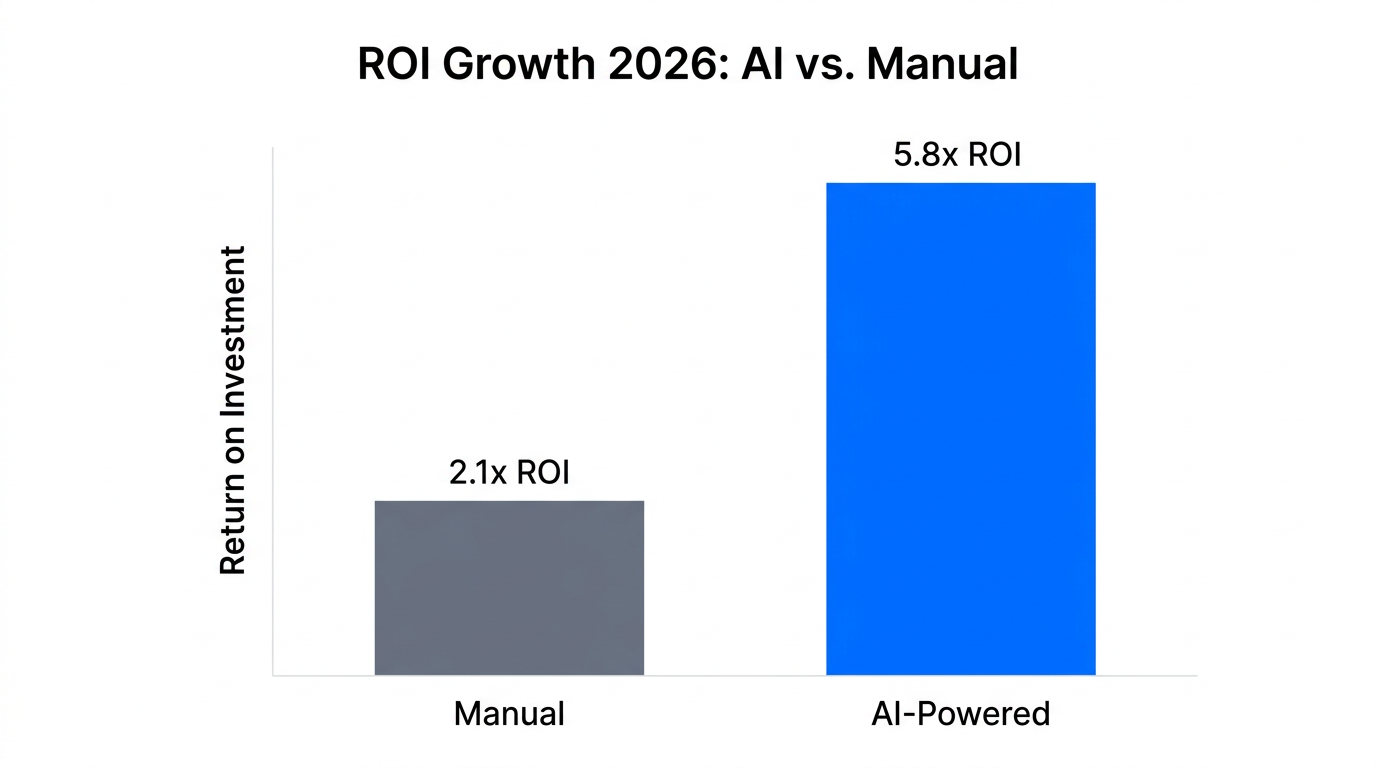
The numbers reflect a sector that has matured into a core performance channel, rivaling traditional paid search and social ads. According to recent industry projections, the global influencer marketing industry is projected to exceed $40 billion by the end of 2026. This growth is fueled by a massive shift in how brands allocate budgets, moving away from broad awareness and toward trackable, high-ROI conversions. In fact, research shows that brands are now earning an average ROI of $5.78 for every $1 invested in influencer marketing.
This efficiency is largely due to the widespread adoption of artificial intelligence. Roughly 60.2% of marketers are now actively using AI tools like ChatGPT and Claude for identification and campaign optimization. For lean growth teams, the impact is even more dramatic. AI-powered platforms are cutting manual research time by 60–80%, enabling a single marketer to manage hundreds of creator relationships simultaneously without sacrificing quality or personalization. This efficiency allows teams to spend less time on spreadsheets and more time on content intelligence marketing strategy.
"AI is becoming the 'infrastructure' of the creator economy. It’s not replacing human creativity; it’s pressure-testing narratives and aligning creators and brands before production even begins." — Amber Kai, Founder at Sequincial.
From Metadata to Content Intelligence: The Semantic Evolution
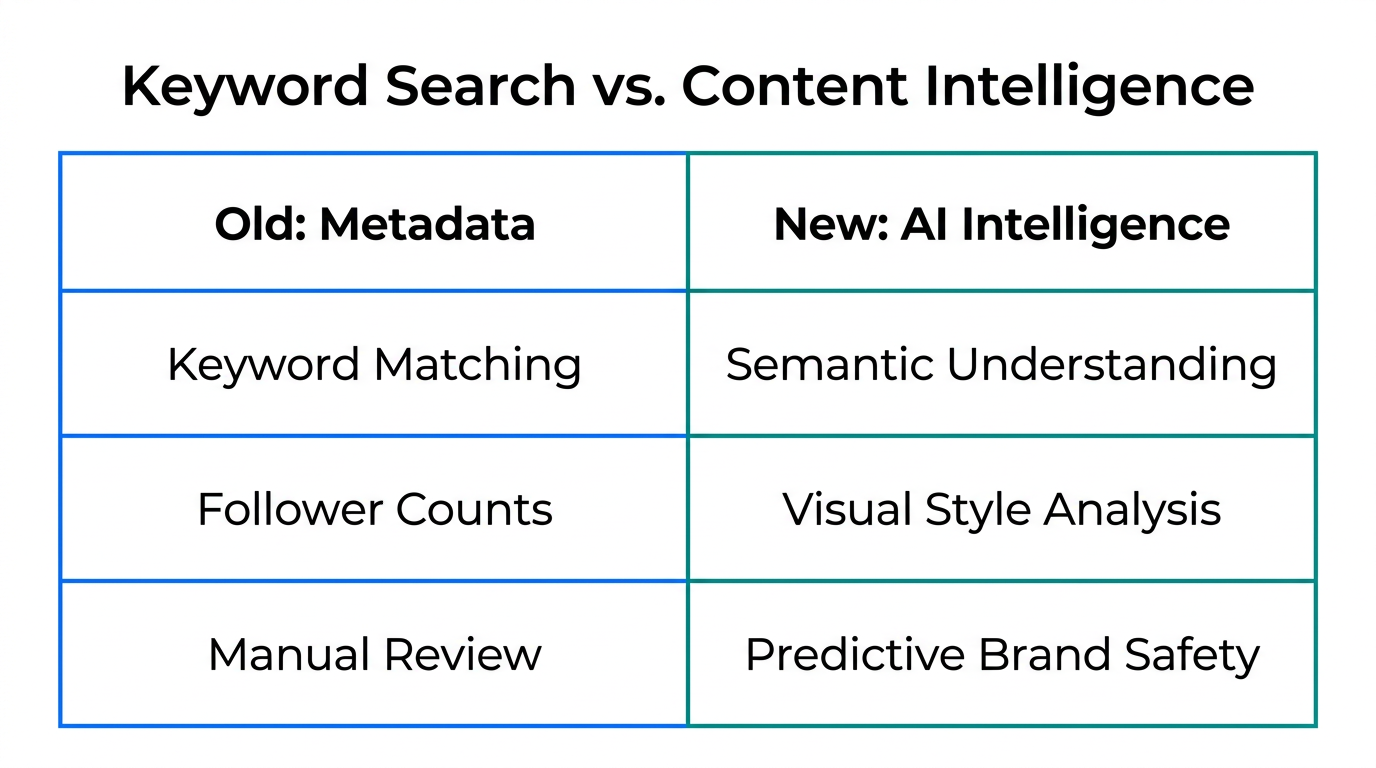
The biggest technical leap this year is the transition from metadata searching—relying on hashtags, bios, and keywords—to semantic creator search. In the old days (pre-2025), you might search for "fitness" or "wellness." In 2026, you use Natural Language Discovery to describe a specific vibe or aesthetic.
Advanced AI agents, such as those found on Kuli, now analyze video content frame-by-frame. This Content Intelligence allows the AI to "watch" thousands of hours of video per second, detecting visual styles, lighting choices, tone of voice, and even the sentiment of the background music. Instead of searching for tags, growth teams enter prompts like: "Find me a creator who talks about sustainable marathon training, has a cozy minimalist home aesthetic, and uses high-quality cinematic editing."
| Feature | Traditional Search (Old School) | AI Semantic Search (2026) |
|---|---|---|
| Search Input | Hashtags, Bios, Keywords | Natural Language Prompts (Vibes/Aesthetics) |
| Verification | Manual Profile Checks | AI Video Frame-by-Frame Analysis |
| Fraud Detection | Follower-to-Like Ratios | Deep Sentiment & Audience Quality Analysis |
| Scalability | Limited to 10-20 creators/day | Automated discovery of 100s/minute |
By leveraging platforms like Stormy AI, teams can bypass the manual vetting process entirely. Stormy’s AI search engine scans across TikTok, YouTube, Instagram, and even LinkedIn to find creators based on deep contextual triggers rather than just surface-level tags. This ensures that the creators you partner with aren't just in the right niche, but actually match your brand's visual identity.
The Micro-Influencer Edge: Scaling Engagement
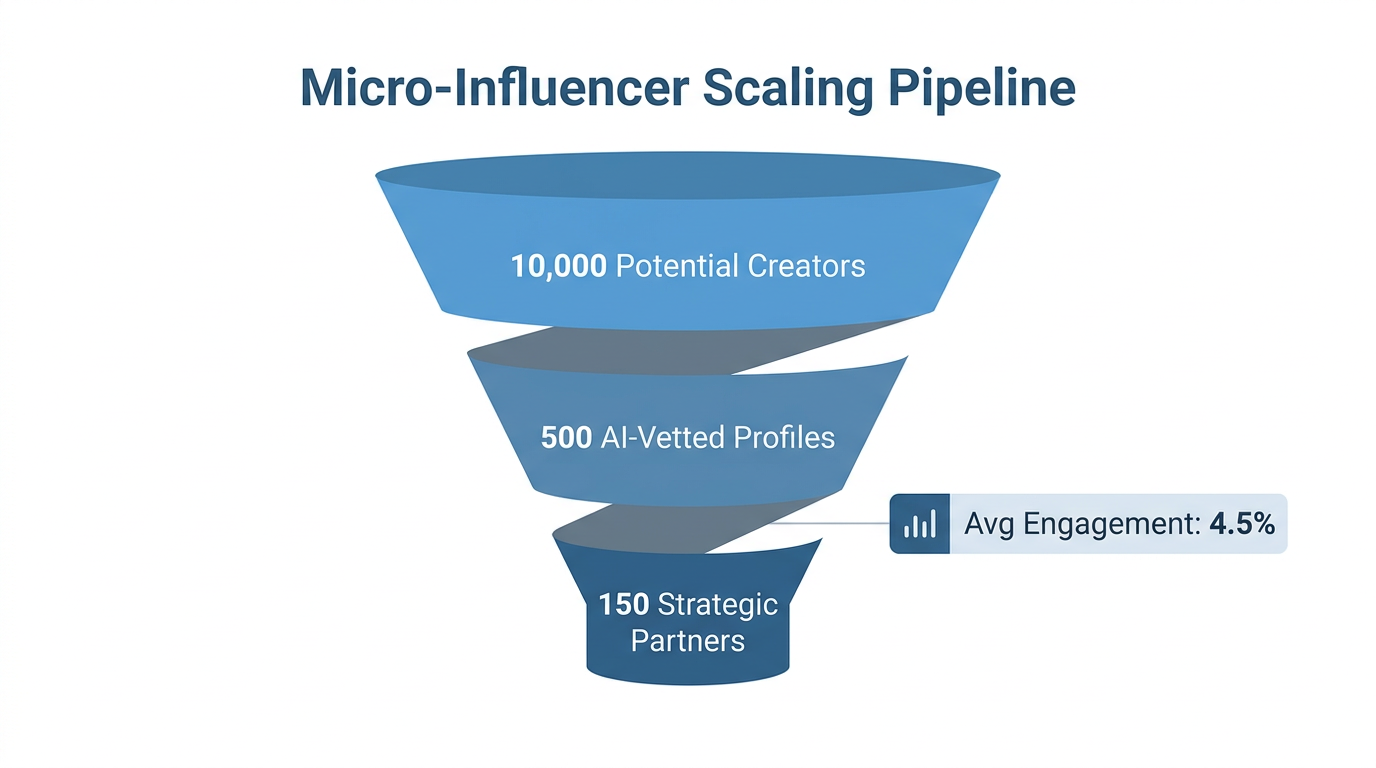
While mega-influencers still grab headlines, the real growth engine in 2026 is the micro-influencer (those with 1k to 10k followers). Data from autofaceless.ai indicates that nano and micro-influencers on TikTok command a massive 10.3% average engagement rate, dwarfing the 1.2% typically seen from mega-influencers.
For growth teams, this 10.3% engagement is the gold standard. It represents a highly attentive audience that trusts the creator's recommendations. However, managing 50 micro-influencers is significantly more difficult than managing one celebrity. This is where AI-Powered Influencer Discovery 2026 tools become essential. By automating the outreach and contract phases through tools like Notion or custom AI workflows, brands can treat a fleet of 100 micro-influencers as a single, cohesive performance channel.
"The micro-influencer edge: 10.3% engagement is the new gold standard for performance marketing in 2026."
Predictive Social Commerce: Forecasting Before You Sign
One of the most powerful integrations in 2026 is the marriage of discovery data with sales performance. Growth teams no longer have to guess if a creator will drive sales. Integration with tools like LTK AI allows marketers to predict conversion rates based on historical sales patterns within specific product categories.
Predictive modeling helps you answer: "Where should you spend your time tomorrow?" as Brian Klais, Founder of URLgenius, suggests. By ingesting billions of data points, these AI assistants forecast the influencer marketing ROI of a potential partnership before a single dollar is spent. This reduces the risk associated with creator marketing and allows for more aggressive scaling of successful campaigns via Shopify storefronts.
The 2026 Playbook: 5 Steps to AI-Powered Discovery
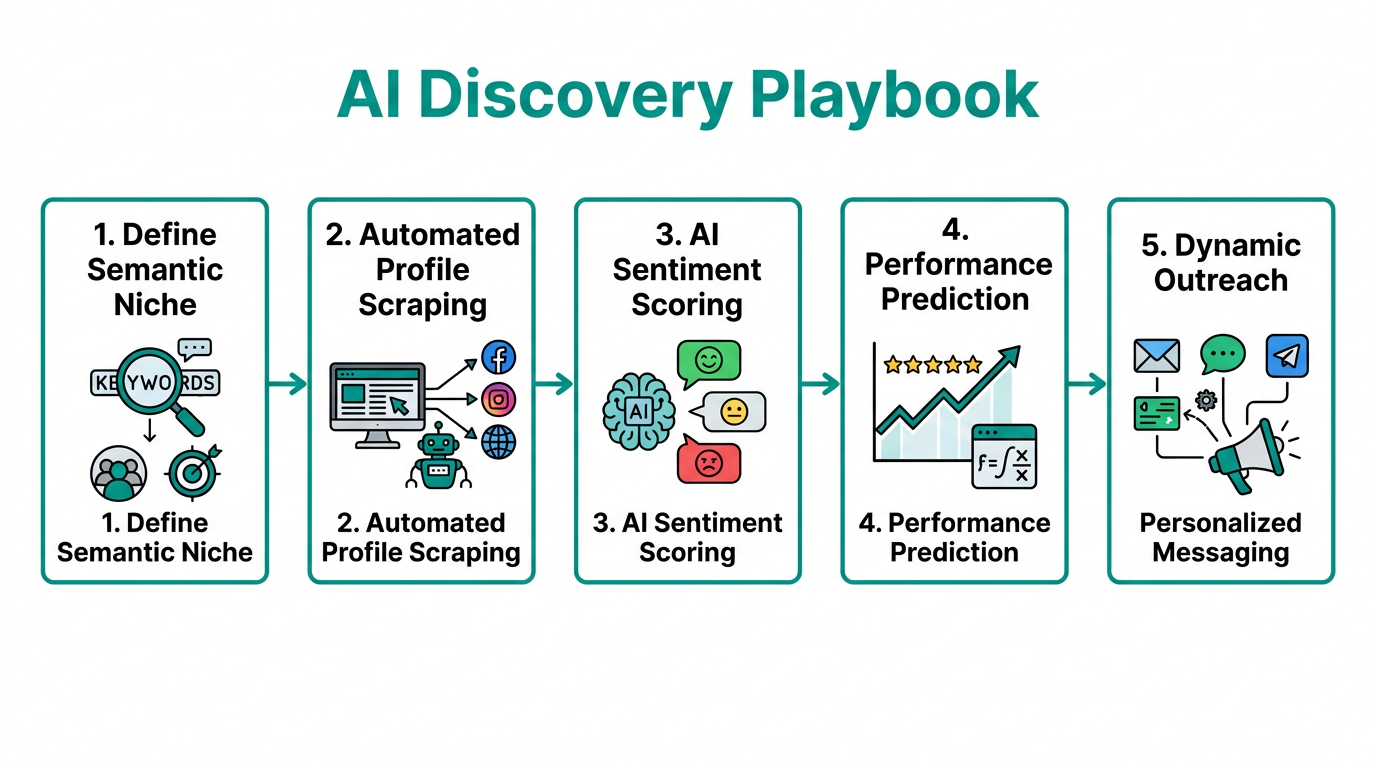
To implement an effective AI-Powered Influencer Discovery 2026 strategy, follow this actionable playbook designed for modern growth teams:
Step 1: Define Your Semantic Brief
Move away from keyword lists. Write a descriptive prompt that outlines the visual expertise, tone, and audience sentiment you need. Use terms that describe the vibe—such as "ASMR style," "cinematic storytelling," or "brutalist aesthetic." Tools like Afluencer's CreatorGPT can help refine these strategist-level discovery prompts.
Step 2: Execute Lookalike Modeling
Find your best-performing creator from last year and use a platform like Favikon to find "twins." AI lookalike modeling analyzes audience overlaps and content themes to find dozens of creators with the exact same profile as your top performer.
Step 3: Vet with Content Intelligence
Use video analysis tools to scan a creator’s last 50 videos. Do not rely on bio descriptions. AI agents can detect if a creator has recently mentioned a competitor, used controversial language, or if their audience sentiment regarding "product trust" is high enough for a conversion-focused campaign.
Step 4: Automate Personalized Outreach
Response rates plummet when creators receive generic emails. Use an autonomous agent like Janney AI or the outreach agent within Stormy AI to generate personalized messages that reference a specific recent video. This can increase response rates by up to 3x by proving you actually understand their content.
Step 5: Consolidate and Track
Avoid "data silos" by using a unified AI-powered partnership platform. Managing discovery in one tool, outreach in another, and tracking in a third leads to fragmentation. A centralized Creator CRM, like the one offered by Stormy AI, allows you to track every negotiation, payment, and post-performance in a single dashboard.
"AI is like a super virtual assistant that ingests billions of data points to answer: 'Where should you spend your time tomorrow?'" — Brian Klais, Founder at URLgenius.
Common Pitfalls in the AI Era
Even with advanced tools, many growth teams fall into predictable traps. The most common is the Vanity Metric Trap. In 2026, follower count is a secondary metric at best. Engagement Quality—the depth of conversation in the comments and the rate of shares—is the only metric that correlates directly with influencer marketing ROI. If the comments are filled with bots or generic "great post!" messages, the AI discovery agent should flag that creator for exclusion.
Another pitfall is the rise of virtual influencers. While brands like Prada and Samsung have seen success with characters like Lil Miquela and Rae, achieving authenticity is difficult. Experts suggest that successful AI personas should include 1–3% imperfections (like facial asymmetry or micro-expressions) to maintain "Zoom-proof" believability. If you are experimenting with virtual creators, avoid the "plastic look" at all costs.
Lastly, avoid over-scripting. AI should be used to provide guidelines and data-backed talking points, not word-for-word scripts. Treating creators like puppets kills the authenticity that makes them valuable in the first place. Use AI to find the right person, then let their natural creativity drive the execution.
Conclusion: The Future is Automated
The transition to AI-Powered Influencer Discovery 2026 marks the end of influencer marketing as a "dark art" and its emergence as a quantifiable science. By leveraging content intelligence marketing and semantic search, growth teams can scale their efforts to thousands of creators while maintaining the personalization of a small-scale campaign.
Whether you are vetting creators for brand safety via InsightIQ or automating your entire outreach funnel with Stormy AI, the goal remains the same: finding the perfect intersection of creator, audience, and brand message. As we move through 2026, the brands that win will be those that use AI to amplify their human relationships, not replace them. Ready to automate your discovery? It's time to let the AI agents do the heavy lifting while you focus on the big-picture growth strategy.