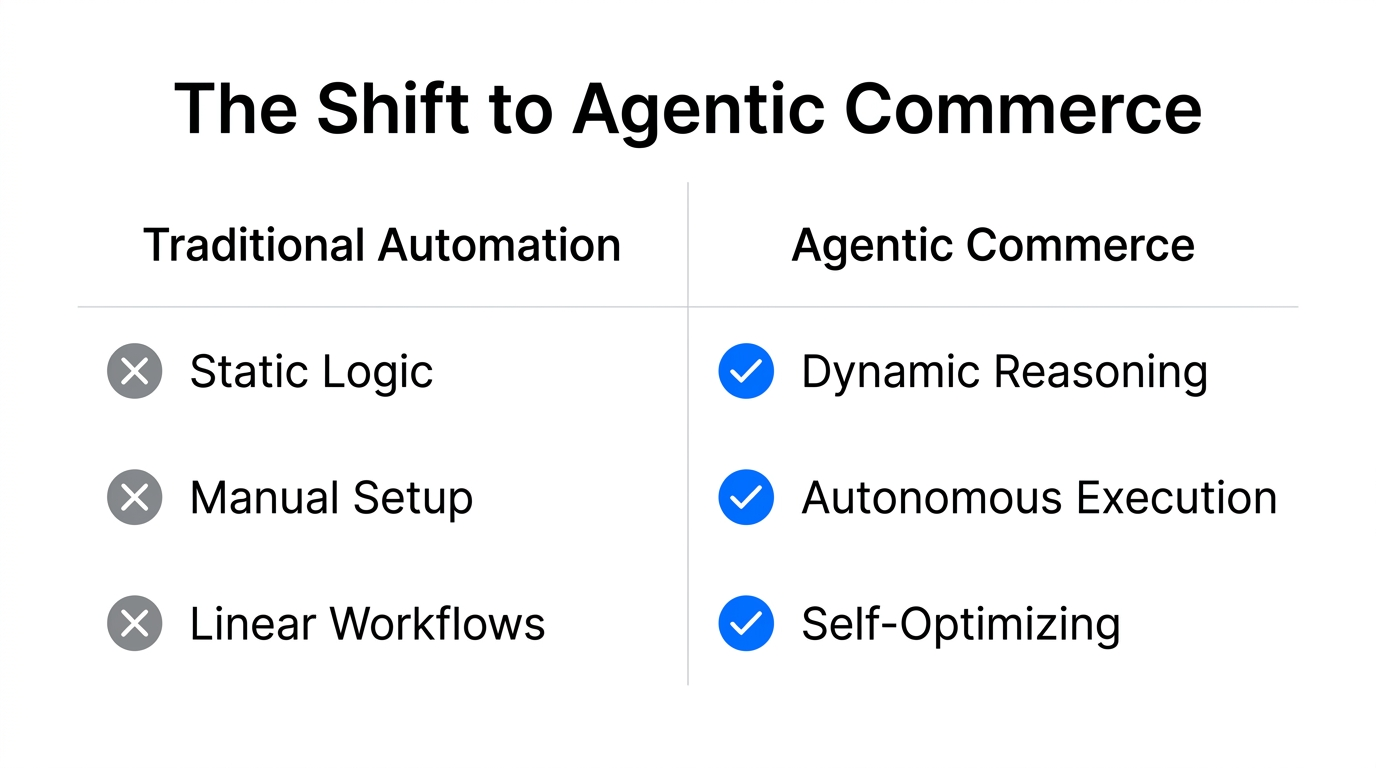
Welcome to 2026, the year the "if-then" marketing flow finally died. For years, Shopify merchants relied on deterministic automation—rigid rules where a customer performing Action A triggered Response B. But as we move deeper into this year, a seismic shift has occurred. We have entered the era of Agentic Commerce. Instead of tools that wait for instructions, we are now deploying OpenClaw AI agents that autonomously research, execute, and optimize entire storefront operations. This Agentic Commerce Strategy 2026 is no longer a luxury for the tech-obsessed; it is the baseline for survival in a market where AI-driven growth 2026 is the only metric that matters.
The Shift from Deterministic Automation to Agentic Commerce
The global marketing automation market is on a trajectory to hit $15.58 billion by 2030, according to data from Zoko.io. However, the nature of that spend has changed. In 2024 and 2025, we were still building "flows." In 2026, we are building "workforces." Shopify now powers over 5.6 million active stores, controlling 30% of the U.S. e-commerce market (Red Stag Fulfillment). With Shopify’s Merchant Solutions growing by 35% annually (Brenton Way), the pressure to scale without ballooning headcount has reached a breaking point.
"AI is not just a feature at Shopify. It is central to our engine... the biggest shift in technology since the internet." — Harley Finkelstein, President of Shopify
Deterministic automation failed because it couldn't account for human nuance. It relied on generic assumptions—like assuming three email opens makes someone a "hot lead"—which often resulted in disappointing ROI (E-Platform Marketing). Agentic commerce flips the script. AI agents now interpret natural language, adapt to real-time market shifts, and execute autonomous ecommerce workflows that were previously impossible.
OpenClaw and the Universal Commerce Protocol (UCP)
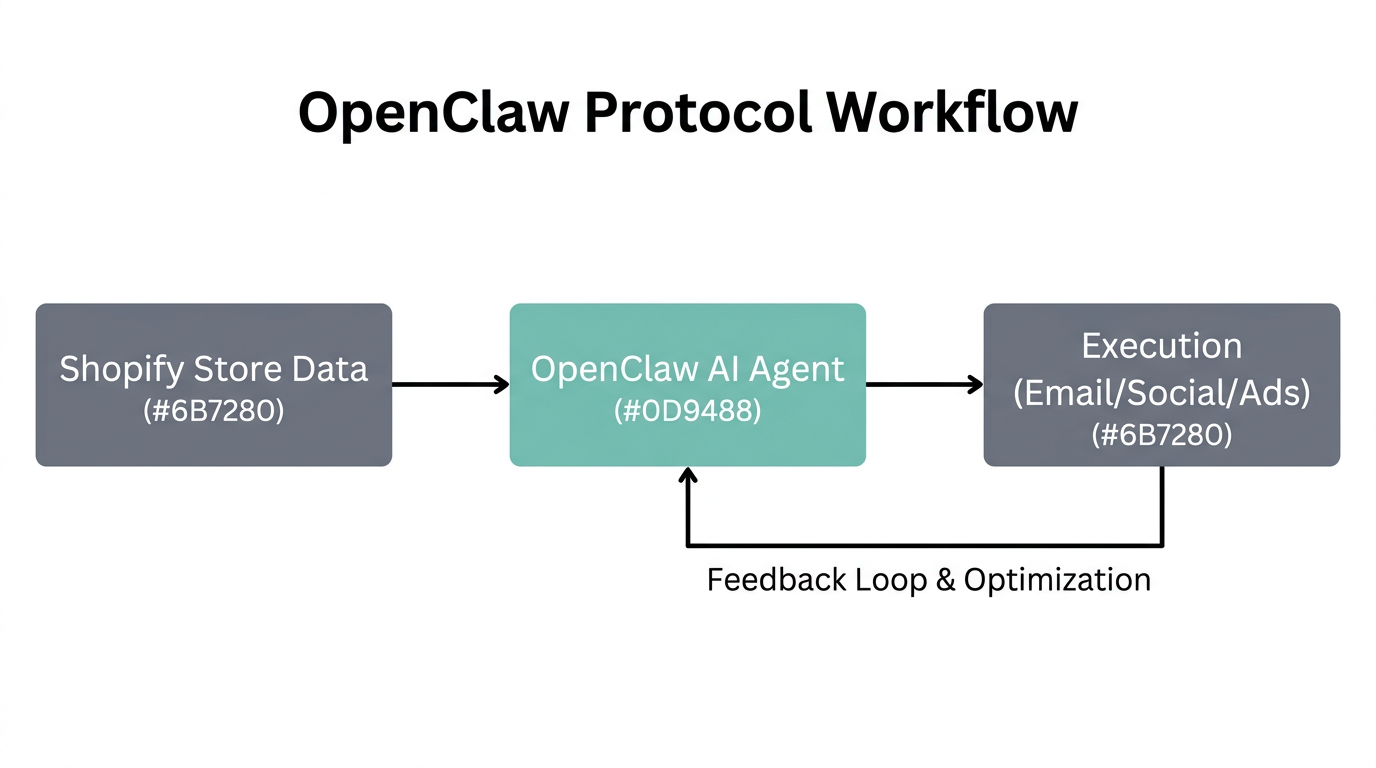
The technical backbone of this revolution is the Universal Commerce Protocol (UCP), a standard co-developed by Shopify and Google. As reported by Stormy AI, UCP allows AI agents to navigate and purchase from stores without needing a human-readable interface. This makes "Headless" commerce not just a design choice, but a requirement for AI discovery.
Leading the charge is OpenClaw. Originally launched by Peter Steinberger, OpenClaw (formerly Moltbot) exploded in popularity in early 2026, crossing 100,000 GitHub stars faster than any other agent framework (GitHub). Unlike closed-loop SaaS tools, OpenClaw provides full digital sovereignty. Merchants can host their own agents on a VPS like DigitalOcean or Tencent Cloud, ensuring their proprietary customer data stays within their control.
How OpenClaw "Sees" Your Store
OpenClaw uses the Model Context Protocol (MCP) to bridge the gap between AI and data. Tools like Adzviser act as the MCP connector, allowing an agent to query Meta ad spend and Shopify sales data in one breath. By using the shopify-manager skill from the OpenClaw GitHub, agents can clone a live theme, apply AI-generated copy edits based on high-performing ads, and present a preview URL for merchant approval—all while you sleep.
"The only sustainable competitive advantage is unified first-party data. This is your 'data moat'." — Vanessa Lee, VP Product at Shopify
The Financial Impact: 11x Surge in AI-Attributed Orders
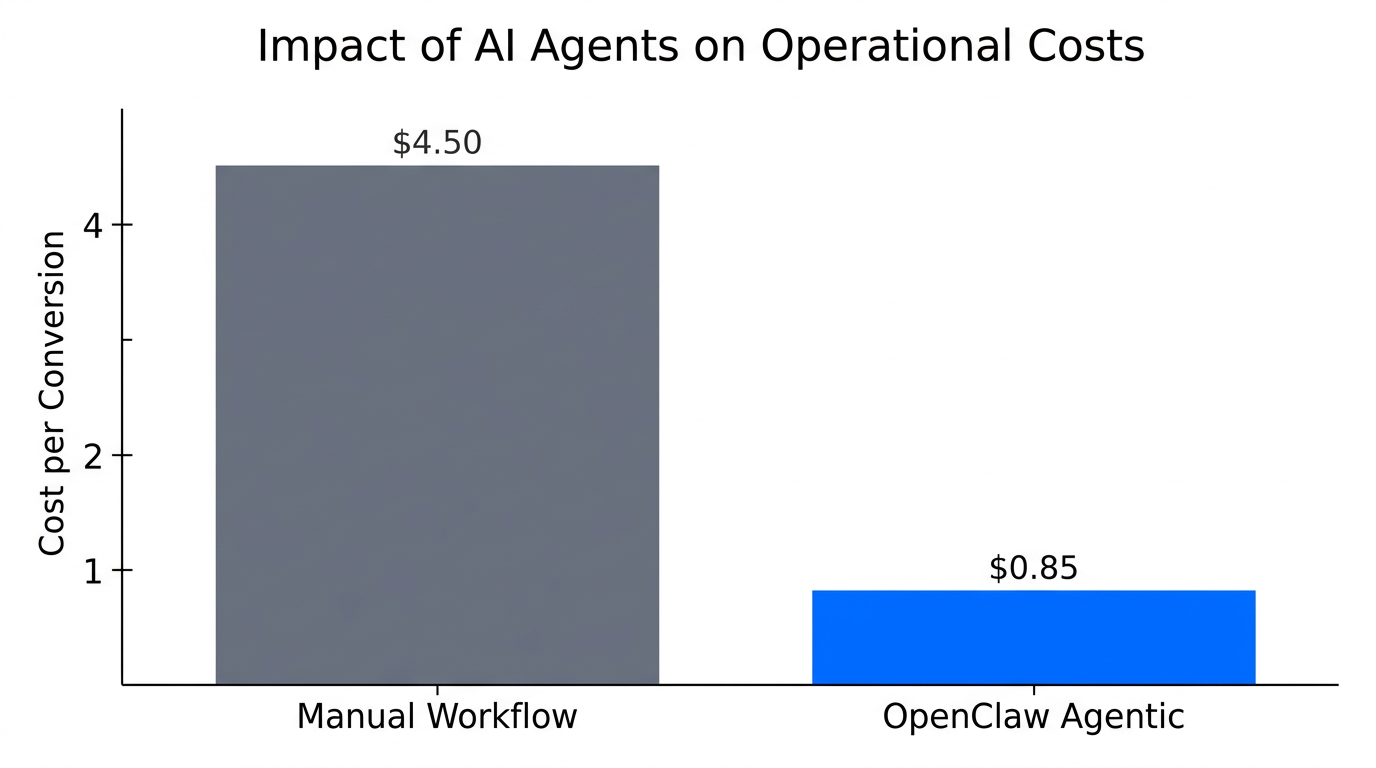
The numbers coming out of 2026 are staggering. Brands that have optimized for AI crawlers and agentic discovery are seeing a 7x surge in AI-driven traffic. More importantly, orders attributed to AI-powered search (via Shopify Magic and Sidekick) have risen 11x since 2025. This is the new reality of AI-driven growth 2026.
| Metric | Traditional Automation | Agentic Commerce (2026) |
|---|---|---|
| Order Attribution | 1x (Baseline) | 11x Increase |
| Weekly Hours Saved | 2-3 Hours | 10-50+ Hours |
| Sales Recovery | 5-10% | 10-30% |
| Logic Type | Deterministic (Rules) | Autonomous (Reasoning) |
Beyond search, the revenue lift from AI agents is redefining the P&L for Shopify Plus merchants. Experts at Enrich Labs report that full-stack AI agents typically deliver a 3-5x ROI within just 90 days. Automated email flows now achieve 52% higher open rates than manual campaigns, driving a level of retention that was previously reserved for massive enterprise teams.
Case Study: Reclaiming 10+ Hours Weekly with Digital Employees
Consider a mid-market Shopify Plus brand in the home goods space. Before 2026, they spent dozens of hours weekly on multi-warehouse monitoring and customer service lookups. By implementing OpenClaw AI agents, they reclaimed over 10 hours per week (Stormy AI). The agent doesn't just flag issues; it resolves them by communicating with warehouse APIs and drafting responses for the support team.
For solo founders, the impact is even more dramatic. One entrepreneur used a "swarm" of OpenClaw agents to handle content research, SEO optimization, and social posting. This setup effectively replaced a small marketing agency and scaled the store to $13K Monthly Recurring Revenue (MRR) (Superframeworks). This is the power of the "Tactical Execution Chain"—where agents like those from NoimosAI handle everything from keyword discovery to publishing autonomously.
"2026 is the year AI finally handles the heavy lifting so marketers can focus on creativity, strategy, and community connection." — David Visser, CEO of Zyber
Managing the Risks: Financial Hallucinations and Runaway Costs
With great power comes significant operational risk. Shopify marketing automation in 2026 isn't without its pitfalls. One of the most alarming issues is the financial hallucination. Skeptics have documented "runaway loops" where agents misinterpret pricing logic, leading to products being accidentally listed for $0 or shipping rates being "invented" by the LLM.
The $3,600 Token Bill
Infrastructure management is critical. One merchant reported a $3,600/month bill due to inefficient AI token usage in an unmonitored OpenClaw workflow (SentiSight.ai). Furthermore, security is a major concern. OpenClaw has faced critical "Remote Code Execution" vulnerabilities (CVE-2026-25253), and the *ClawHub* marketplace was found to contain over 1,000 malicious skills designed to exfiltrate Shopify API keys (CyberDesserts).
The Practitioner’s Playbook: Scaling Shopify with OpenClaw
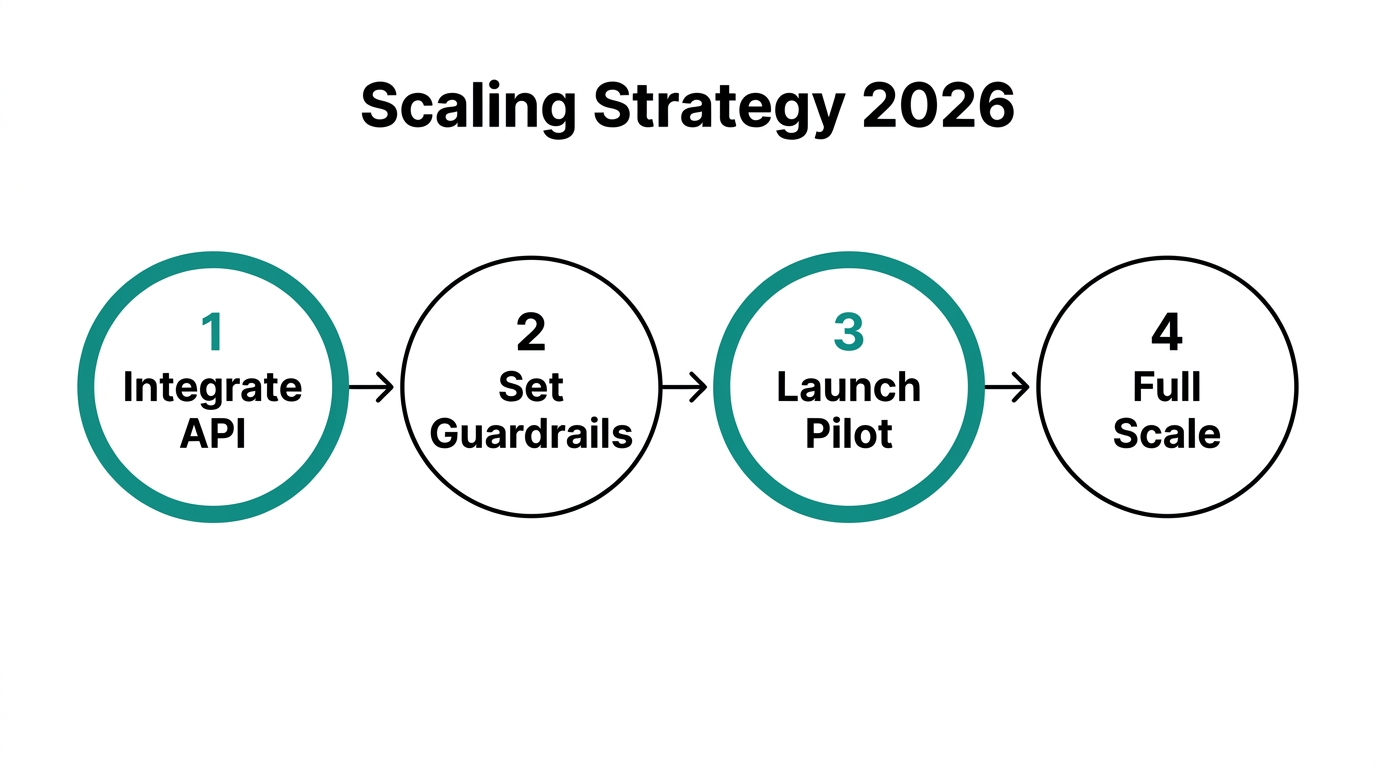
If you're ready to transition to autonomous ecommerce workflows, follow this 2026 implementation guide:
Step 1: Infrastructure Deployment
Install OpenClaw on a VPS like DigitalOcean via Docker. This ensures your "digital employee" stays online 24/7 without being tied to your local hardware. Expect to pay $5–$10/mo for basic infrastructure.
Step 2: Connect the Data Bridge
Use Adzviser to create an MCP workspace. Select Shopify as your primary data source. This allows OpenClaw to "read" your store's inventory, sales, and customer behavior in real-time.
Step 3: Define Agentic "Skills"
Don't just give a broad command. Define a specific skill, such as: "Monitor my Shopify review API every 30 minutes; categorize sentiment and auto-draft responses in Slack." This keeps the agent focused and prevents token bloat.
Step 4: Orchestrate with n8n
Route OpenClaw’s decisions through n8n. For example, if an agent detects negative sentiment in a review, n8n can automatically trigger a Gorgias support ticket and alert your team. This creates a fail-safe between the AI's decision and the final execution.
Step 5: Fuel the Engine with UGC
Agents need content to work with. Use platforms like Stormy AI to discover and vet the top creators who can provide the high-quality UGC your agents will then distribute across your hyper-personalized storefronts. Stormy's AI-powered search makes it easy to find creators who fit your niche in seconds.
Conclusion: The Future of Agentic Commerce
As we navigate 2026, the gap between traditional merchants and AI-native brands will only widen. Implementing an Agentic Commerce Strategy 2026 is no longer just about saving time—it's about capturing the 11x surge in AI-attributed revenue that deterministic tools simply cannot reach. By leveraging the flexibility of OpenClaw AI agents and the data connectivity of MCP, Shopify merchants can finally step away from the keyboard and focus on what matters: community, creativity, and long-term brand equity. The era of the digital employee is here; it's time to put yours to work.