2026 E-commerce Growth: Scaling Social Commerce with Sprout Social, Later, and Predis.ai
Master your e-commerce social media strategy 2026 with our guide to AI social media scheduling. Learn to automate product posts and drive social commerce growth.
In 2026, the digital storefront has moved beyond the browser and firmly into the social feed. With the U.S. social commerce market projected to exceed $100 billion this year, according to latest data from ALM Corp, brands are no longer asking if they should be on social, but how they can possibly keep up with the demand for content. The answer lies in a sophisticated e-commerce social media strategy 2026 that leverages AI social media scheduling to bridge the gap between manual effort and explosive scale. This year, the winners are those who have moved from reactive posting to an automated, catalog-synced distribution model that works while they sleep.
The State of Social Commerce in 2026: By the Numbers
The landscape of marketing has undergone a seismic shift. The global AI in social media market is now hitting an incredible $3.42 billion in 2026, on its way to a staggering $70.53 billion by 2034, as reported by Fortune Business Insights. For e-commerce brands, this isn't just a trend—it's core infrastructure. Marketing departments that have fully integrated AI social media scheduling are reporting a 14.5% increase in productivity and a 12.2% reduction in overhead costs, yielding an average ROI of $5.44 for every dollar invested, according to Templated.io.
However, the volume of content required to stay relevant has created what John Premkumar of Infosys calls an "output gap." As noted in MarTech, competitors using AI can now publish ten times more quality content than those relying on manual workflows, effectively dominating search results and social feeds. To compete, brands must adopt tools that go beyond simple post-timing and move toward autonomous "AI Agents" that manage entire multi-platform campaigns, a trend highlighted by Flytask as the definitive shift of 2026.
"The 'output gap' is real. If your brand isn't using AI to scale content, you're essentially yielding your market share to competitors who can out-post you ten to one."
Syncing Your Catalog: Automated Product Posts with Predis.ai
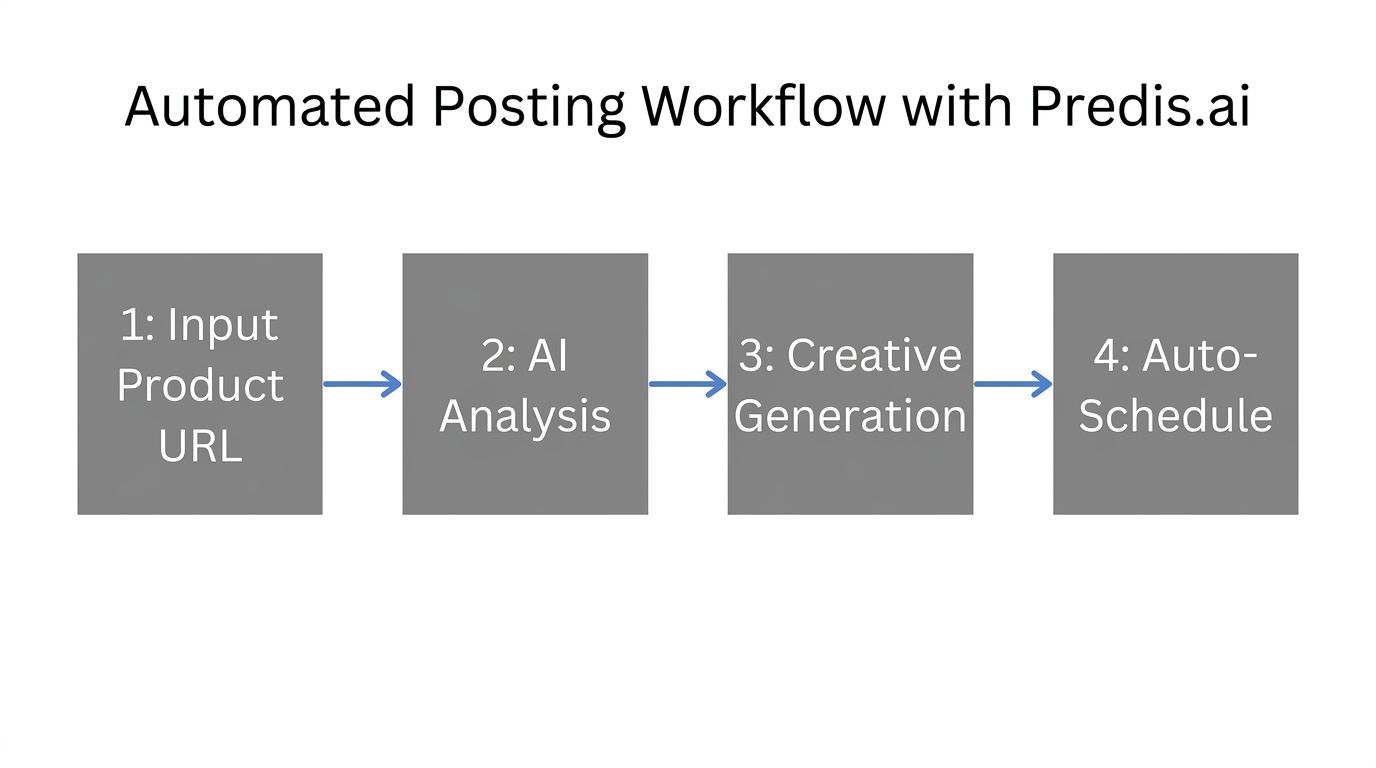
The most significant hurdle in social commerce growth is the manual creation of product-centric content. In 2026, top-tier e-commerce brands have eliminated this bottleneck by syncing their Shopify or WooCommerce catalogs directly with Predis.ai. This integration allows the AI to pull product images, descriptions, and pricing in real-time to generate automated product posts, videos, and carousels with a single click. Instead of spending hours in Canva, marketers can now use tools like Xyla AI to automate daily product updates based on inventory levels or trending items.
Step-by-Step Catalog Automation Playbook
- Connect Your Store: Integrate your Shopify or WooCommerce API key with your AI scheduling platform. This ensures the AI always has access to the latest product images and 'Out of Stock' status.
- Set Brand Guardrails: Train the AI on your brand voice and visual style. Brittany Long of Impact Driven AI suggests this allows small teams to "clone" their best marketer's voice across thousands of posts (Social Media Examiner).
- Generate in Batches: Use the AI to generate a week's worth of Reels and carousels based on your "New Arrivals" category.
- Review and Approve: While the AI does the heavy lifting, a human should always perform a final quality check to ensure technical accuracy.
| Feature | Predis.ai | Stormy AI | Legacy Tools |
|---|---|---|---|
| Best For | AI Content Generation | Influencer Discovery & Tracking | Basic Scheduling |
| Catalog Sync | Full Integration | Post Tracking | Manual Uploads |
| Primary Strength | Single-link post creation | Audience quality & ROI | Visual aesthetics |
Implementing the 70:30 Rule for Authenticity
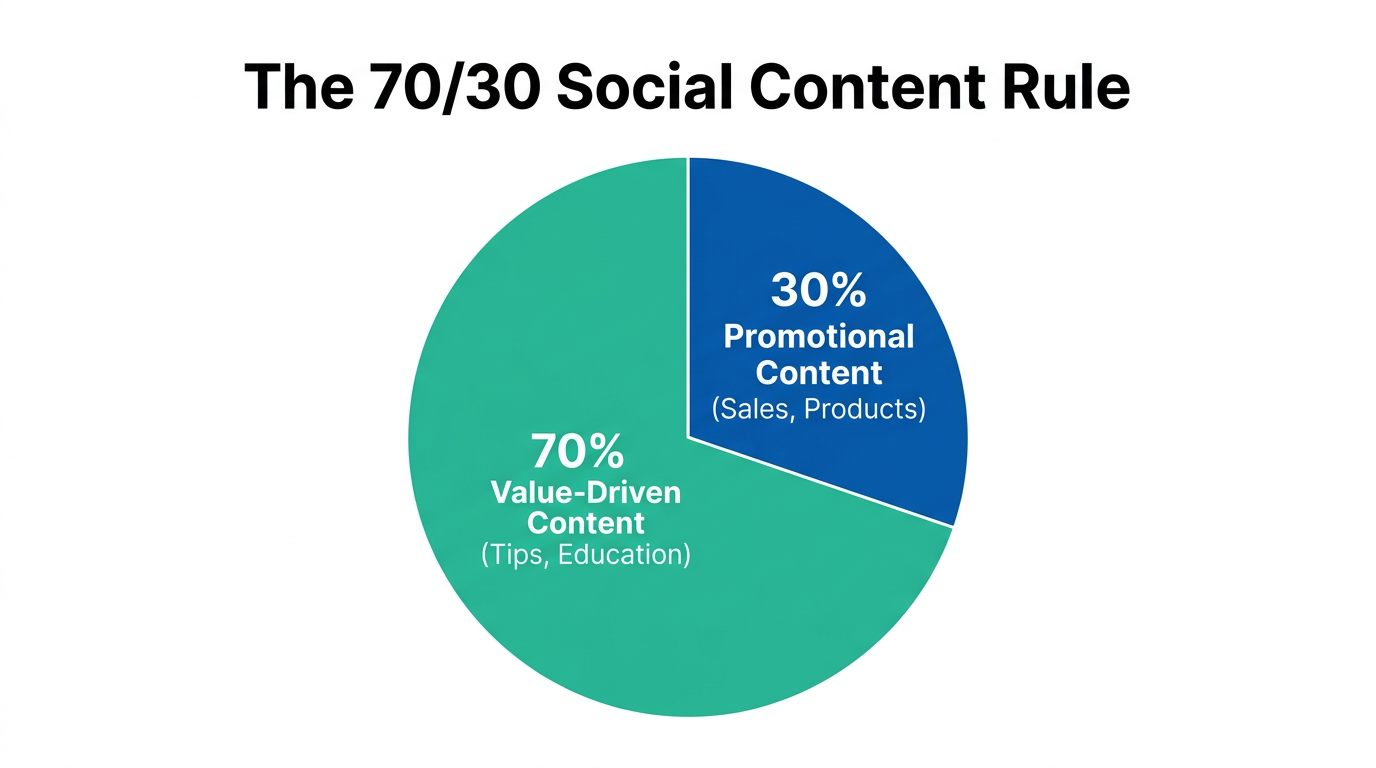
While AI social media scheduling is powerful, over-automation can lead to a "robotic" brand presence that alienates 2026's savvy consumers. To combat this, industry leaders like Hashmeta recommend the 70:30 Rule. This strategy dictates that 70% of your content should be AI-generated—handling routine product updates, hashtag research, and repurposing existing assets. The remaining 30% must be reserved for human-led storytelling, real-time community engagement, and high-impact User-Generated Content (UGC).
UGC is particularly critical in 2026, as 52% of consumers express concern about undisclosed AI content, according to ALM Corp. To fuel the 30% human-centric side of your strategy, platforms like Stormy AI are essential. By using Stormy's AI search engine, brands can find authentic creators who fit their niche perfectly, ensuring that the "human" portion of their feed remains vibrant and trustworthy. Mixing these authentic creator videos with automated product carousels creates a balanced feed that converts.
"The 70:30 rule isn't just a suggestion; it's a survival tactic. Use AI for the volume, but keep your soul for the 30% that actually builds community."
Precision Timing with Stormy AI Post Tracking
The days of posting every Monday at 9:00 AM are over. In 2026, audience behavior is too dynamic for static schedules. Leading brands now utilize predictive timing and advanced post-monitoring tools. Analyzing real-time audience activity peaks rather than generic industry benchmarks often results in a 20–30% lift in engagement per post, as cited in recent performance reports from Statista.
During high-stakes 2026 sales cycles like Black Friday or seasonal drops, these peaks can shift by hours within a single day. By using platforms like Stormy AI, e-commerce marketers can track individual videos and monitor views and engagement across platforms to hit the feed exactly when their specific customer base is most active. For enterprise brands, integrating this data into a centralized Creator CRM allows social interactions to be tracked directly against collaboration history, proving the impact of social commerce growth strategies.
Maintaining Brand Aesthetic with Visual Planning Tools
While data handles the timing, visual cohesion remains the gold standard for brands focusing on Instagram and Pinterest. In 2026, aesthetic consistency is still a primary driver of brand trust. Using a visual grid planner, often developed in design suites like Figma, allows brands to see exactly how their AI-generated Reels and carousels will look next to their high-production brand photography.
For e-commerce, the ability to automate Shoppable Pins on Pinterest and 'First Comment' hashtags on Instagram is a game-changer. By automating these technical steps, brands can maintain a high-frequency posting schedule without the manual fatigue. This is especially useful for app-driven brands using TikTok Ads Manager or Meta Ads Manager, where organic visual consistency helps lower customer acquisition costs (CAC) by reinforcing brand identity across all touchpoints.
2026 Hazards: Avoiding the 'Autopilot Trap'
Despite the efficiency of AI social media scheduling, several pitfalls can derail an e-commerce strategy. Over-automation is the most frequent mistake. Scheduling weeks of content without checking for real-time relevance can make a brand appear out of touch during sensitive global events, a warning echoed by LinkNow. Furthermore, failing to "train" your AI results in a generic brand voice that sounds like a chatbot rather than a unique identity (WayMore).
Another critical error is the lack of transparency. As Gartner research shows, consumers in 2026 value honesty. If a post is entirely AI-generated, subtle disclosure or ensuring a high degree of personalization is necessary to maintain trust. Brands like Sephora have mastered this by using AI algorithms to analyze past interactions, ensuring that even automated recommendations feel deeply personal and helpful rather than intrusive.
"AI is your engine, but a human must always be the pilot. Autopilot is for the straightaways; humans handle the turns and the turbulence."
Conclusion: Your 2026 Social Commerce Roadmap
Scaling social commerce in 2026 requires a symphony of AI and human creativity. By syncing your product catalog with Predis.ai, you solve the content volume problem. By using advanced post-tracking for predictive timing, you solve the engagement problem. And by maintaining a 70:30 balance—supplemented with UGC sourced via Stormy AI—you solve the authenticity problem.
The e-commerce social media strategy 2026 is not about replacing your marketing team; it’s about giving them the tools to operate with the capacity of a global agency. Start by automating your most repetitive tasks today, and watch your social commerce revenue reach new heights as the year unfolds.