In 2026, the cost of customer acquisition (CAC) is no longer a metric managed by spreadsheets alone; it is a battle won or lost in milliseconds. As the global AI-enabled ecommerce market surges toward a projected $64 billion valuation by 2034, the baseline for success has shifted from static retargeting to hyper-relevant, real-time engagement. For growth leads, the 2026 customer acquisition strategy is built on a single premise: the transition from "search and scroll" to "ask and act" commerce.
Today, generic product grids are conversion killers. Research from Salesforce indicates that product recommendations now drive up to 31% of total ecommerce revenue. If your brand isn't leveraging tools like Amazon Personalize or Google Recommendations AI to intercept session intent, you are likely leaving 20–30% of your potential conversion lift on the table. This guide outlines the tactical AI personalization playbook required to lower CAC and turn first-time browsers into loyal buyers.
The ROI of Real-Time Relevancy in 2026
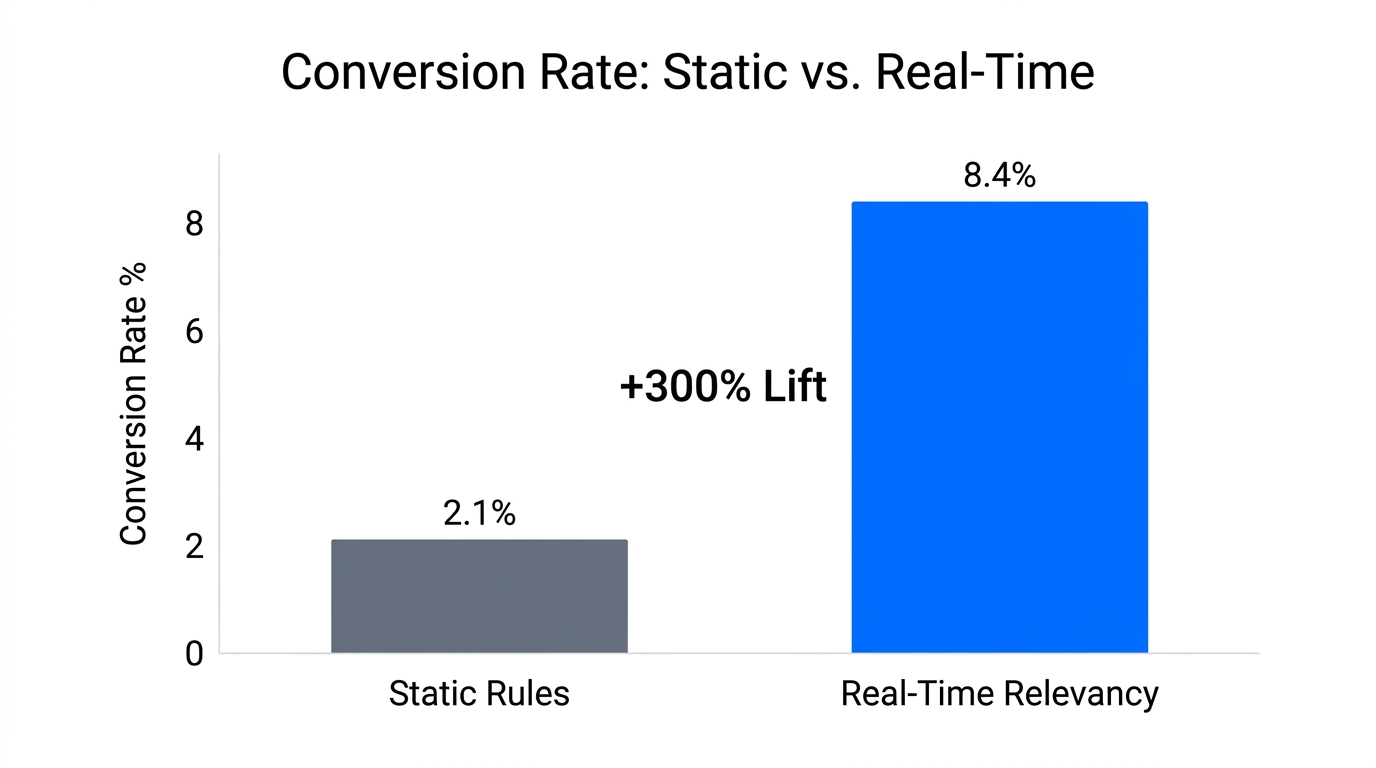
We have entered an era where 71% of consumers expect personalized experiences, according to McKinsey & Company, and 76% will abandon a site if they feel the experience is generic. The performance data is clear: shoppers who engage with personalized AI recommendations are 4.5x more likely to complete a purchase. This isn't just about "Customers also bought"; it's about instantaneous behavioral adaptation.
| Metric | Generic Experience | AI-Driven Experience |
|---|---|---|
| Conversion Rate Lift | Baseline | +20% to +30% |
| Revenue Contribution | <10% | ~31% |
| Add-to-Cart Likelihood | 1.0x | 4.5x |
"The winners in 2026 will be the brands that move beyond simple correlations to hyper-relevancy, detecting subtle patterns like scrolling speed and hover time to adjust relevancy scores in real-time."
Tactical Step 1: Implementing Real-Time Contextual Triggers
To make AI feel human, growth leads must feed recommendation engines more than just historical purchase data. Contextual triggers allow Amazon Personalize conversion lift strategies to account for the customer's immediate environment. In 2026, a high-performing engine must ingest:
- Weather & Seasonality: Automatically prioritizing rain gear if the local forecast via the OpenWeather API in the user's IP location shows a storm. Recommending winter coats in July is now an avoidable error.
- Hyper-Local Trends: Using location-based data to suggest products trending in specific neighborhoods or cities.
- Session Intent: Analyzing the specific path a user took to reach the site (e.g., via a TikTok Ad vs. an organic search) to adjust the landing page recommendations instantly.
Behavioral Signals: The New Relevancy Score
Traditional recommendation engines rely on "clicks." In 2026, the Google Recommendations AI for growth playbook focuses on pre-click behaviors. Systems now utilize deep learning to analyze scrolling speed and hover time. If a user lingers on a product image for more than 2.5 seconds but doesn't click, the AI interprets this as "high interest, low certainty" and may trigger a recommendation for a similar item with higher social proof or a slightly lower price point.
To fuel these engines with authentic visual data, growth teams often turn to AI-powered creator platforms like Stormy AI to discover and manage UGC creators who produce the high-converting content these AI models recommend to shoppers.
The Growth Lead’s Guide to Avoiding AI Hallucinations
With the rise of conversational shopping interfaces, the risk of AI hallucinations has become a critical threat to ecommerce conversion optimization. Dean Hickman-Smith of Testlio warns that 82% of AI failures in retail are due to misinformation rather than system crashes. [Source: Testlio Research]
To protect your brand equity, your 2026 strategy must include:
- Human-in-the-Loop Verification: Regularly auditing conversational logs for inaccuracies in product specs or return policies.
- Data Centralization: Ensuring your recommendation engine draws from a single source of truth for inventory via a Shopify Plus or custom ERP to prevent recommending out-of-stock items.
- Confidence Thresholds: Setting your AI to offer a generic help link rather than a "hallucinated" answer when the query is ambiguous.
"In the age of AI, trust is harder to build and easier to destroy. One hallucinated product claim can erase months of brand-building."
Strategic A/B Testing: Above the Fold vs. Conversion Rate
Where you place your recommendations is as important as what they contain. In 2026, the A/B testing for recommender systems should focus on the impact of "above the fold" placement. Using statistical significance models, brands like Sephora and IKEA have optimized these placements to achieve up to 35% higher online sales.
Reducing Choice Overload: Why Less is More
A common mistake in ecommerce conversion optimization is showing too many suggestions. Choice overload confuses visitors and leads to cart abandonment. In 2026, the most successful brands are limiting recommendations to 3–5 high-quality, high-relevancy items rather than a scrollable carousel of twenty.
By using Hybrid Filtering—combining collaborative filtering (what others liked) with content-based filtering (product attributes)—you can ensure that those few slots are occupied by products the user is statistically likely to buy.
The 2026 Customer Acquisition Playbook: Step-by-Step
Step 1: Centralize Your Data Pool
Before launching Amazon Personalize, ensure your customer data is structured and accessible. Clean data is the fuel for accurate learning loops.
Step 2: Define Hypothesis-Led Tests
Don't just "turn on" AI. Use specific goals like "Implementing real-time location triggers will reduce CAC by 10% for mobile users."
Step 3: Enrich Your Catalog with Visual UGC
Modern discovery is visual. Platforms like Stormy AI can help you source authentic user-generated content that makes recommended products feel more trustworthy and relatable to new customers.
Step 4: Monitor for Hallucinations
Set up automated alerts for when conversational AI agents deviate from your core product database using tools like LangChain or custom monitoring agents.
Conclusion: The Future of Growth is Hyper-Personal
The 2026 customer acquisition strategy is no longer about reaching the most people; it is about reaching the right person with the right context at the exact moment of intent. By leveraging Amazon Personalize conversion lift and Google Recommendations AI for growth, you can transform your ecommerce site from a storefront into a personal shopper.
The bottom line for growth leads is simple: the brands that embrace hyper-relevancy and visual discovery will thrive, while those clinging to static layouts will see their CAC spiral. Integrating these tools with an influencer discovery and UGC management platform like Stormy AI ensures your recommendation engine has a constant stream of fresh, high-performing content to display, closing the loop between acquisition and conversion.