In 2026, the creator economy has reached a tipping point where the 'middle class' of creators is finally becoming the primary focus for savvy brands. For years, the industry was obsessed with mega-influencers, but as we navigate this year, the focus has shifted toward the long-tail of content. This shift isn't just a trend; it's a structural pivot driven by the accessibility of ChatGPT Pro and the deep research capabilities of Perplexity AI. By treating these AI models as high-level analysts, entrepreneurs are now building automated sponsorship marketplaces that match niche creators with high-paying advertisers at a scale previously impossible, according to recent Goldman Sachs research.
The 2026 Long-Tail Opportunity: Why Niche is Scaling
 39:15
39:15The biggest growth opportunity in the creator economy 2026 lies in the aggregation of niche voices. While a single podcast with 1,000 listeners might seem insignificant to a major brand, a bundle of 500 such podcasts represents a massive, highly engaged, and hyper-targeted audience. Advertisers are increasingly fleeing the rising costs of traditional social ads and looking for authentic placements where 66% of sales reps already report that AI helps them better understand customers and personalize outreach. This demand for personalization is the engine behind the new podcast sponsorship marketplace model.
Current data shows that corporate legal teams waste 23% of their time on manual tasks, and similar inefficiencies exist in influencer marketing. Legacy agencies struggle to manage thousands of small relationships manually. This is where influencer marketing automation steps in. By using AI agents to discover, vet, and manage these 'long-tail' creators, platforms can unlock inventory that was previously too expensive to touch. To find these creators efficiently, smart marketers are turning to specialized tools like Stormy AI, which uses natural-language search to find creators in underserved niches instantly.
"The future of the creator economy isn't about finding the next MrBeast; it's about building the infrastructure that makes 10,000 niche creators accessible to one brand."
The Junior McKinsey Analyst: ChatGPT Pro vs. Perplexity AI
1:13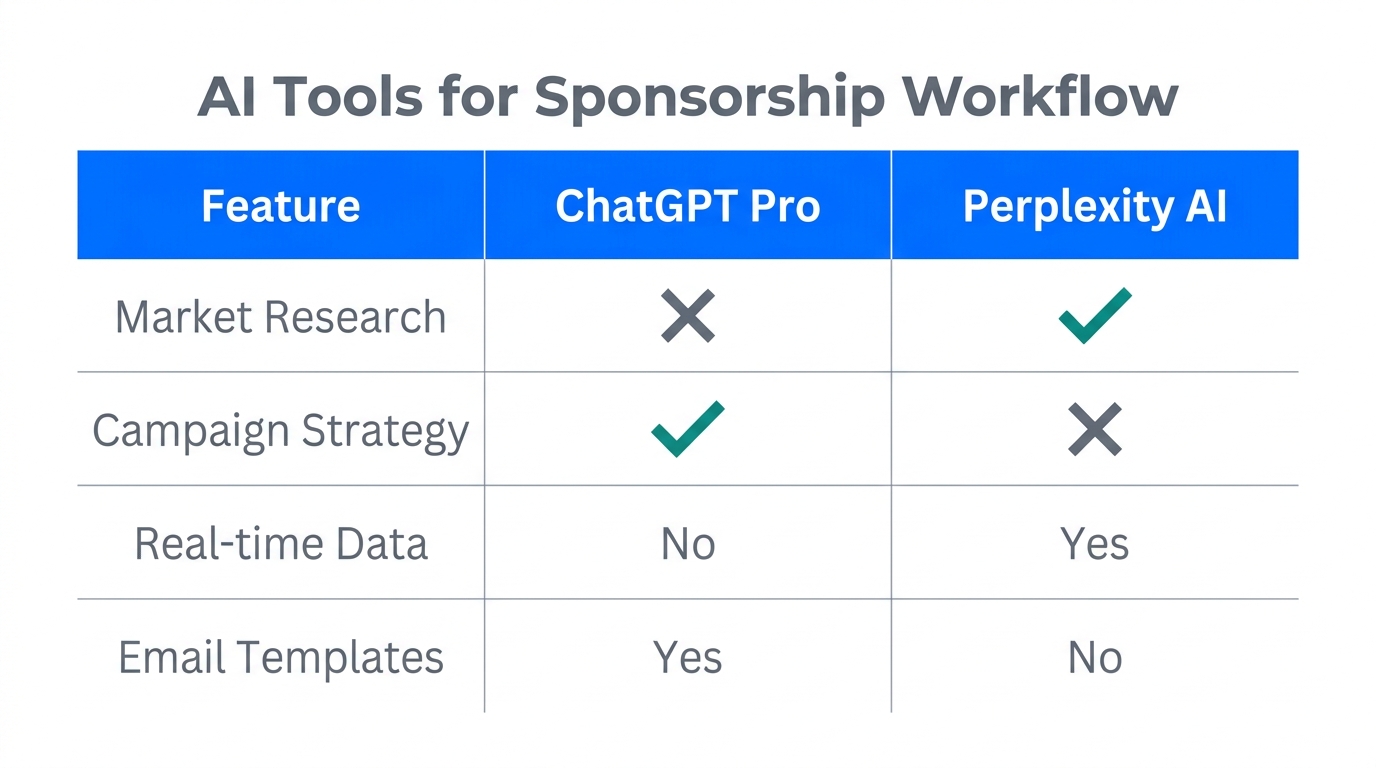
To build a defensible business in 2026, you need deep market intelligence. We recently tested the differences between the $200/month ChatGPT Pro Deep Research and the Perplexity AI Pro models. Think of these not as chatbots, but as junior analysts you would typically pay six figures for. They can scan dozens of sources, including YouTube transcripts and industry reports, to identify high-value sponsorship niches that are currently underserved.
| Feature | Perplexity AI (Deep Research) | ChatGPT Pro (Deep Research) |
|---|---|---|
| Speed | Extremely Fast (minutes) | Slower (up to 10-15 mins) |
| Source Depth | High (30+ sources cited) | Very High (Multi-layered reasoning) |
| MVP Playbooks | Concise, action-oriented | Detailed, long-form strategies |
| Visuals | Excellent tables and matrices | Text-heavy but comprehensive |
When prompted to find a startup idea with a $1M ARR potential, Perplexity identified a 'Clause Genealogy' legal agent, while ChatGPT Pro suggested an AI-powered marketplace for long-tail podcasts. Both models emphasized that proprietary data is the only lasting moat in an AI-commoditized world. For those looking to build their own empire, communities like Startup Empire provide the roadmap to turning these AI-generated insights into cash-flowing businesses.
The AI Matchmaking Moat: Turning Data into Dollars
If you're building a sponsorship marketplace in 2026, your competition isn't other humans; it's other AI models. To win, you must develop a 'data network effect.' This means that every time your AI agent runs a sponsorship campaign, it learns which content resonates and which ad placements yield the highest ROI for specific niches. This unique dataset becomes your competitive moat. As you scale, your AI becomes better at predicting success than any human broker could ever hope to be.
"Data is the new oil, but in the creator economy, distribution is the engine that burns it for profit."
Consider the success of companies like Cursor or Jenni AI, which reached $5M ARR by focusing on high-utility AI applications. Your goal should be to embed your AI agent directly into the workflow of either the creator or the advertiser. For instance, an agent that automatically generates AI transcripts and summaries for podcasters not only provides immediate value but also creates a searchable index that makes those creators discoverable to sponsors. Platforms like Stormy AI are already pioneering this by using deep data to analyze creator quality and detect engagement fraud automatically, ensuring that 'long-tail' doesn't mean 'low-quality.'
The $5,000 MVP Playbook: From Zero to One
20:01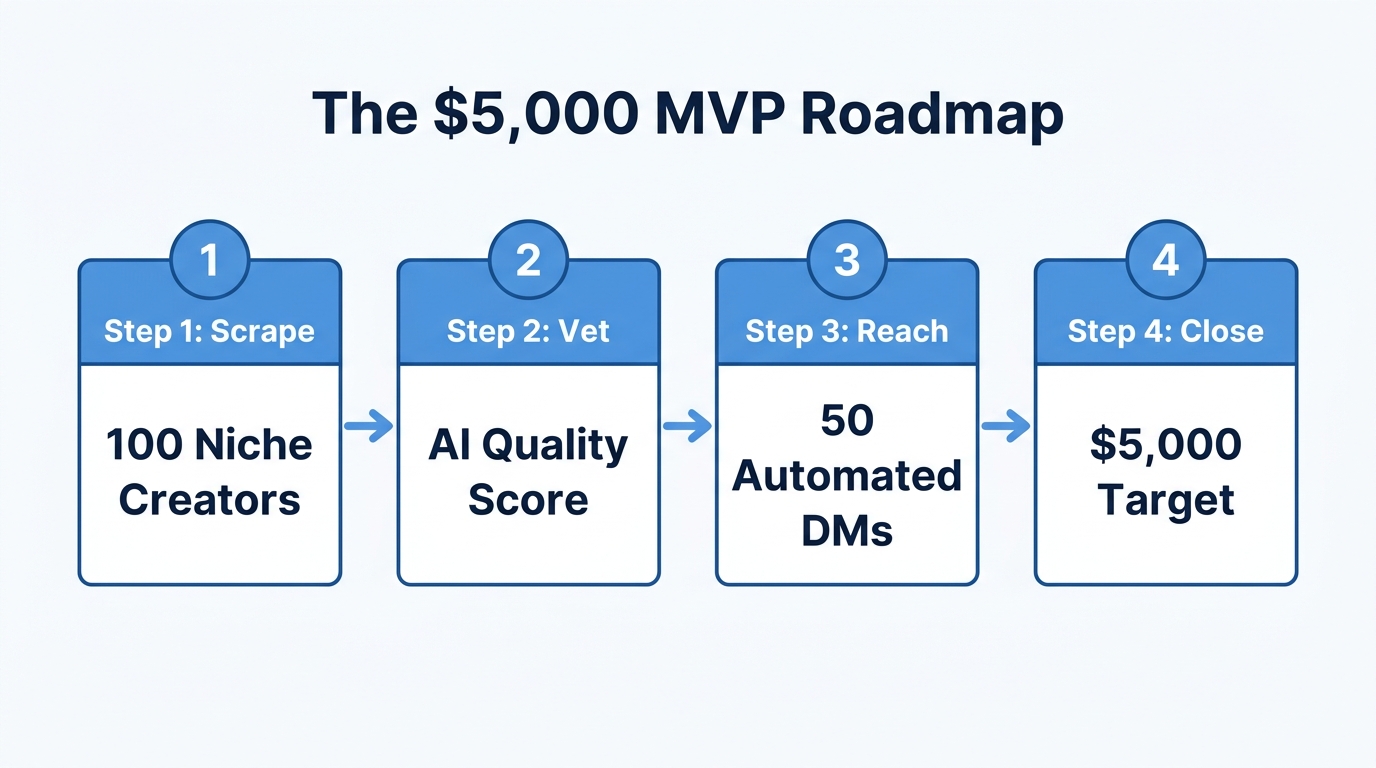
Scaling a startup to $1M ARR in 2026 doesn't require a $100k development budget. With low-code tools and AI APIs, you can launch a functional MVP for under $5,000. Here is the sequential playbook for a podcast sponsorship marketplace:
- Identify the Niche: Use Perplexity AI to find industries with high CPC (Cost-Per-Click) but low influencer saturation (e.g., specialized SaaS found on G2, biotech, or legal tech).
- Automate Discovery: Build a simple scraper or use the OpenAI Whisper API via AssemblyAI to transcribe the latest episodes of 500 small podcasts. This makes their content searchable for keywords that match advertiser needs.
- The 'Wizard of Oz' Matchmaking: Don't build a complex matching algorithm on day one. Use a basic web interface and manually 'bless' the matches the AI suggests to ensure high quality for your first ten paying advertisers.
- Cold Outreach at Scale: Use a virtual SDR agent like Instantly to reach out to potential sponsors. 66% of reps say AI helps them personalize, so use the podcast transcripts to tell a brand exactly why they should sponsor a specific 15-minute segment of a niche show.
Scaling to $5M ARR: A Distribution-First Approach
1:51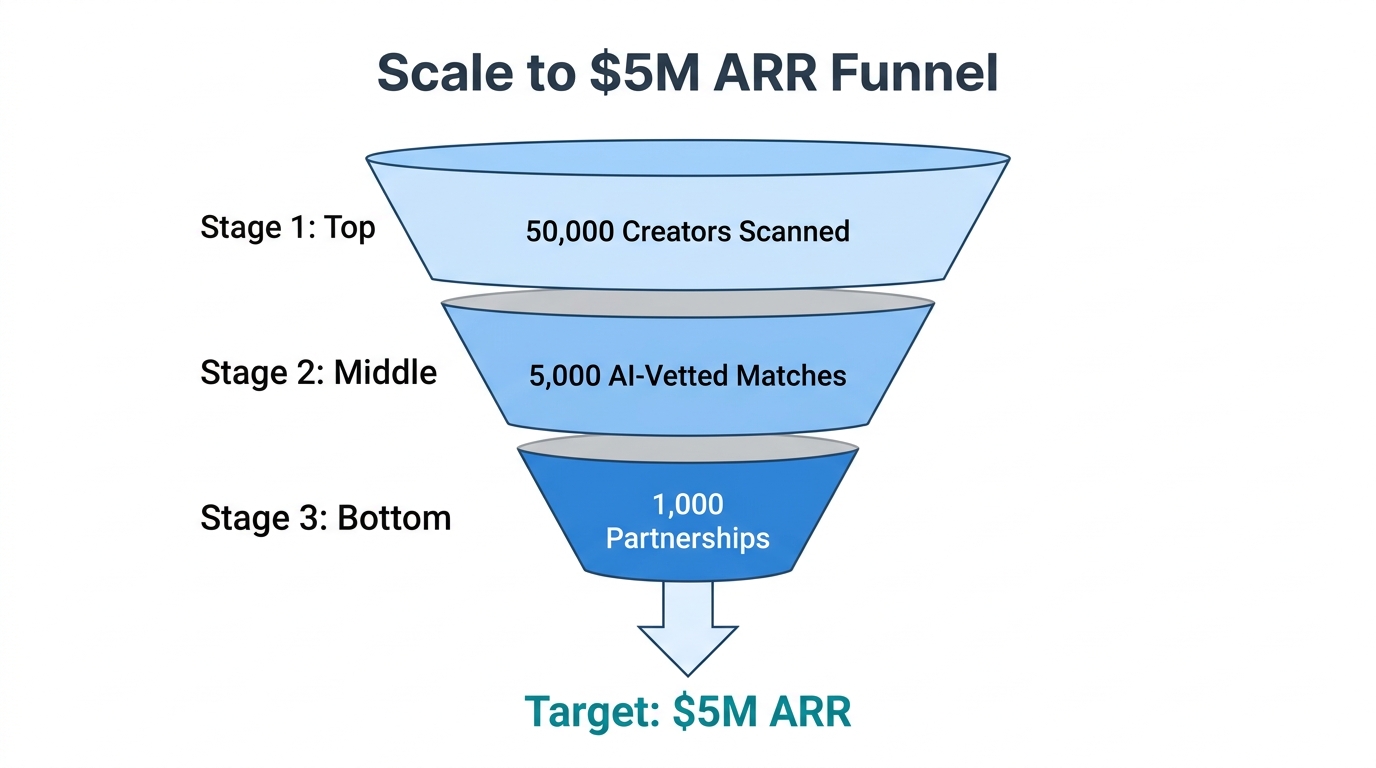
By year two, your focus must shift from product development to aggressive distribution. In the 2026 landscape, the most successful startups are those that leverage a viral self-serve growth model. This involves getting individual sales reps at large companies to use your tool for free, which eventually leads to a 'land and expand' enterprise deal. If 200 companies convert to paid plans at an average of $5,000 a year, you’ve hit your first $1M ARR milestone.
To reach $3M and $5M ARR, you need to integrate into existing ecosystems. Listing your marketplace on platforms like Salesforce or connecting with email marketing tools like Klaviyo allows you to tap into where advertisers already spend their time. For those looking to manage these creator relationships at scale, a robust Creator CRM is essential to track negotiations, payments, and campaign performance in one central hub.
"Distribution is a moat. If your product lives where the customers already work, you've already won half the battle."
Conclusion: The Future of Agentic Marketing
The 2026 creator economy pivot is defined by the democratization of deep research and the automation of the long-tail. By leveraging ChatGPT Pro and Perplexity AI, entrepreneurs can now identify and exploit market gaps that were previously hidden. Whether you are building a legal automation tool or a niche podcast marketplace, the core principle remains: use AI to aggregate value where others see only noise.
As you build, remember that the tools you use for discovery and vetting—like Stormy AI—are your eyes and ears in a crowded market. The opportunity to build a $5M ARR business with a lean team has never been greater. It’s time to stop looking at the stars and start mining the long-tail goldmine. Happy building.