The landscape of Amazon Seller Central in 2026 has transitioned from a mere transactional portal into what industry veterans call an "Agentic Operating System." While total Amazon revenue hit a staggering $716.9 billion in 2025, the game for 2026 isn't just about capturing top-line growth. It is about defending margins against a new era of fee granularity and advertising inflation. With third-party sellers now accounting for 61–62% of all units sold, the competition is no longer among amateurs, but among hyper-professional brands utilizing advanced automation to survive.
For the modern DTC operator, 2026 represents a "Competition Paradox." While new seller registrations have dropped to a 10-year low of 165,000 annually, the barrier to entry has skyrocketed. Success today requires navigating the new 3.5% fuel surcharge, managing unit-level fee hikes, and maintaining a Breakeven ROAS that often exceeds 3.0:1. To stay ahead, brands are increasingly relying on an AI ecommerce employee like Stormy AI to handle the heavy lifting of inventory monitoring and supplier follow-ups in the background.
Breaking Down the 2026 Logistics Updates: New FBA Surcharges
The most significant shift in the 2026 Amazon Seller Central ecosystem is the introduction of the Fuel & Logistics Surcharge. Starting April 17, 2026, Amazon implemented a flat 3.5% surcharge on all fulfillment fees to account for rising energy costs and global supply chain volatility. This isn't a one-time adjustment but a dynamic fee that requires constant monitoring to ensure your pricing strategy remains viable.
In addition to the surcharge, unit-level fees have seen targeted increases. Small standard items have seen an average increase of $0.25 per unit, while standard-size products (priced between $10 and $50) have seen an average hike of $0.08 per unit. For high-volume sellers, these pennies quickly turn into thousands of dollars in lost margin. This is where Stormy AI steps in as a teammate; it can import arbitrary CSVs from your fulfillment reports and flag individual SKU fee discrepancies before they erode your monthly P&L.
"In 2026, revenue without margin is unsustainable. The brands winning today are the ones treating FBA fees as a variable they can optimize, not a fixed cost they must accept."
Calculating Your 2026 Breakeven ROAS
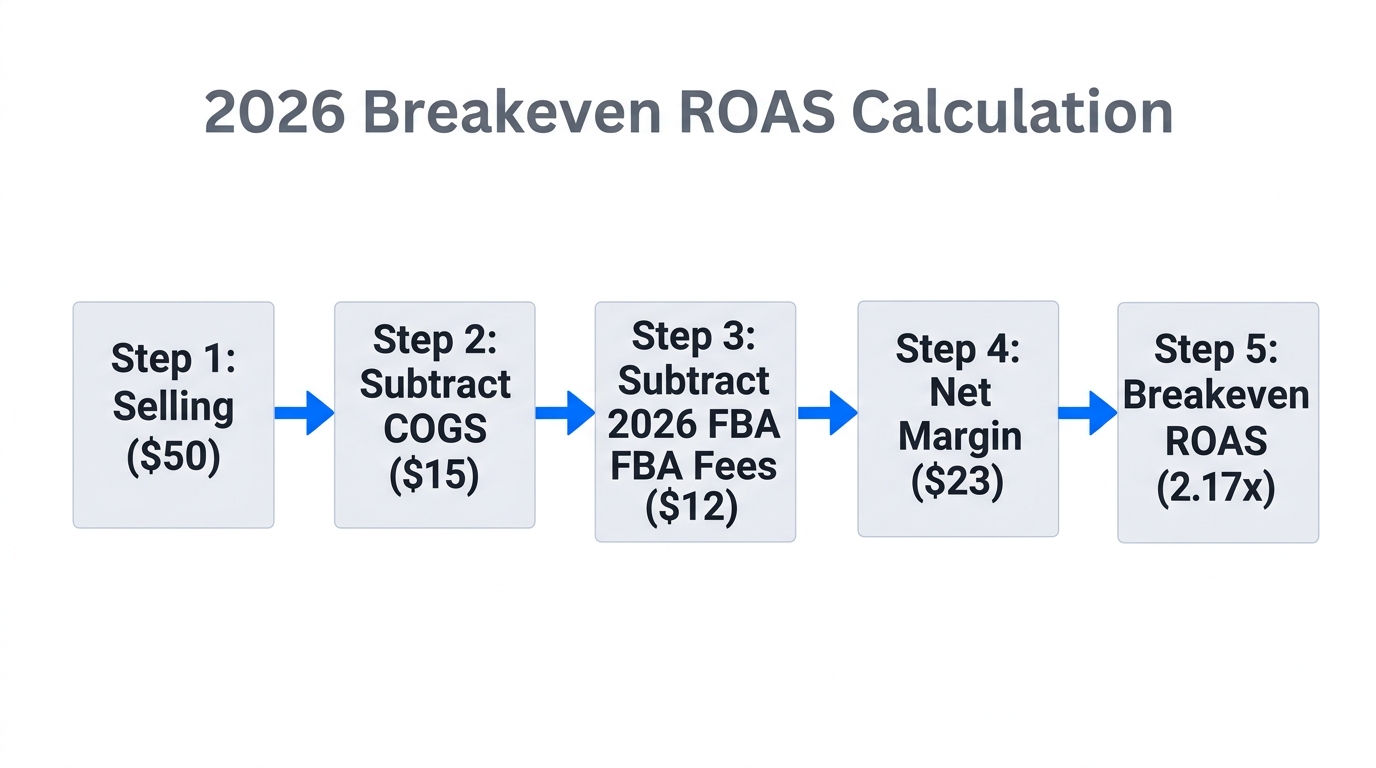
Advertising on Amazon is more expensive than ever, with total ad revenue reaching $68.6 billion. To maintain profitability, you must understand your Breakeven ROAS (Return on Ad Spend). In the 2026 marketplace, most established sellers now require a ROAS of 2.8:1 to 3.5:1 just to cover their COGS, FBA fees, and referral commissions. If your ROAS falls below this floor, you are essentially paying Amazon for the privilege of selling your product.
The median ROAS across the platform currently sits between 4.5x and 5.5x, but this varies wildly by category. For instance, high-repeat purchase categories like Supplements target a lower ROAS of 4.2x because they prioritize Lifetime Value (LTV), whereas Electronics brands must hit 4.8x+ to account for thin margins. Stormy AI helps here by pulling campaign performance from Amazon Ads every morning, comparing spend against revenue in a shared workbook, and flagging underperforming campaigns that threaten your breakeven threshold.
| Metric | 2026 Median Benchmark | High-Margin Strategy |
|---|---|---|
| Average CPC | $1.18 – $1.25 | Target long-tail semantic keywords |
| Conversion Rate | 8% – 15% | Invest in Premium A+ Content |
| Breakeven ROAS | 2.8:1 – 3.5:1 | Optimize COGS via Stormy AI supplier tracking |
| Ad Spend as % of Rev | 15% – 20% | Balance with organic SEO (Rufus AI) |
The Rufus AI Shift and Advertising Benchmarks
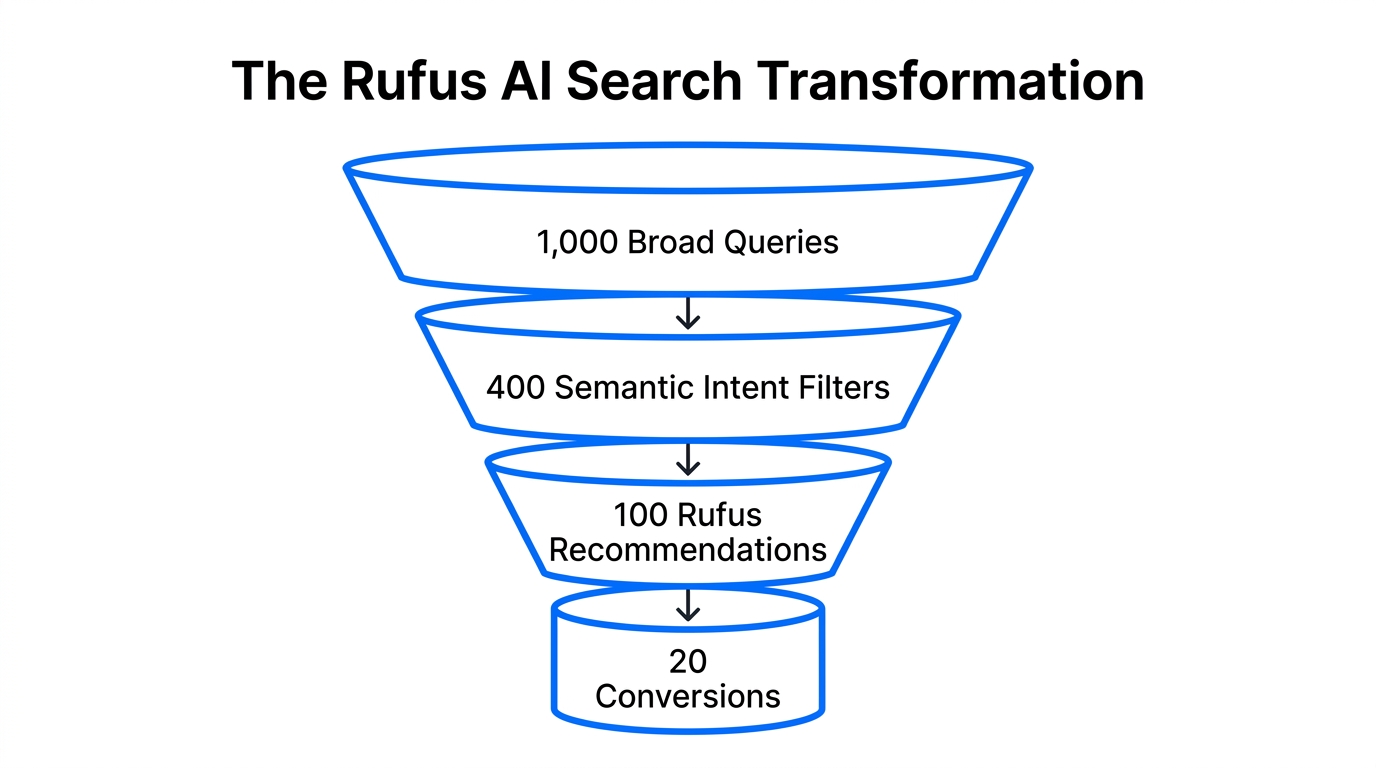
One of the most disruptive changes in 2026 is the dominance of Rufus AI, Amazon’s shopping assistant. Rufus now handles 25% of all product queries. Unlike the traditional search bar, Rufus prioritizes natural semantic language. Listings that rely on old-school keyword stuffing are being deprioritized in favor of those that answer specific customer questions, such as "What do people call this product in a dorm setting?"
This shift has contributed to a rise in Average CPC, which now fluctuates between $1.18 and $1.25, a 12% increase from 2025. During peak Q4 periods, these costs are projected to hit $1.45. To combat this, smart sellers are using Stormy AI to analyze performance reports week-over-week, identifying which "Intent Clusters" are driving the highest conversion velocity and shifting budget away from broad keywords that no longer serve the AI-driven search algorithm.
Utilizing Premium A+ Content to Offset CPC
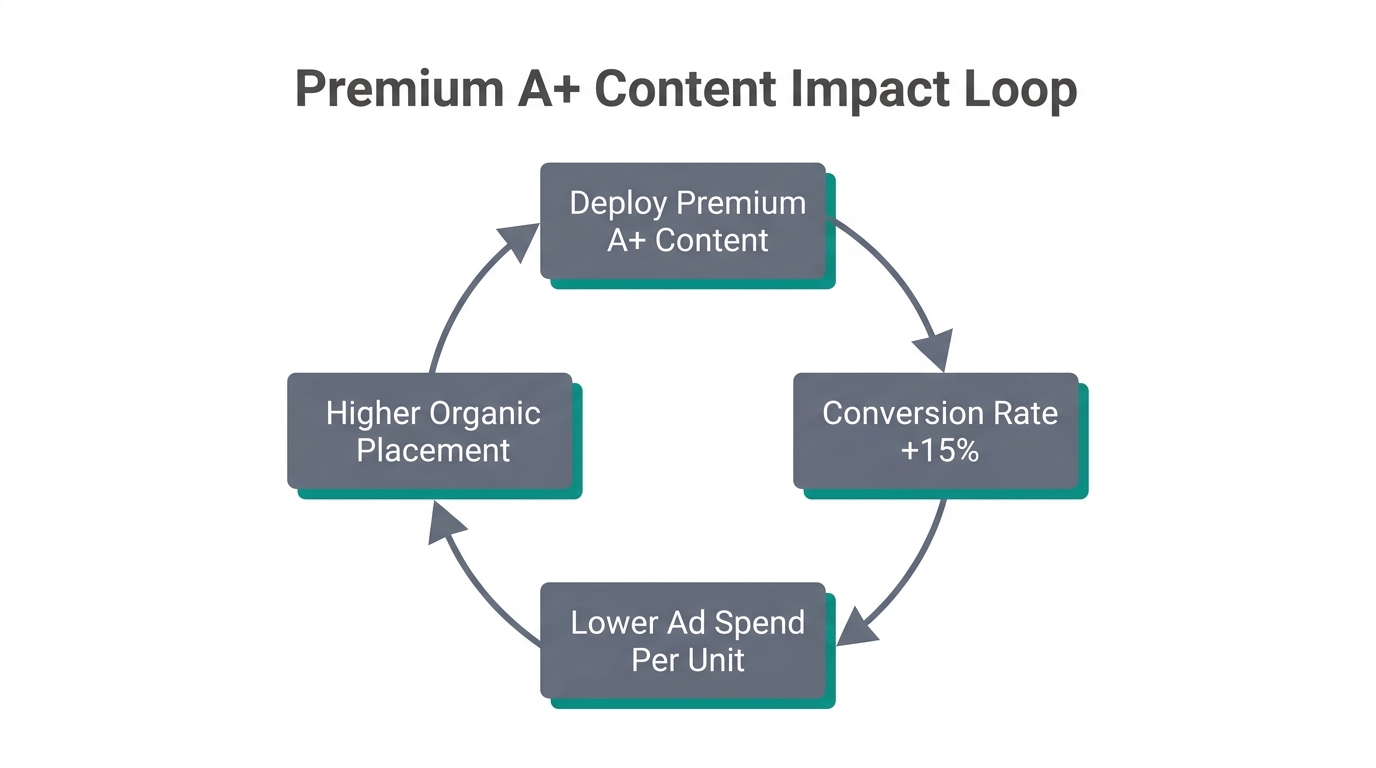
When Cost-Per-Click (CPC) rises, your only lever for maintaining margin is improving your Conversion Rate (CVR). This is why Premium A+ Content has become the standard for the "Million-Dollar Club." Brands like Sony have used these interactive modules and full-width imagery to educate customers on complex features, resulting in significantly higher CVR than standard listings.
By increasing your conversion rate from 10% to 12%, you effectively lower your cost per acquisition, allowing you to bid more aggressively for top-of-search placements. Furthermore, the 2026 algorithm now utilizes a "Relevance Loop" where high-converting listings are rewarded with even more organic visibility. To manage this at scale, you can ask Stormy AI to monitor listing health and flag suppressed variants or missing images that might be tanking your conversion velocity.
"The secret to 2026 isn't more traffic; it's better traffic. Premium A+ Content turns window shoppers into buyers before they even reach the review section."
Multi-Channel Diversification: Amazon vs. TikTok Shop vs. Walmart
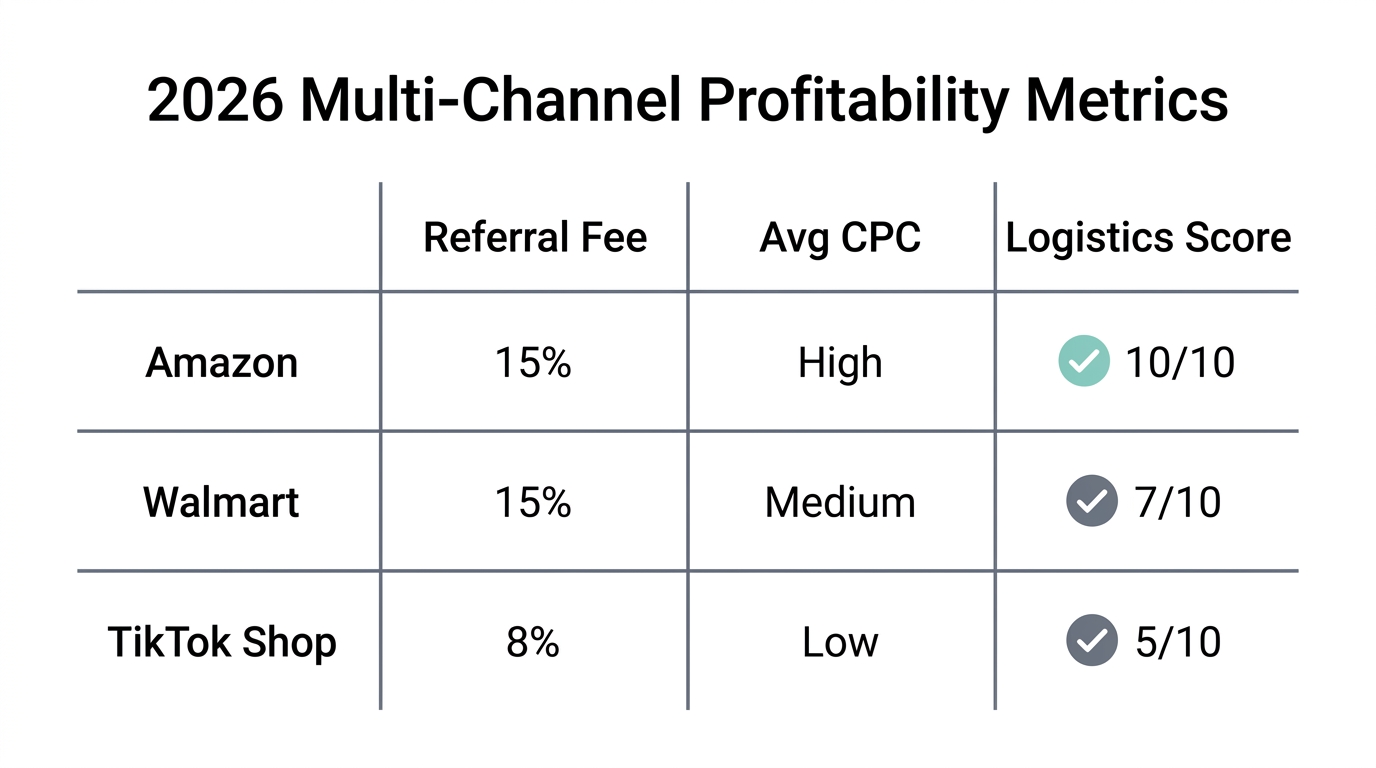
While Amazon remains the "Blue Chip" of ecommerce, 2026 is the year of diversification. Many brands are shifting volume to TikTok Shop, which offers a lower 6% commission compared to Amazon's 15%. However, there is a catch: return rates on TikTok are often 5–8% higher. Meanwhile, Walmart Marketplace remains a low-competition alternative with $0 monthly subscription fees, providing a much-needed margin buffer for commodity products.
Managing these different channels can become a logistics nightmare. Stormy AI acts as your central hub, connecting to Shopify, Amazon, and TikTok Shop simultaneously. It can track creator affiliate posts on TikTok while monitoring inventory levels on Amazon, ensuring you don't stock out on one platform while holding excess inventory on another. This multi-channel view is essential for protecting cash flow in a high-interest environment.
| Feature | Amazon Seller Central | TikTok Shop | Walmart Marketplace |
|---|---|---|---|
| Commission | 15% (Average) | 6% | 6% – 15% |
| Monthly Fee | $39.99 | $0 | $0 |
| Logistics | FBA (Best-in-class) | TikTok Fulfillment | WFS (Growing) |
| Saturation | High (9.7M accounts) | Moderate | Low (150K sellers) |
Managing Cash Flow and Preventing "Sameness Saturation"
The biggest threat to Amazon sellers in 2026 isn't just fees; it's "Product Homogenization." Because AI tools often suggest the same "winning" products to everyone, price becomes the only lever, leading to a race to the bottom. To survive, you must use AI forecasting to manage the "silent killer": inventory carrying costs. A seller doing $1M/year can still be insolvent if they have too much capital tied up in slow-moving stock.
Using a tool like InventoryLab alongside an agent like Stormy AI allows you to set row-level reminders for reorders and follow up with suppliers automatically when shipments are late. By maintaining a lean inventory cycle, you free up the cash flow necessary to invest in Brand Registry 2.0, which now requires physical proof of logos permanently affixed to products to prevent counterfeits and maintain premium pricing.
How-To: Optimize Your 2026 Seller Central Setup
If you are launching a new brand or refreshing an old one, follow this tactical playbook to maximize your 2026 incentives:
- Register for New Seller Incentives: Between March 1, 2026, and February 28, 2027, Amazon is offering 5%–10% back on your first $1,000,000 in branded sales. This can effectively offset the 3.5% fuel surcharge.
- Pass Video Verification: Prepare for a live video call where you may need to show 50+ units of inventory to prove brand authenticity.
- Leverage the "Canvas" Dashboard: Switch your UI to the new "Canvas" experience. Ask the AI: "What products in my category have high demand but low review counts?" to find niches that aren't yet saturated by AI-driven competitors.
- Automate Back-Office Ops: Deploy Stormy AI to handle your daily inventory pulse and ad audits. Let the AI agent do the spreadsheet work while you focus on brand strategy and product differentiation.
Conclusion: The Margin-First Mandate
Amazon Seller Central in 2026 is no longer a platform for the casual reseller. With FBA fees taking 35% and ads taking another 20%, the margin for error is razor-thin. Success requires a rigorous focus on unit economics, a proactive approach to multi-channel selling, and the integration of AI tools to manage the messy back office.
By understanding your Breakeven ROAS, investing in Premium A+ Content, and utilizing an AI teammate like Stormy AI to watch your spreadsheets and follow up with suppliers, you can turn the complexity of 2026 into a competitive advantage. The era of "passive" Amazon income is over—the era of the AI-powered ecommerce professional has begun.