In 2026, the barrier between "having an idea" and "having a customer" has effectively vanished. We are no longer in the era of three-month development cycles or six-figure seed rounds just to build a Minimum Viable Product (MVP). Today, a solo founder can transition from a blank cursor to a production-ready application with a fully automated marketing engine in exactly two weeks. This is the era of agentic workflows, where autonomous AI agents own entire outcomes rather than just assisting with tasks.
The global AI market has surged to $390.91 billion in early 2026, according to recent data from Gartner. For SaaS founders, this isn't just a trend—it's a fundamental shift in unit economics. With AI-enabled SaaS growing at a staggering 38.28% CAGR, those who fail to automate their go-to-market (GTM) strategy are competing against machines that never sleep. This playbook outlines the exact 14-day sprint to launch your SaaS, utilizing NoimosAI marketing automation and Apollo.io outreach agents to secure your first 10 beta users before the month is out.
"The IDE of the future looks less like an editor and more like a control center for managing autonomous engineering agents. We're not just pairing with AI anymore; we're managing teams of them."
The 2026 SaaS Landscape: Speed is the Only Moat
The current market for software has split. On one side, you have legacy enterprise tools struggling with churn; on the other, you have high-margin, vertical AI Micro-SaaS models. Reports from BetterCloud indicate that 80% of companies have now deployed AI-enabled apps in their IT environments. In this high-velocity environment, your primary moat is no longer feature depth—it is brand authority and vertical data integration.
| Feature | Traditional SaaS (2020-2024) | AI-Only SaaS (2026) |
|---|---|---|
| Cost to MVP | $50,000 – $300,000 | $200 – $500 |
| Time to Launch | 6 – 12 months | 2 – 14 days |
| Team Size | 3 – 10 people | 1 person (Solopreneur) |
| Primary Moat | Feature Depth | Vertical Data & Brand Authority |
As the Precedence Research global software market data shows, SaaS is projected to hit $408 billion by the end of 2026. To capture this, your SaaS go-to-market strategy 2026 must focus on "Vibe Marketing"—the art of managing agents to handle the heavy lifting of customer acquisition while you focus on high-level strategy.
Days 1-3: Building the Scaffolding (Infrastructure)
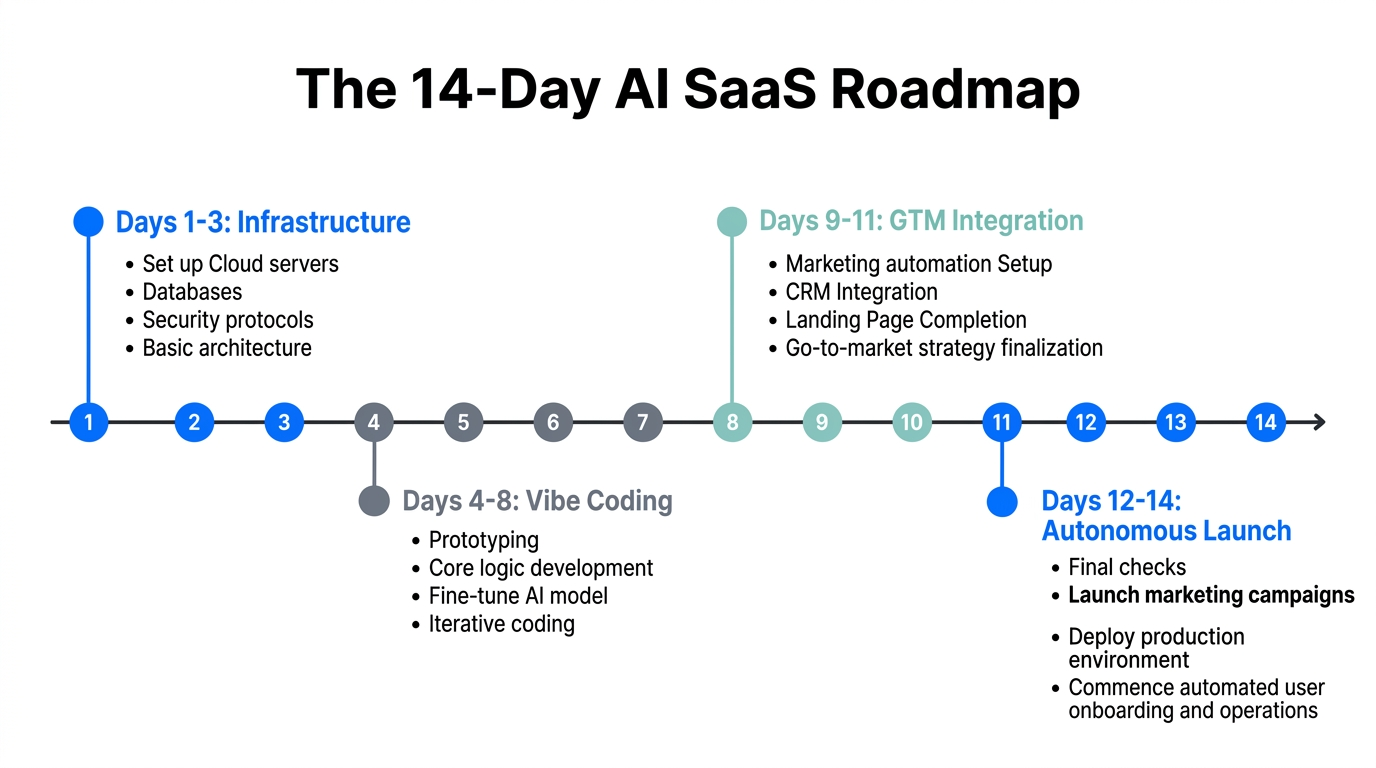
The first three days are about "plumbing." You don't want to spend time building authentication, multi-tenancy, or Stripe integrations from scratch. In 2026, founders use specialized starter kits to handle the boring parts. Tools like Makerkit or Agent Initializr allow you to deploy a production-ready shell in hours. According to case studies on Dev.to, automating the infrastructure phase allows you to spend 90% of your time on the actual agent behavior and user experience.
Days 4-8: Vibe Coding (Feature Build)
This is where the "Vibe Coding" revolution happens. Using platforms like Lovable, you can generate full-stack React MVPs in under five minutes. Lovable's success is legendary—reaching $100 million in ARR within 8 months of its launch by enabling non-technical users to ship production-grade code. If you are more technically inclined, a VS Code fork like Cursor or Windsurf (by Codeium) allows you to run up to 8 parallel agents simultaneously to refactor code and implement Stripe logic autonomously.
However, be wary of "Action Hallucinations." As noted on Reddit r/SaaS, some agents may report a successful deployment when the operation actually failed. The rule for 2026 is simple: Never accept code you haven't manually verified. Run your test suites after every AI-generated change to ensure you aren't building a house of cards.
Days 9-11: Integration & Agentic Ecosystems
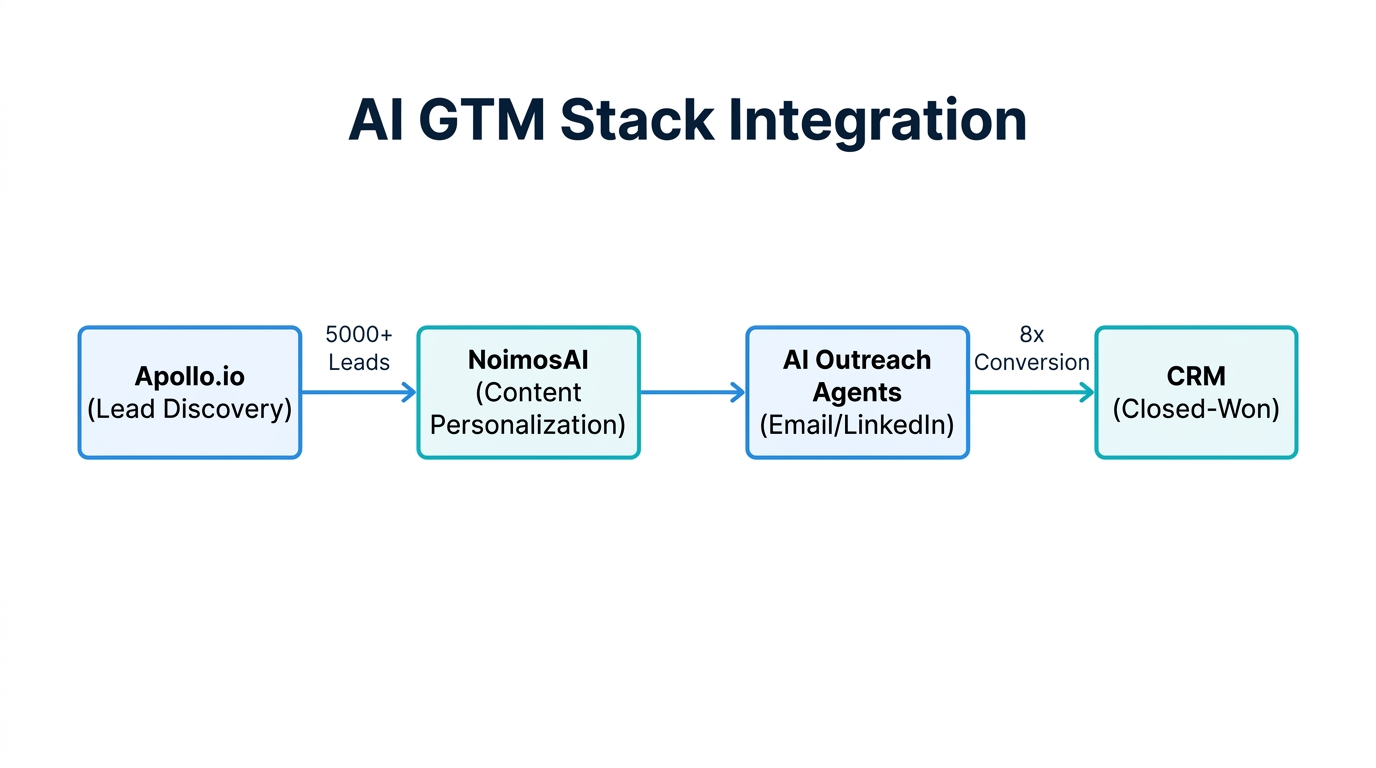
A SaaS in 2026 isn't just a website; it's a node in an ecosystem. By connecting your app to the Model Context Protocol (MCP), you allow your SaaS to "talk" to tools like Google Ads, HubSpot, or Slack. This connectivity is what separates "optional" software from "mandatory" automation. In a year where tools that only save a few clicks face a 15% monthly churn, your SaaS must automate actual decisions and workflows.
During this phase, ensure you are using Model Routing. According to research on Medium, running 80% of simple tasks on cheaper models like Llama 3 and reserving high-reasoning tasks for Claude 4 can reduce your token spend by up to 80%. This is critical for maintaining healthy operational margins.
Days 12-14: The Autonomous Launch with NoimosAI
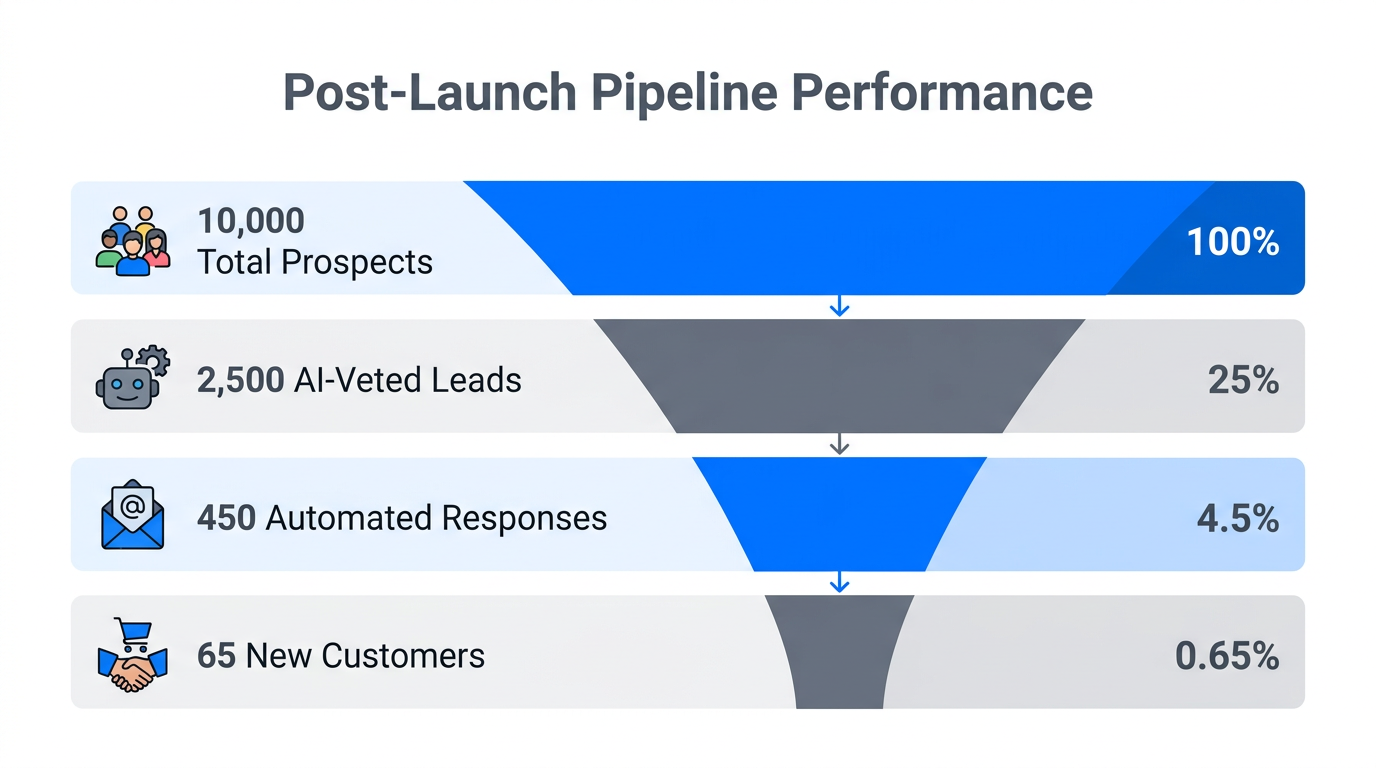
The final three days move from development to AI-driven customer acquisition. Traditional SEO is largely dead in 2026, replaced by GEO (Generative Engine Optimization). You no longer optimize for a Google search page; you optimize to be cited in the answers provided by Perplexity, ChatGPT, and Gemini.
This is where NoimosAI marketing automation becomes your secret weapon. NoimosAI acts as an all-in-one marketing team that handles your SEO, social media, and content 24/7. In minutes, it can generate a GEO-optimized landing page and a 30-day automated content calendar. As noted in the HubSpot 2026 State of Marketing, AI chatbots and GEO-driven funnels now achieve lead conversion rates exceeding 40%, obliterating the 2.35% industry average for static pages.
"Standard SEO is dead. In 2026, if your SaaS isn't being cited by an Answer Engine, you don't exist in the eyes of the consumer."
To supplement your organic GEO strategy, deploy Apollo.io outreach agents. These autonomous agents handle cold outreach at scale, identifying and messaging potential beta users while you sleep. By leveraging Apollo.io, founders are seeing a 25-40% lift in conversion rates through hyper-personalized, agent-driven sequences. For additional reach, particularly if your SaaS targets creators, platforms like Stormy AI allow you to instantly find and vet influencers who can amplify your launch to a targeted audience.
Measuring Success: The Rule of 40 in 2026
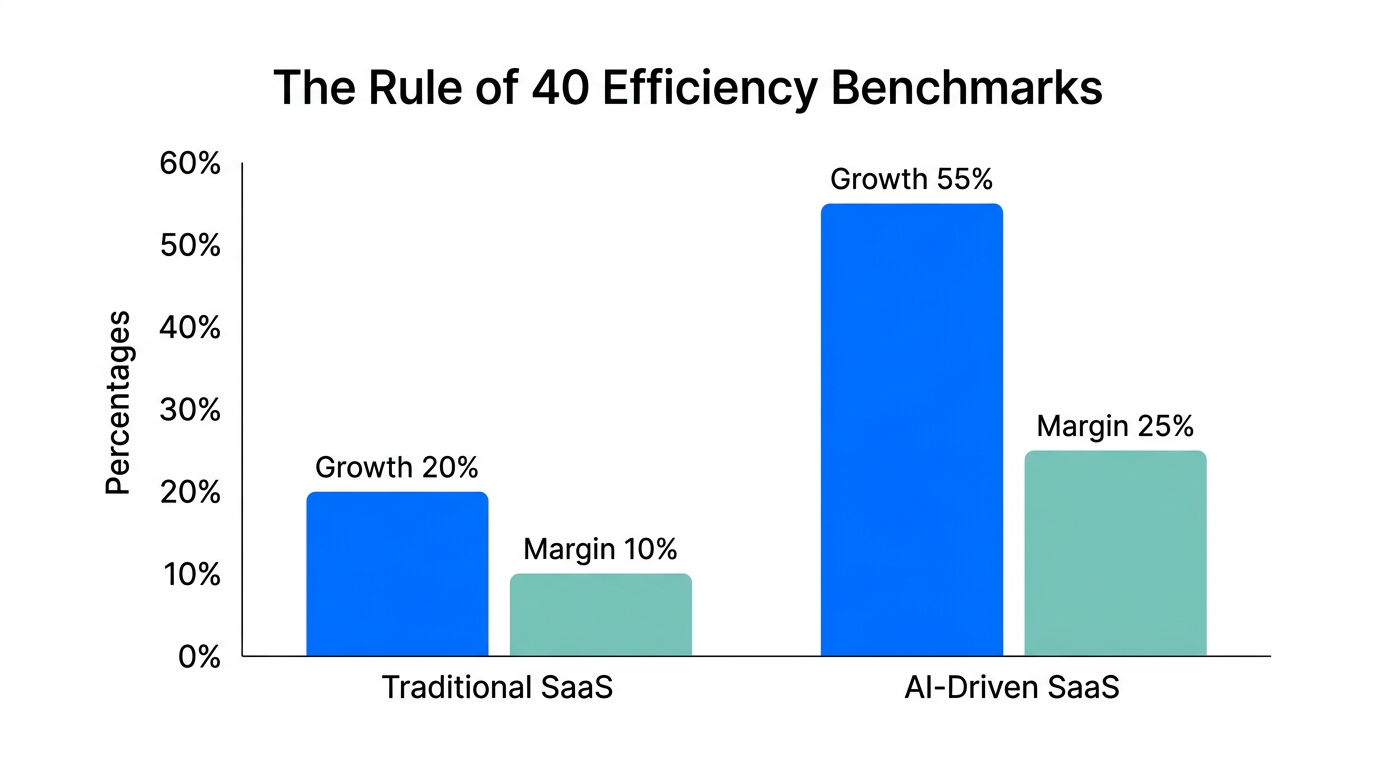
Investors in 2026 have moved past "growth at all costs." The new gold standard is the Rule of 40 (Growth Rate + Profit Margin ≥ 40%). While traditional SaaS companies boast gross margins of 80%, AI-native SaaS margins often hover around 52% due to high inference costs. To stay competitive, you must balance your rapid launch growth with strict control over your compute overhead.
According to research from PwC, organizations adopting agentic AI report an average 171% ROI. By managing a "team" of agents—from Averi.ai for B2B content engines to NoimosAI for SEO—you ensure that your 14-day SaaS launch guide results in a sustainable, revenue-generating asset.
Conclusion: The Era of the Solopreneur Empire
The 14-day sprint is no longer a pipe dream—it's the standard for modern SaaS development. By shifting from manual execution to managing autonomous agents, you can build, launch, and scale a business with zero manual code commits and a fully automated marketing funnel. Tools like NoimosAI and Apollo.io have democratized the GTM process, allowing anyone with a clear vision to compete with established giants.
As you move forward, remember the words of Dario Amodei, CEO of Anthropic: the gap between human and AI software will soon be indistinguishable. The only variable left is how quickly you can move. Start your 14-day clock today, and if you need to supercharge your discovery phase, don't forget to discover creators on Stormy AI to lead your market entry.