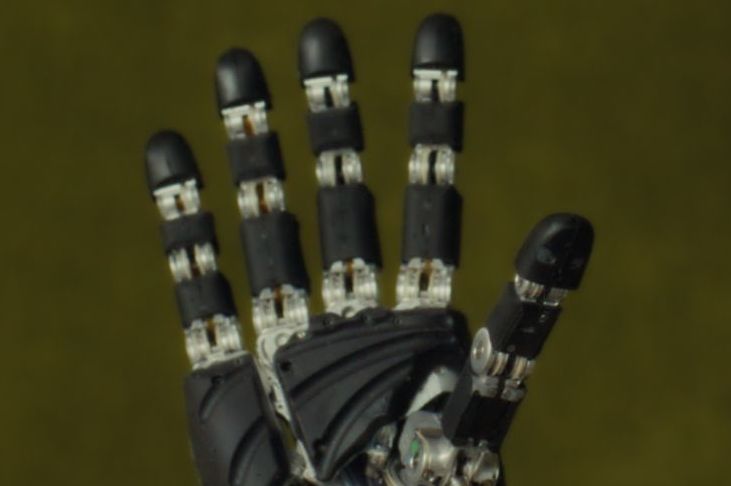
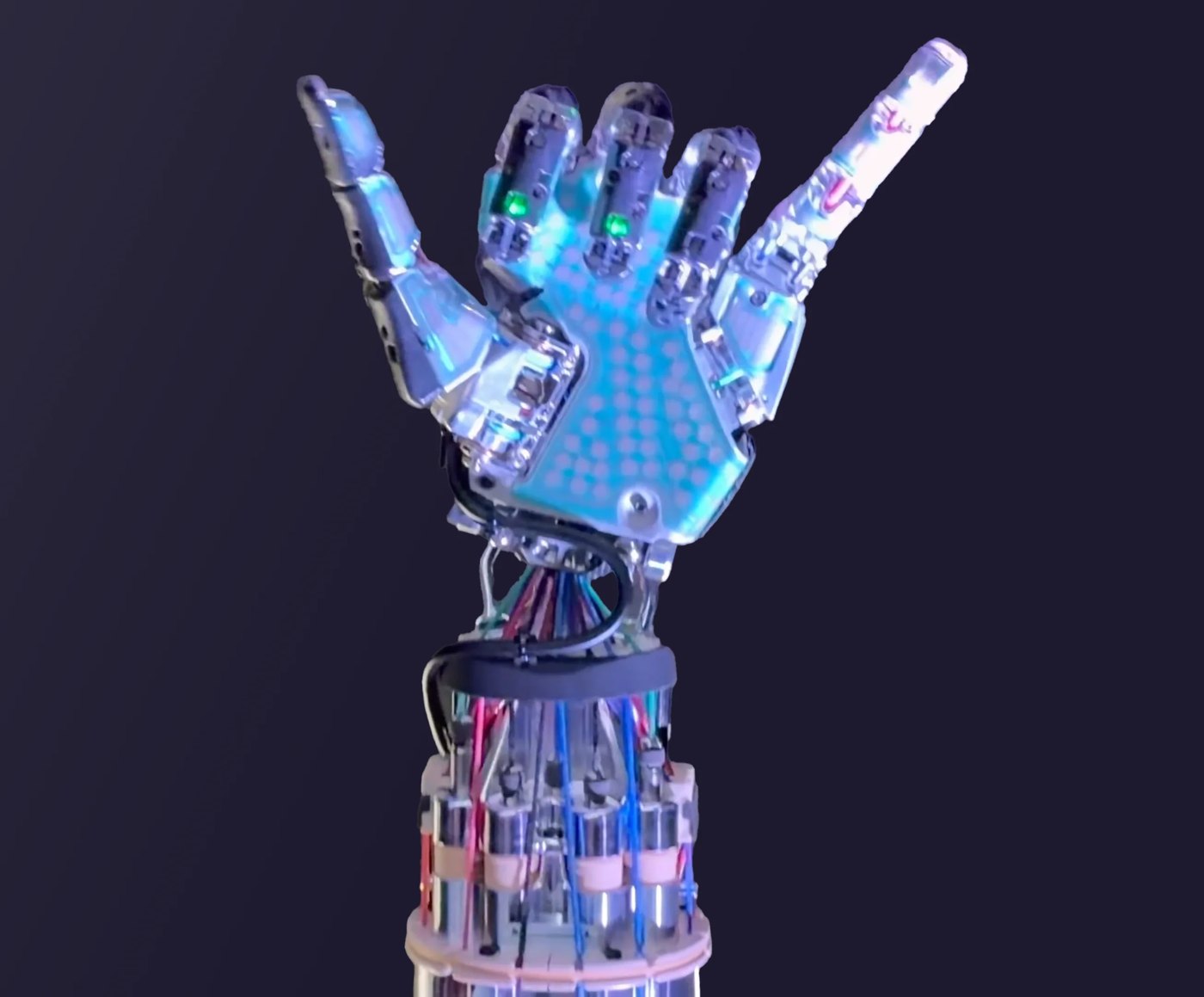
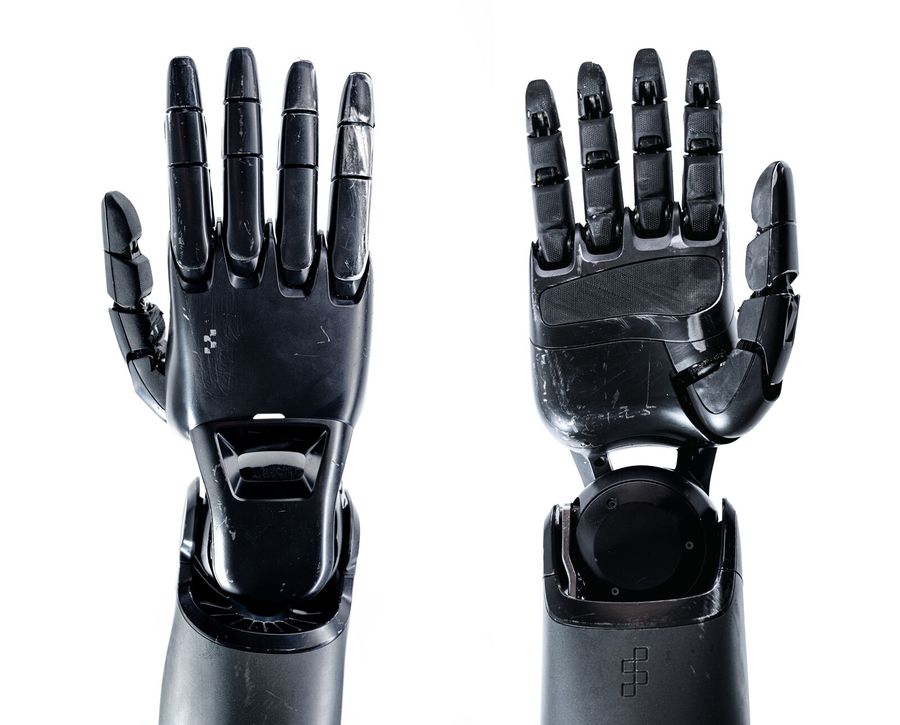
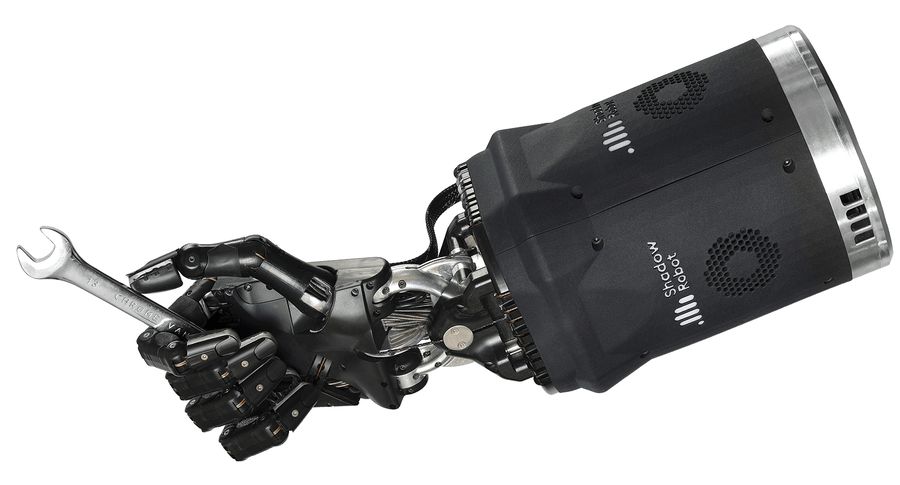
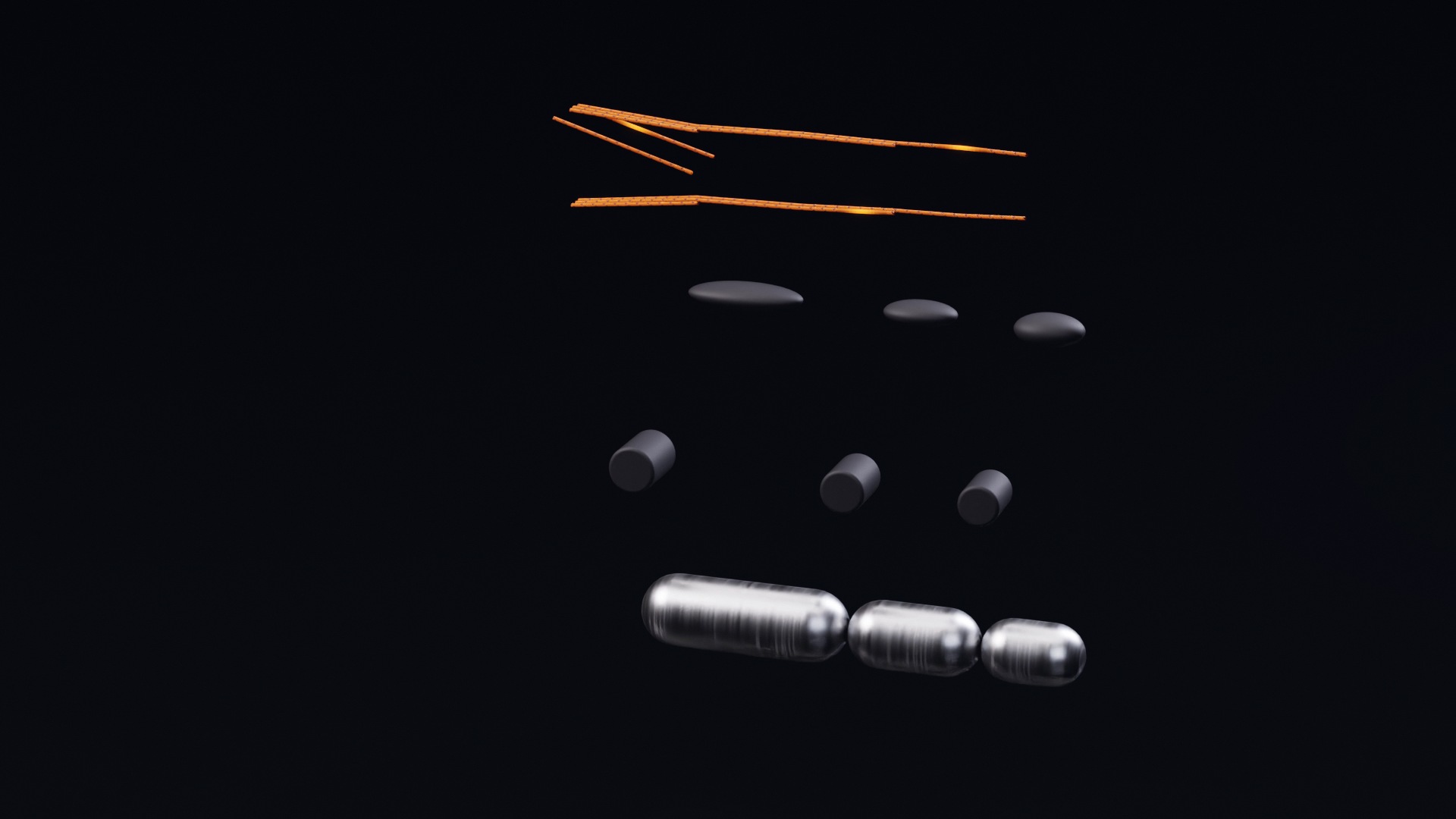
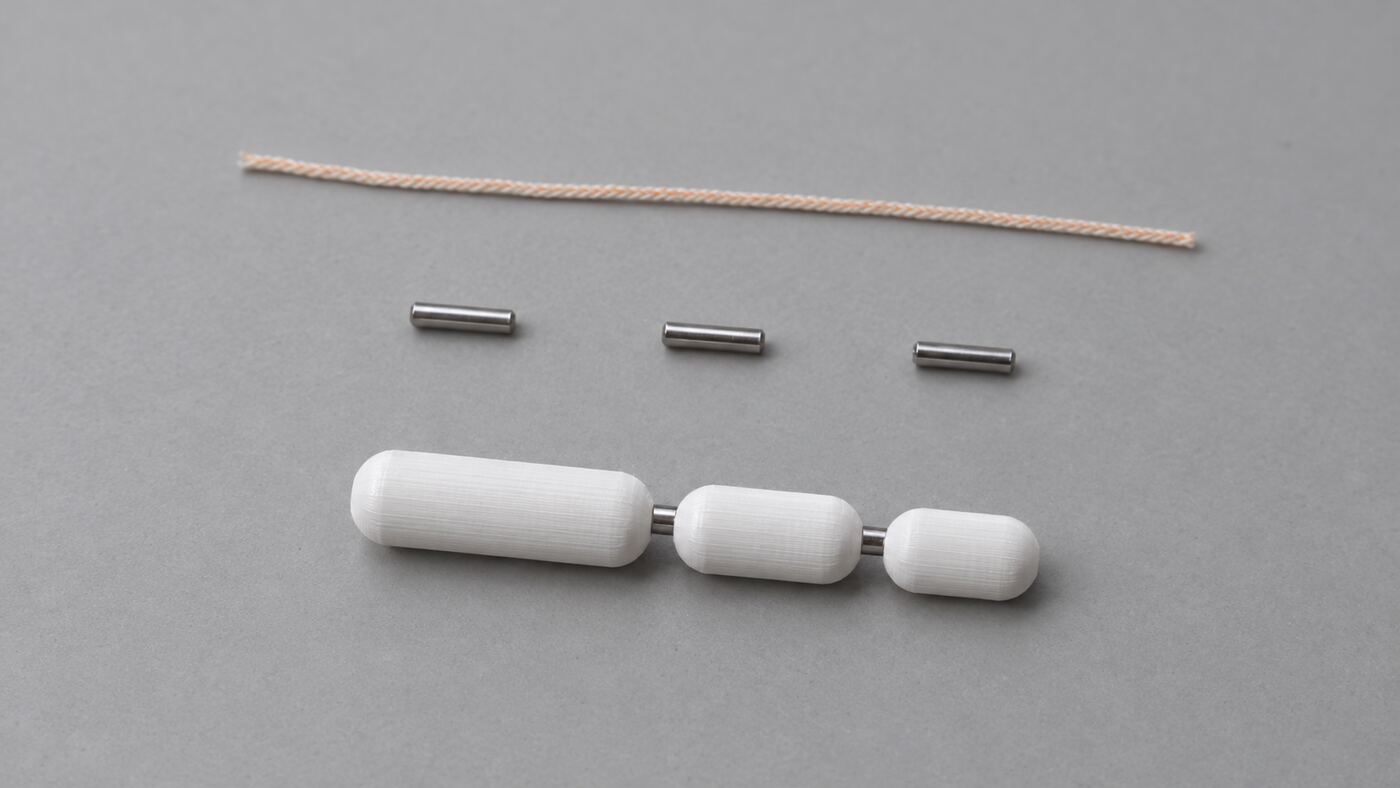
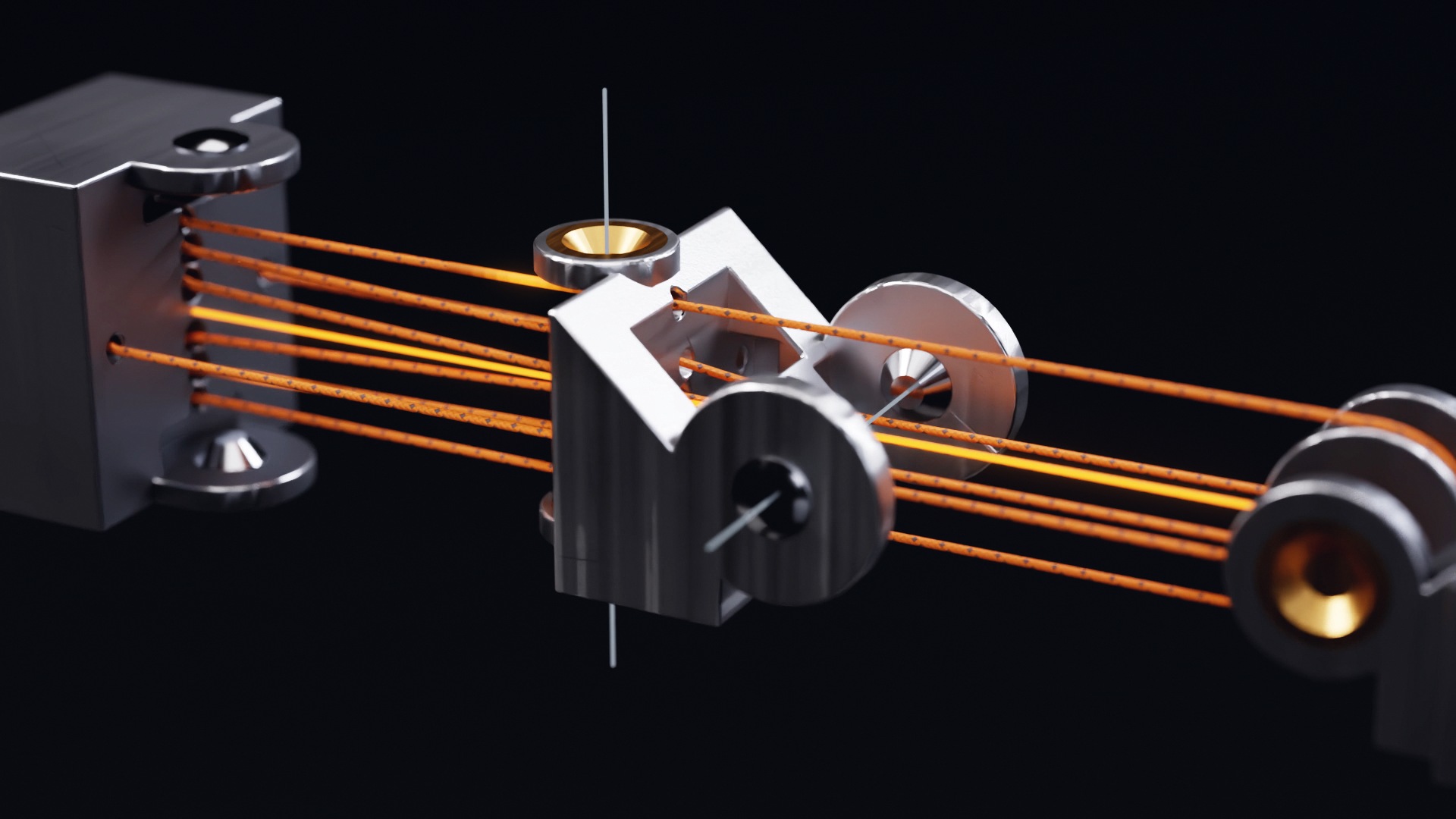
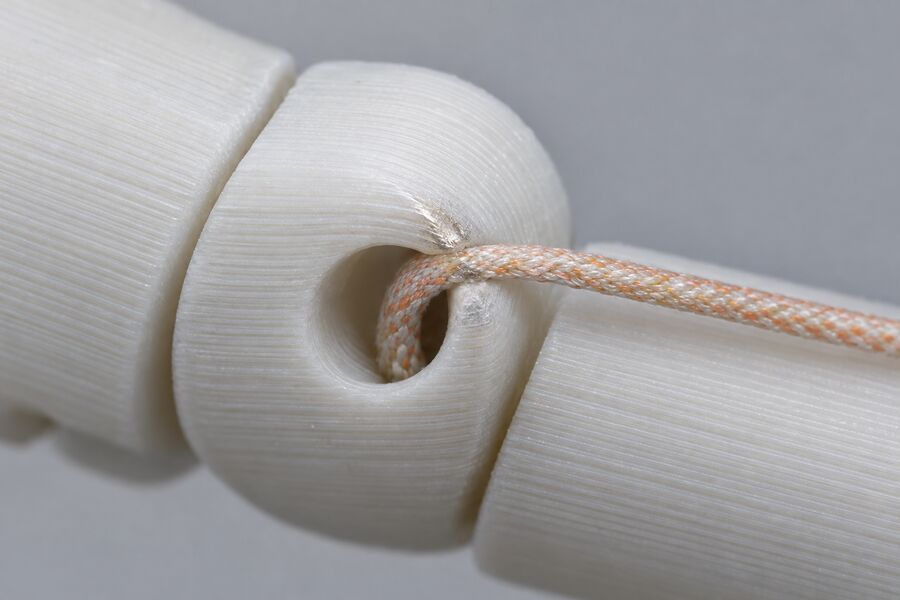
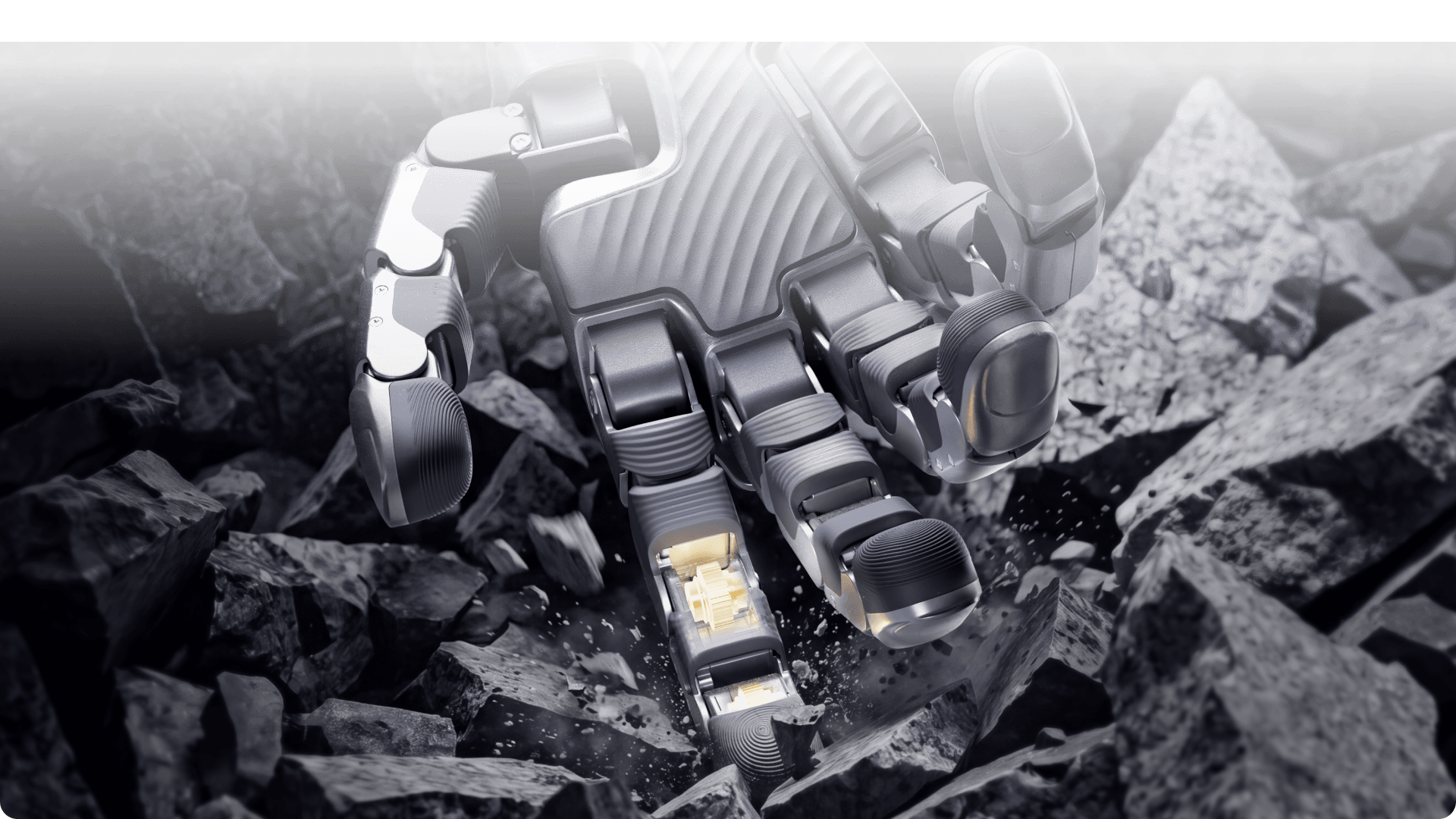
How a robot hand works, why it is so hard to build, and what it costs.
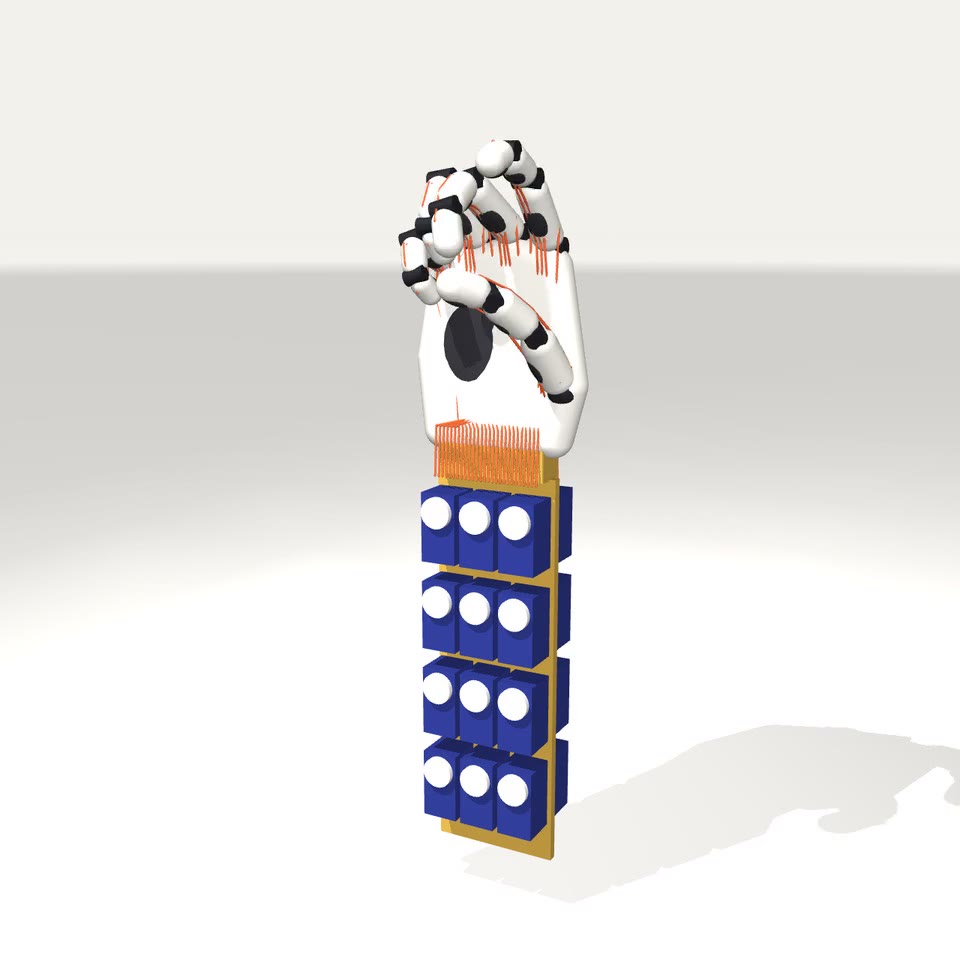
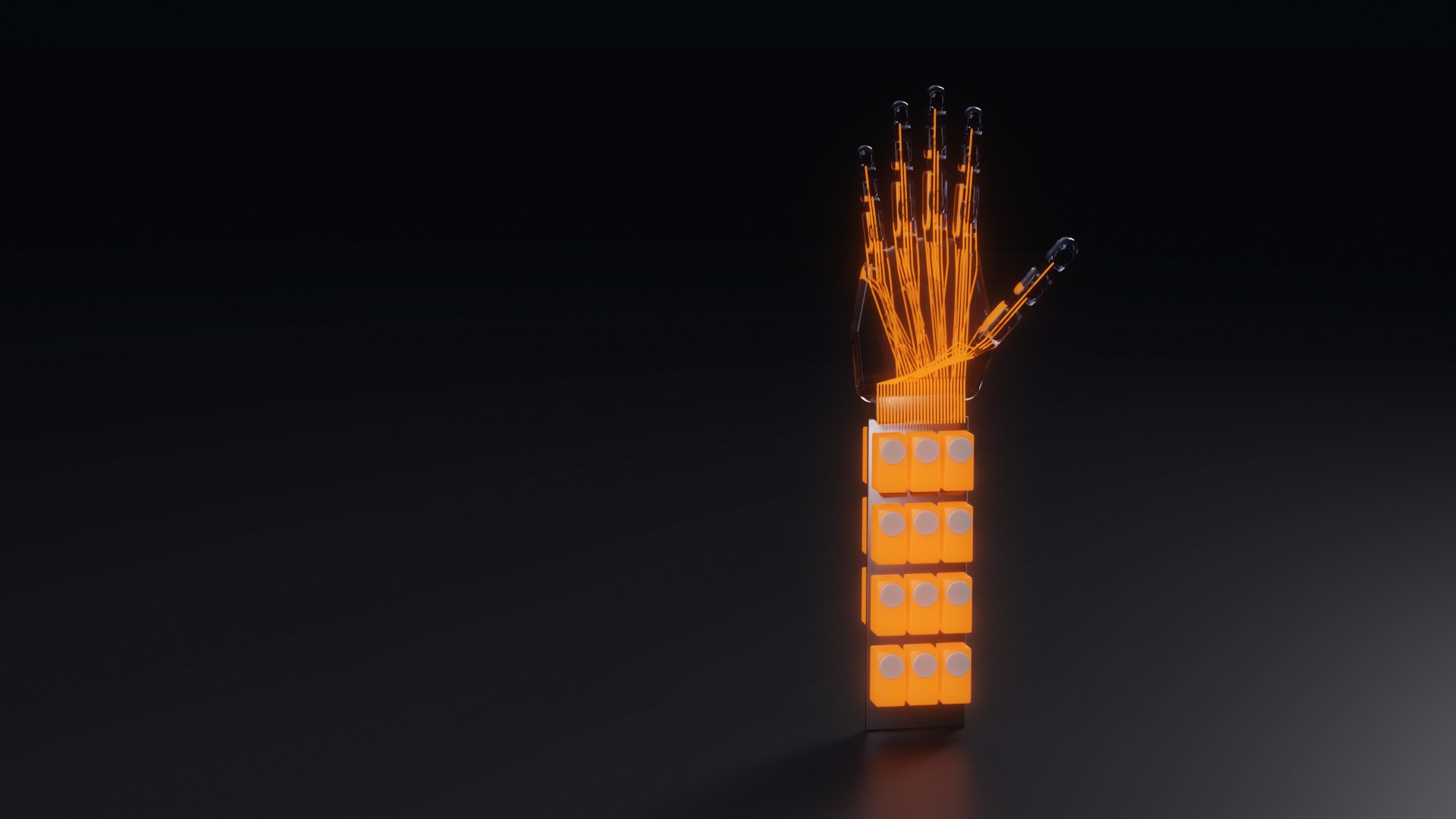
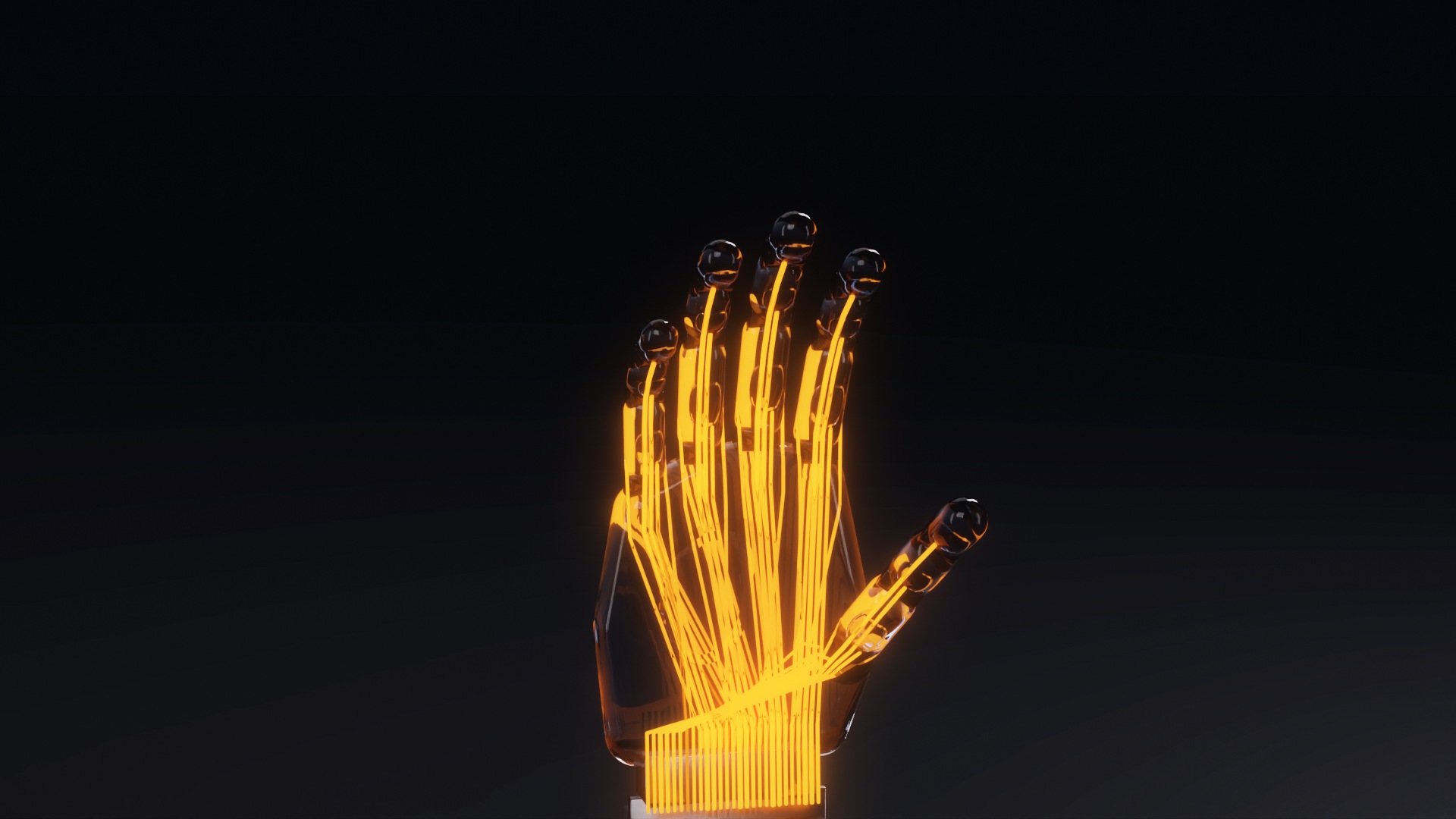
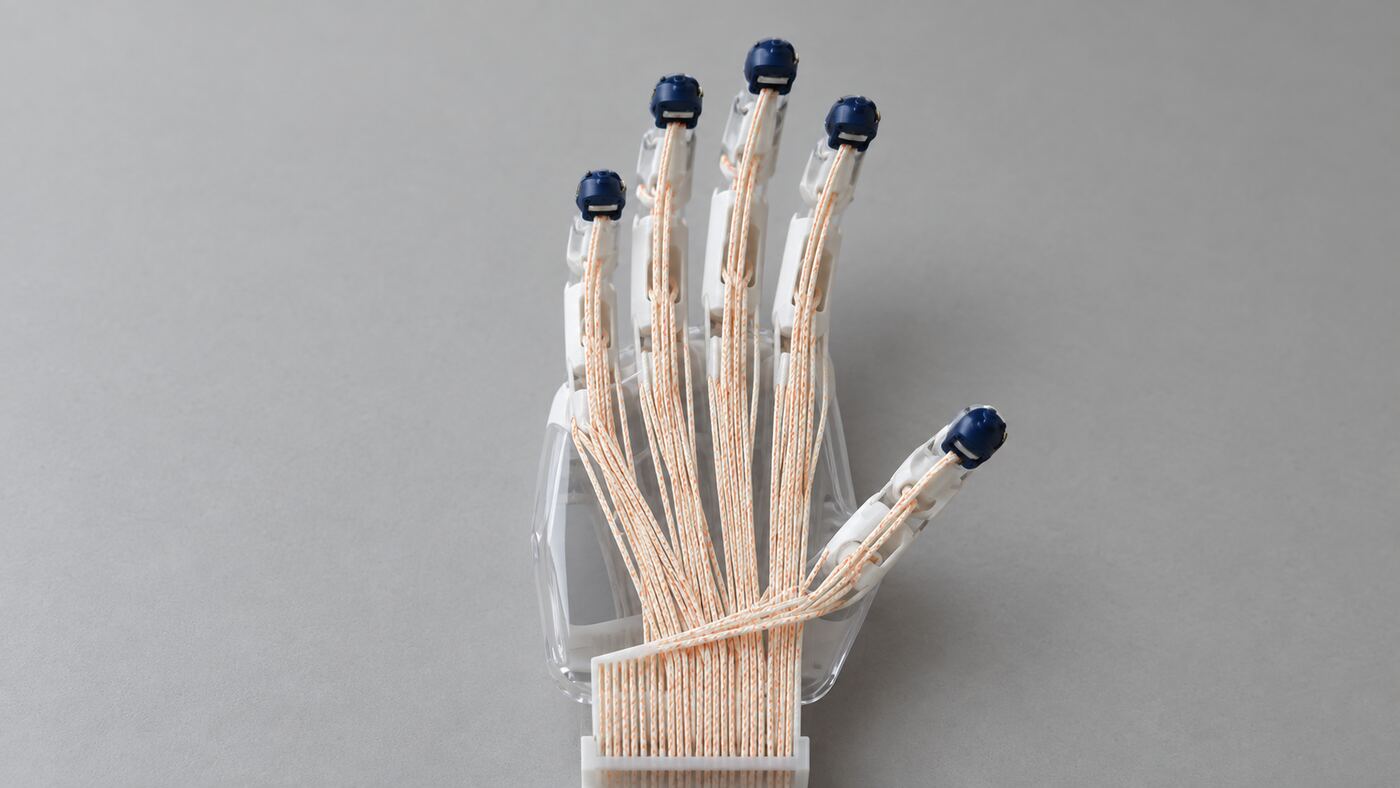
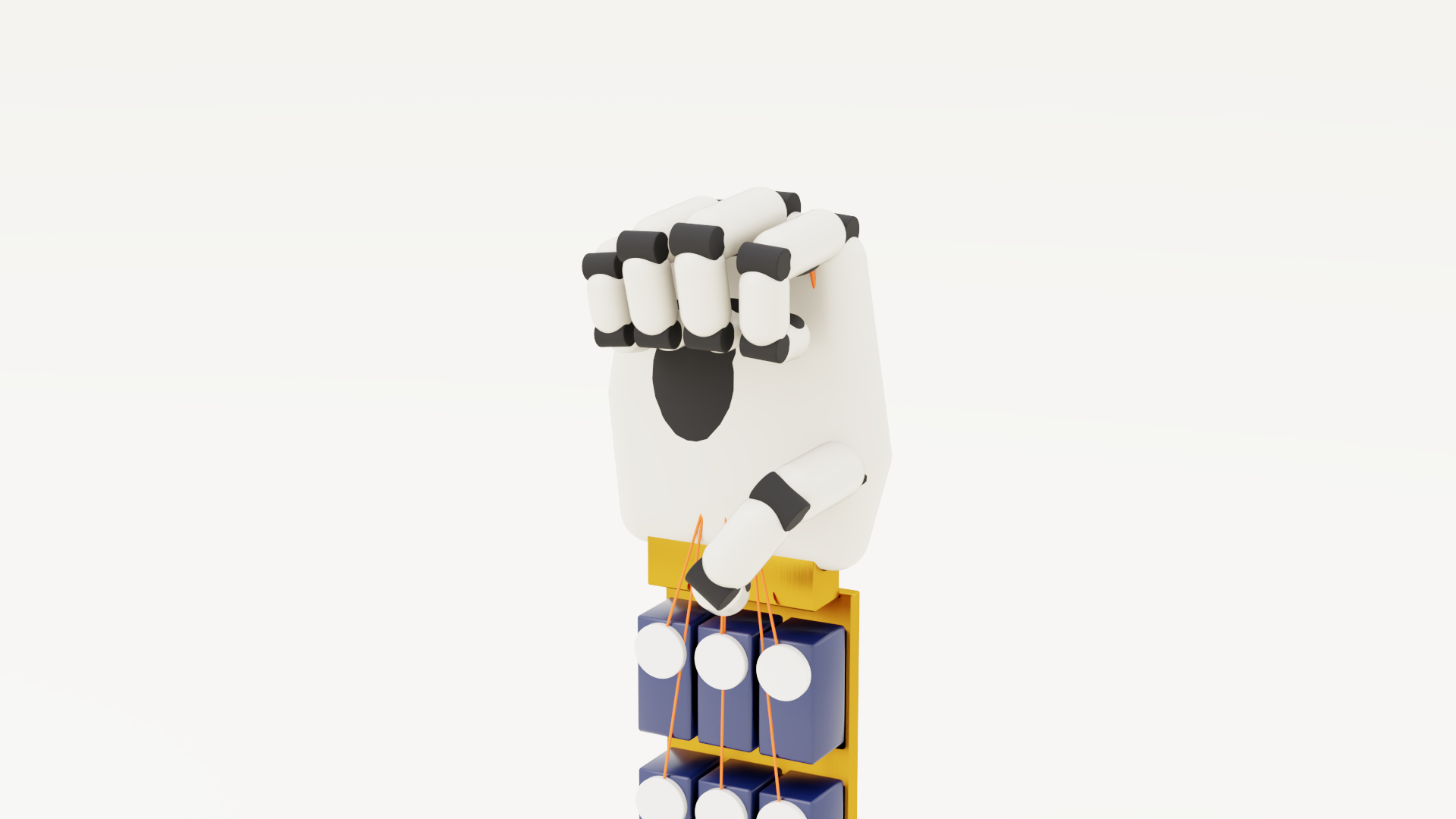
Render of a simulation
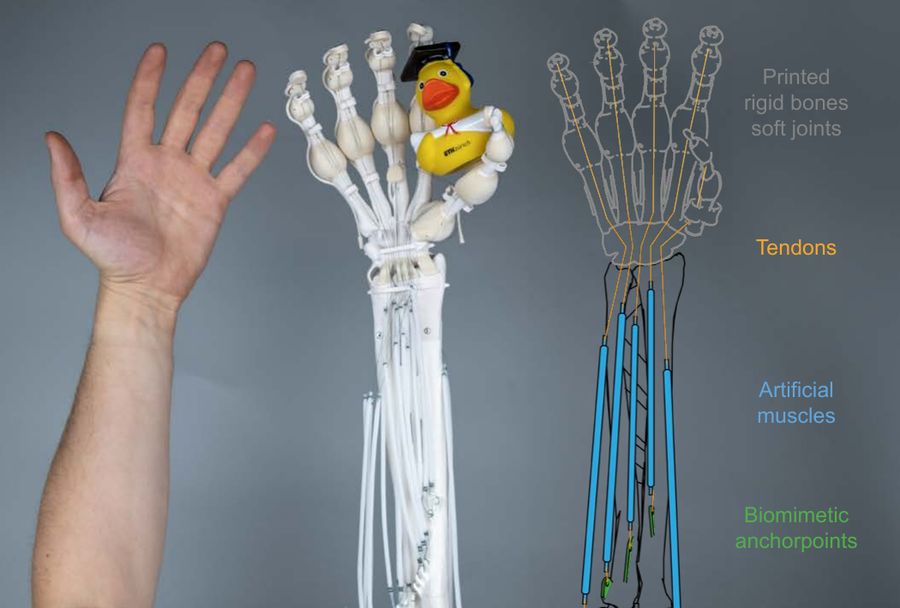
27 bones8 in the wrist, 5 in the palm, 14 in the fingers
About 21 moving finger jointsa joint is a hinge
Tendonscords that pull the fingers shut, in orange
our drawing
3,551humanoid robots sold by one maker, Unitree, from January to September 2025press, from its filing
72.8 %of them were sold with no five-finger hand at allour arithmetic on the filing
The shopping list
about twenty moving joints
something to move every one of them
a sense of touch
strong enough for a bag, gentle enough for an egg
survives being used all day
cheap enough to build many
All of it in something the size of your hand.
Each item fights another
more jointsless room
strongerbigger motors
cheaperfewer parts
our view
One of our three simulated handsRender of a simulation
27 bones8 in the wrist, 5 in the palm, 14 in the fingers
About 21 moving finger jointsa joint is a hinge
Tendonscords that pull the fingers shut, in orange
our drawing
The idea. Your hand is the best tool you will ever own, and it came without a manual. Watch it for a minute. It holds an egg without breaking it, turns a key, carries a heavy bag, and finds a coin in your pocket without looking. Strong, gentle, exact, and it feels what it touches. Inside are 27 bones paperan encyclopedia and about 21 moving finger joints. our inferencea common count A joint is just a hinge.
The hard part: one hand does all four
1. gentle
2. exact
3. strong
4. feels
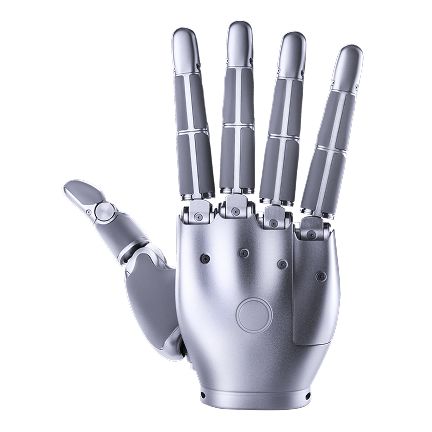
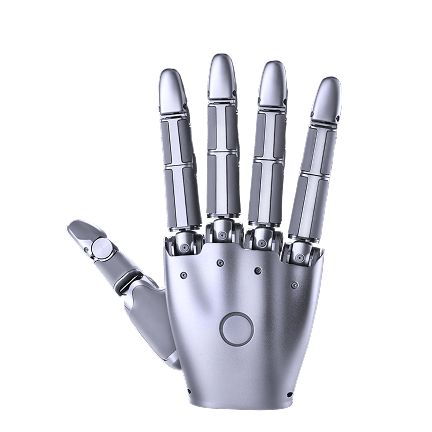
AI generated, for reference. Generic hands; not photographs of real people.
3,551humanoid robots sold by one maker, Unitree, from January to September 2025press, from its filing
72.8 %of them were sold with no five-finger hand at allour arithmetic on the filing
Why it matters. People are now building robots shaped like people, so they can work in places built for people. Everything in those places was made for a hand: handles, buttons, tools, zips. A robot that walks well but cannot hold things can do very little. Most of them cannot yet: of 3,551 humanoid robots one maker sold in nine months of 2025, about 2,585 were sold with no five-finger hand at all. pressfrom its filingour inferenceour arithmetic
The shopping list
about twenty moving joints
something to move every one of them
a sense of touch
strong enough for a bag, gentle enough for an egg
survives being used all day
cheap enough to build many
All of it in something the size of your hand.
The problem. A robot hand has to fit about twenty moving joints, whatever moves them, and a sense of touch into something the size of your hand. That is only the start of the shopping list. Make it strong enough for a bag and gentle enough for an egg. Make it survive being used all day. And make it cheap enough to build many.
Each item fights another
more jointsless room
strongerbigger motors
cheaperfewer parts
our view
The claim. Every item on that list fights another one. More joints need more things to move them, and there is less room. Stronger means bigger motors. Cheaper means fewer parts. our inferenceour view One robot maker goes further, and says the hand is harder than everything else in the robot put together.
EMElon Musk, on Tesla’s humanoid robotinterview at dwarkesh.com, 5 February 2026
“From an electromechanical standpoint, the hand is more difficult than everything else combined.”
Our takeNow you can see why someone would say it.
One of our three simulated handsRender of a simulation
The experiment. The plan: we build one finger and watch where it gets hard, then a whole hand, then we look at what real hands cost and how long they last. We are Stormy, a small team building robot workcells, and one warning before we start: everything we built is a computer simulation, and nothing here was measured on a real hand.
In every picture a tendon (a cord that pulls a finger) is orange, a joint is blue and a motor is green. The figures are live. Grab a slider.
Read the detailhow we worked, and what the five labels on the numbers mean
We use two kinds of evidence. The first is what other people have published: papers, patents, spec sheets, company filings, price lists and press reports. We collected 241 facts from them and labelled every one by where it came from. The second is our own: three hands that exist only in simulation. We have not built a physical hand, and we say so again wherever it matters.
Every number on this page wears one of five labels: maker’s claimpaperpresssimulationour inference
Maker’s claim
Reported by the maker: a company’s own page, spec sheet, patent or filing.
Paper
Reported in a paper or preprint; also a government survey or an encyclopedia.
Press
Reported by journalists, analysts and resellers.
Simulation
Measured by us in simulation, on our own models. Never hardware.
Our inference
Our arithmetic or judgement on the lines above.
Idea 01 / 6
A hand is hinges, and every hinge needs something to turn it
Your hand has 27 bones, and most of the muscles that close it sit in your forearm. paperan encyclopedia
Our drawing
Our drawing of the 27 bones of a human hand, and five of the tendons that run to muscles in the forearm.
For size, at one scale: a fingertip 14 mm wide, as on our simulated hand, beside a tendon 0.4 mm thick, the size one research hand uses. paper
Gallery · twenty robot hands and one human one
A dash means the number is not published. It never means zero. Tap a card for the full row and its source.
For scale 1
Drawing: ours, after the anatomy
Human hand
Muscles sit in the forearm and the hand. The 27 bones are 8 in the wrist, 5 in the palm and 14 in the fingers. Orange lines are five of the tendons that close the fingers.
The 27 bones are 8 in the wrist, 5 in the palm and 14 in the fingers. The count of about 21 moving finger joints is our inference from how one maker, Shadow, models the hand.
In the drawings green is a motor, orange a tendon and blue a joint; a dashed box with a question mark means the maker does not say where the motors sit. A drawing is our schematic, not the maker’s design.
Show the full tableTable 1 · Twenty robot hands and one human one
An empty cell means the number is not published. It never means zero. a Includes the forearm that holds the motors. b One US reseller’s listing press; the Dex5-1 price is without touch sensing. c ¥18,000, given as about $2,641 press. d A parts bill, not a price. The human count of about 21 moving finger joints is our inference from how one maker, Shadow, models the hand.
150 gbar held in a fist by our six-motor hand, and shakensimulation · one run
0 of 6pinches with six driven joints; 3 of 6 with 22simulation · weak thumb model
The problem. A hand is a set of hinges, and a hinge does nothing until something turns it. Pick up a cup: you just ran about 21 of them without a thought. our inferencea common count of the moving finger joints A robot has two ways to turn one: a small motor right at the hinge, or a motor further away pulling a string, like a puppet. The string is called a tendon.
The hard part: every hinge needs a mover, and a finger is thin
About 14 mm wide: little room for a motor simulationour model; our view
A hinge needs something to turn it
So the motors often move down here
AI generated, for reference. Not a photograph; nothing here was built.
The experiment. Six motors is the cheapest hand on sale, so we built one in a simulator and handed it a 150 g bar. It made a fist. We shook it. The bar stayed. simulationone run We were briefly very pleased with ourselves.
What happened. Then we asked it to pinch, the thing you do to pick up a coin, and it managed zero out of six. The thumb never reached another finger. With 22 driven joints the same model managed three. simulationweak thumb model Six motors make a fist. They do not pick up your change.
Read the detailyour own hand, the three numbers, table 1 in words, what our six-motor hand could not do
6 of 18hands built by others publish a fingertip force, and no two use the same testour count of table 1
96.19 %of Unitree’s spend on bought-in hands went to Inspire’s six-motor handpress, from the filing
0 of 6pinches with six driven joints in our model; 3 of 6 with 22our sim · weak thumb model
109 : 97of 120 on six tasks, a hand with 6 driven joints against one with 20paper · different hardware and policy
Before that can be tested we have to say what a hand is, because the “22” on a spec sheet can mean three different things.
Start with your own. The human hand has 27 bones: 8 in the wrist, 5 in the palm and 14 in the fingers paperhere an encyclopedia. The muscles that curl the fingers are mostly not in the hand. They sit in the forearm and pull on long tendons paperthe same. Make a fist and watch your forearm move.
A robot hand has three numbers, and they are rarely equal. Joints are the hinges. Driven joints are the hinges that can be moved independently of the others. Motors are what moves them. LEAP v2 has 16 joints moved by 8 motors paper. Inspire’s RH56 drives 12 joints with 6 actuators maker’s claim. One hand in Tesla’s patent application has 22 finger degrees of freedom driven by 17 actuators maker’s claim. When one motor moves several joints, something else decides how they share the motion. That is chapter 3.
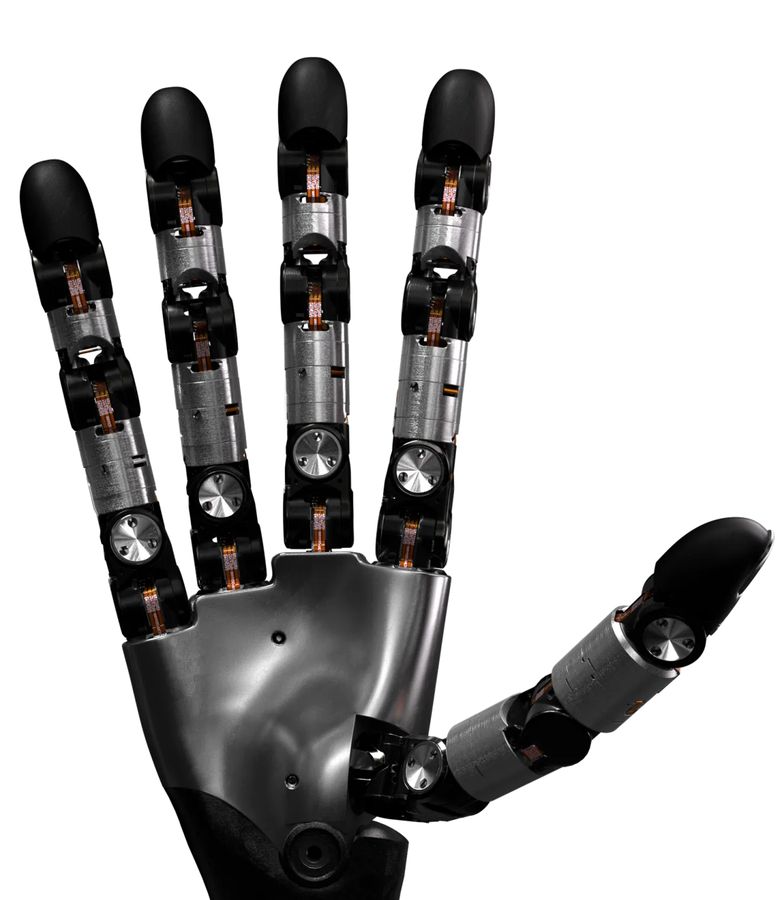
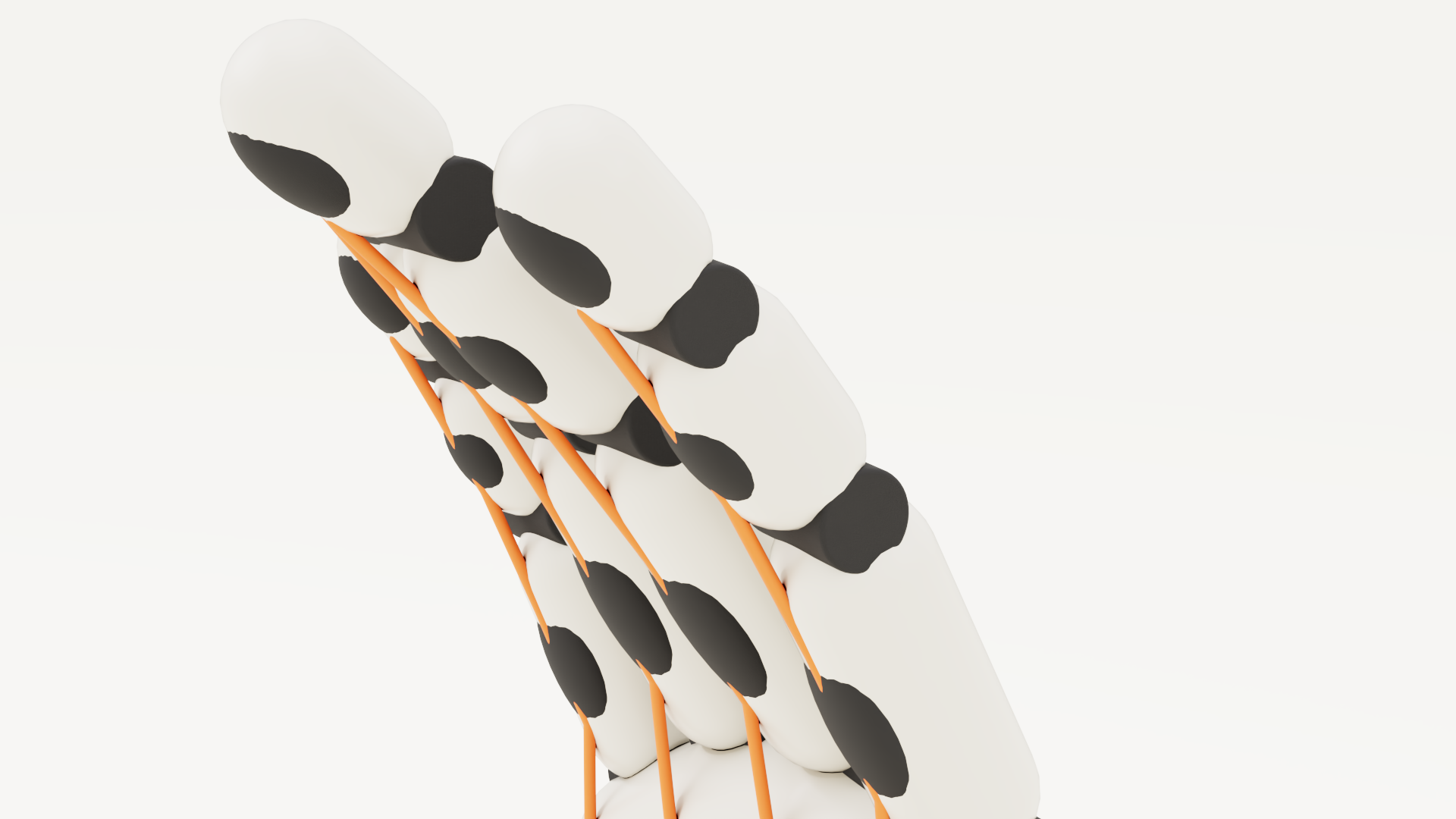
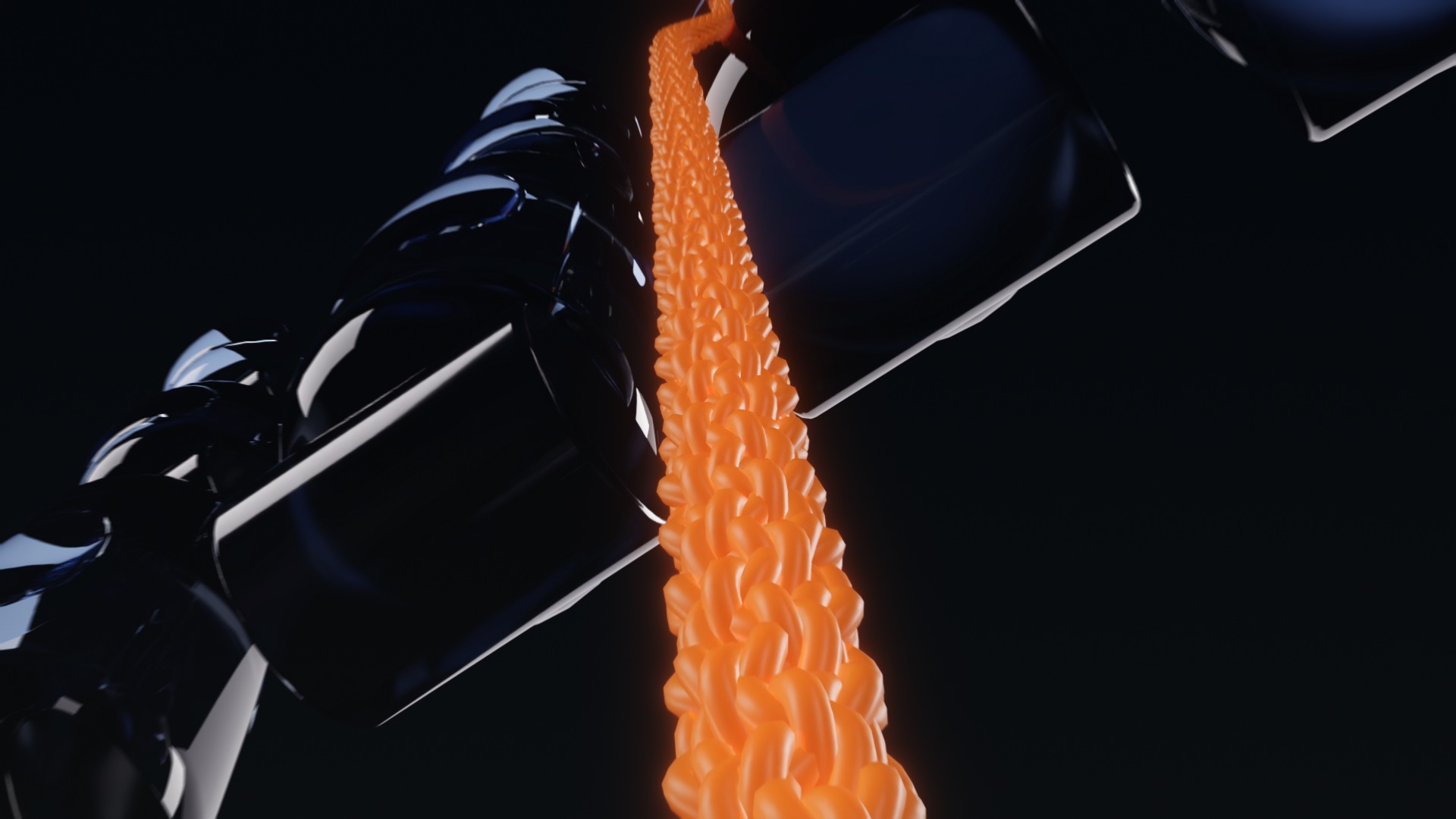
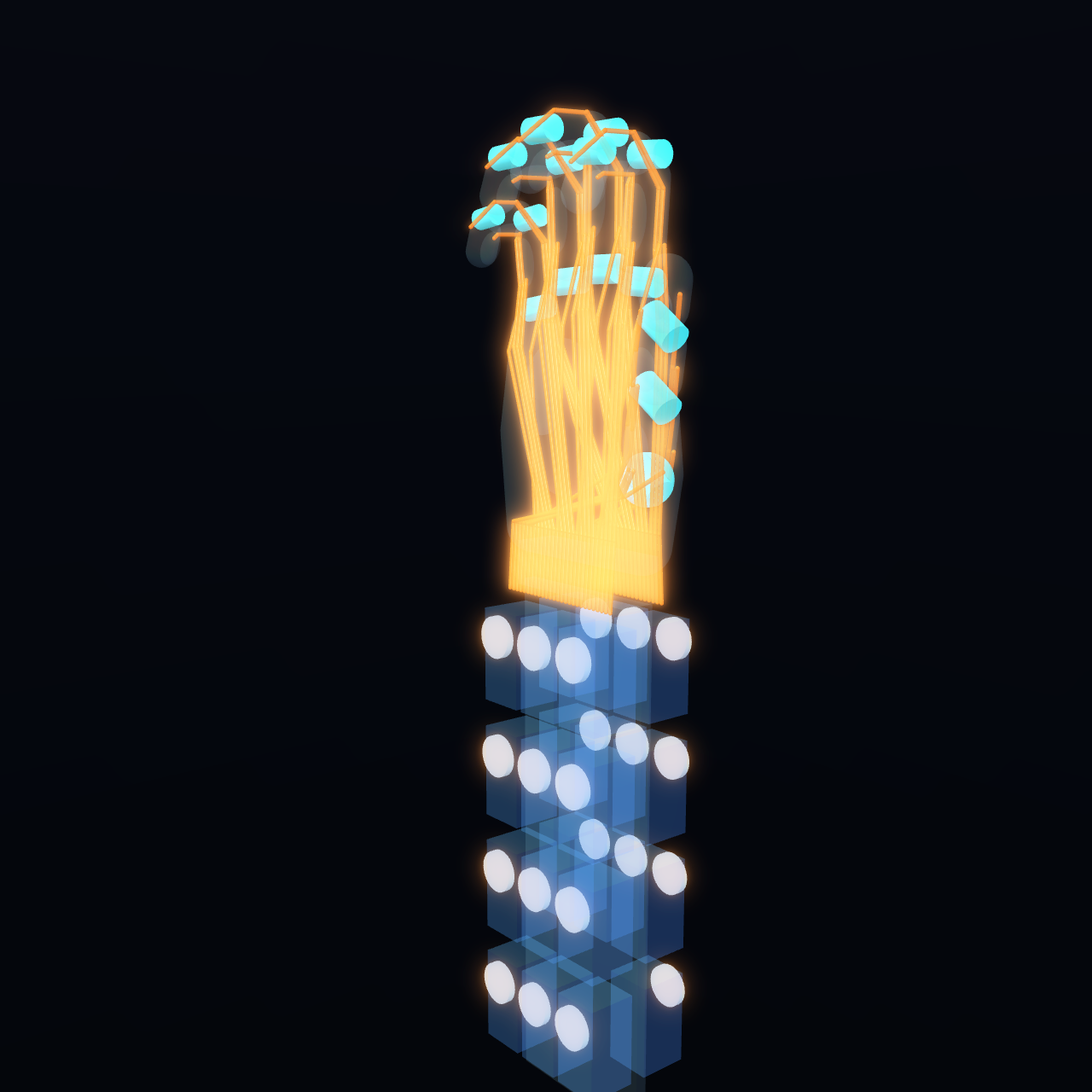
View B · fingers, close upRender of a simulationOur simulated six-servo hand. The dark bands are the joints; the orange lines are the tendons, drawn as straight tubes between the points that hold them.
Three things stand out. Most cells are empty. Of the eighteen hands that others built, six publish a fingertip force, and no two say they use the same test, so we would not rank them. Mass depends on where the motors are: Shadow’s 4.3 kg includes a forearm full of motors, and Wuji’s 580 g is the whole hand with its motors inside. And six motors are already the bottom of the market. Inspire’s hand is exactly that, and Inspire took 96.19 % of what Unitree spent on bought-in hands in the first nine months of 2025 pressfrom the filing. Six motors are enough to sell.
Are they enough to work? We built a six-servo hand in simulation, with 16 joints and 5 tendons. It closed into a fist and kept hold of a 150 g bar after we let go of the bar and shook it simulationchapter 12. Then we asked the model where its fingers could reach. With six driven joints the thumb touched 0 of 10 target points on the other fingers and made 0 of 6 pinches. With 22 it managed 1 and 3 simulationthe model’s thumb is weak, see chapter 6.
One paper pulls the other way. A hand with 6 driven joints scored 109 of 120 on six tasks against 97 of 120 for a hand with 20, though the two differed in hardware and in control policy paper.
One string can close a finger, in the order the finger chooses
Render of our design
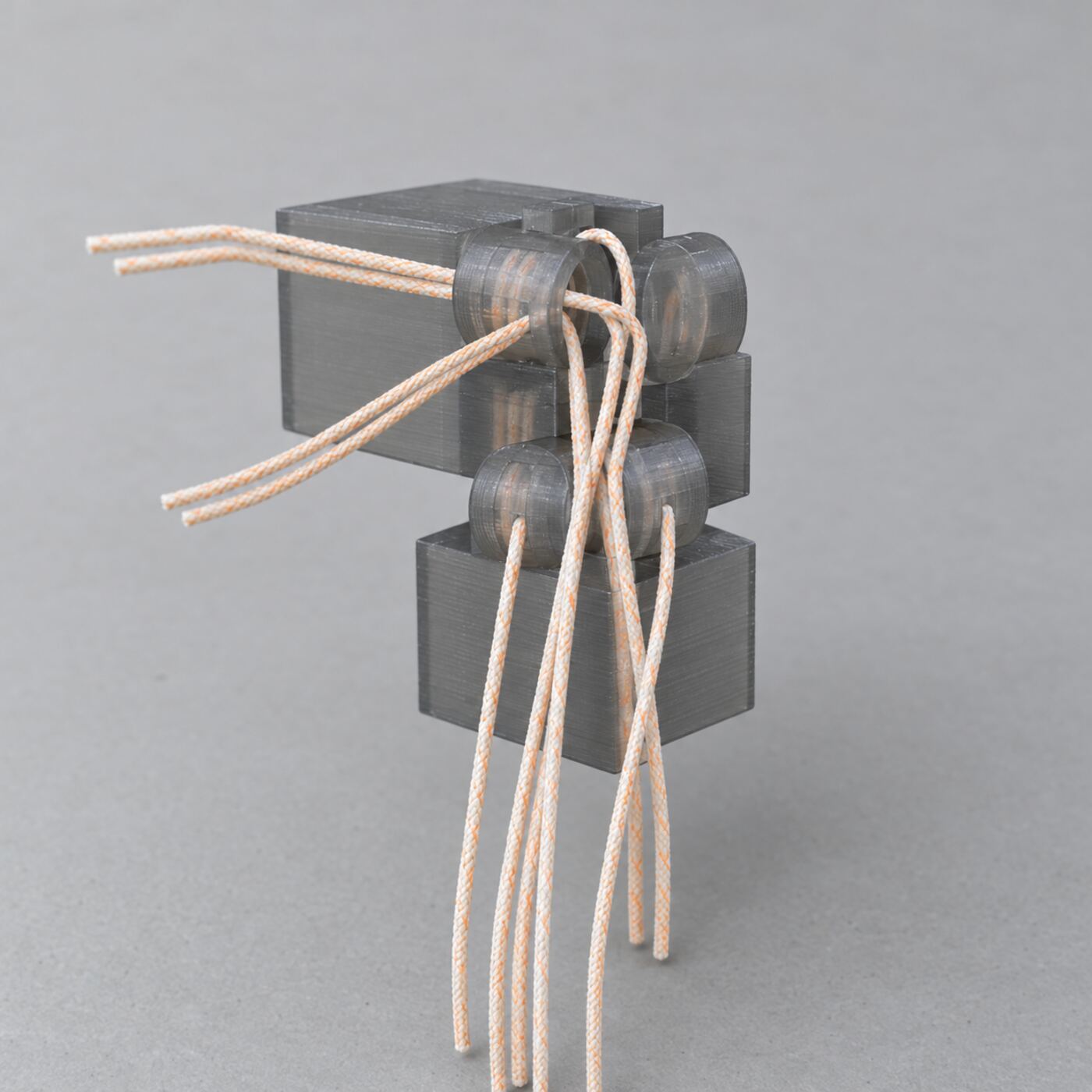
One cord can close a whole finger. In our simulations its shape and springs set the order, not the motor. simulationfive studies; no real finger
One tendon, three joints, one motor. The metal is a rendering choice: our design is a printed part, and nothing was built.
Experimentpull harder and see what happens
Fig. 1 · One finger, one tendonturn = arm × pull ÷ stiffness
Fig. 1Pull, swap the springs, pull again. Watch who moves first. simulation · a flat sketch
The problem. One motor can close a whole finger with one string, but the loosest hinge moves first, and nobody asked you. A motor for every hinge is a lot of motors, so many hands cheat this way, like the cord on a window blind: three hinges, one string.
The hard part: one cord, three hinges, and the order is not yours
One cord runs the whole finger
The loosest hinge moves first
You do not get to choose which
AI generated, for reference. Not a photograph; nothing here was built.
The experiment. We pulled one finger shut with the loosest hinge at the base, and it wrapped round the part and held it. The first bone swings out over the part and the fingertip closes underneath. So far, so smug.
What happened. Then we swapped the springs and pulled just as hard, and the part left. The fingertip curled first and the finger made a fist beside it. So we pulled harder. The part left sooner. In our simulations the order came from the finger’s shape and springs, and from nothing else. simulationfive studies
Read the detailmoment arms, the rule behind the order, about this figure
About Fig. 1A flat model made for this page. Joints turn in proportion to moment arm ÷ stiffness, as in our simulations, and stop where a bone meets the part. The moment arms are the human values above; the springs are ours, chosen to show the two orders. A filled balloon marks a joint the part has stopped.
A weak grip looks like a shortage of force. Fit a bigger motor, pull harder, hold tighter. To see where that goes wrong, take the simplest finger there is.
One tendon is fixed at the fingertip and runs down the palm side of three joints to one motor. Pull it and the finger curls. That is how six motors can run a hand: one for each finger, and one more to swing the thumb across.
But the tendon pulls on all three joints at once. Which curls first? At each joint the tendon passes a small distance from the hinge, called the moment arm, and the pull times that distance turns the joint. In a human index finger the deep flexor tendon sits about 15.5 mm from the knuckle, 10.7 mm from the middle joint and 7.7 mm from the last one papersix hands. Against it stands whatever resists: a spring, an elastic hinge, a tight skin.
In our simulations the rule was plain. Each joint turns by its moment arm times the pull, divided by its stiffness, so the closing order is set by moment arm over stiffness and by nothing else simulationin five separate studies. Pull harder and every joint turns further, in the same order.
Begin with the soft base. The first bone swings out over the part, the second folds down behind it and the fingertip closes underneath. Let go, and the part settles a millimetre or two into the cage.
Now press the other button, which swaps the springs. The tip curls first, and the finger rolls into a fist before it has gone anywhere. When the base does turn, the fist comes down on top of the part. Let go, and the part falls. Push the slider to the end: joint 1 is stopped, the finger is as closed as it will ever be, and the part still falls.
In this model the pull sets how far the joints go, and the springs and moment arms set the order. A stronger motor reaches the wrong shape sooner. The order is decided when the finger is drawn, long before anyone chooses a motor.
Base joint closes first
Part held. The finger wraps round it.
Fingertip closes first
Part falls. The finger makes a fist beside it.
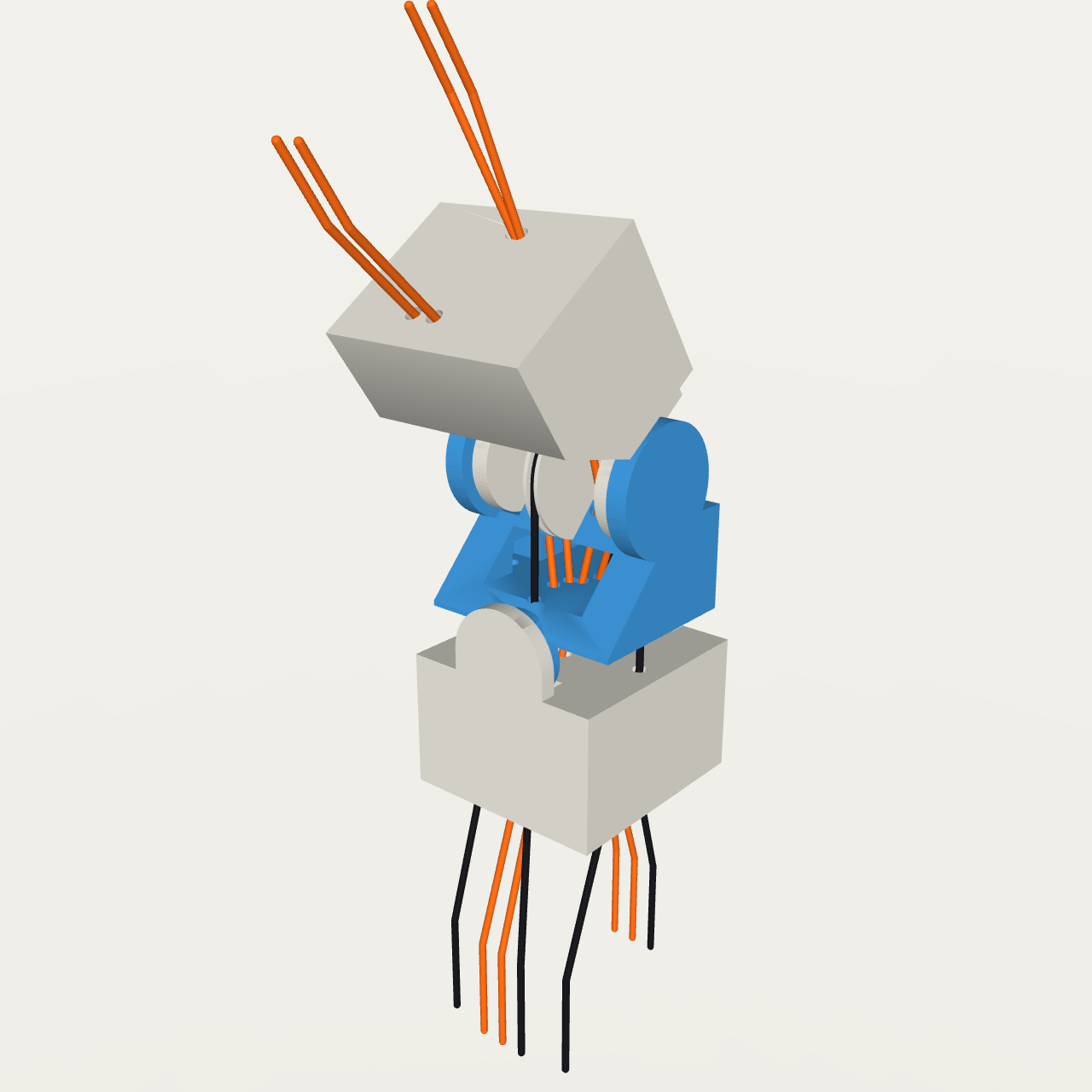
simulation · a flat sketch · the same full pull in both
Routing stopped the tendons tugging each other in our model. Friction stayed. simulationfriction assumed, not measured
Our simulated knuckle, curled 90°. Shown in metal for the render; our design is a printed part, and nothing was built.
The hard part: pull is lost wherever the cord rubs
40 N of pull goes in
The cord rubs on this edge
After three such bends, 9.7 N arrives our inferencea formula; friction of 0.3 assumed
AI generated, for reference. Not a photograph; nothing here was built.
A rope round a post
A lace through an eyelet
The same thing every time: a cord rubbing on what it bends round.
Experimentbend a cord round a corner and count what arrives
Fig. 5a · A cord round the edge of its guidewhat arrives = what goes in ÷ e^(friction × bend)
Fig. 5aBend the cord further, or make the wall rougher, and watch the rub zone glow. a formula · friction assumed
Off the hinge
18.87 mm of path change. The next joint turns 97° by itself.
On the hinge line
0.38 mm of path change. The next joint stays put.
our schematic · numbers from our simulation
The problem. To choose each hinge yourself you need a string for each hinge, and every string has to be led round corners to reach it. At each corner the cord rubs on the wall of its guide, and rubbing eats pull. You know this one already: it is why a rope wrapped round a post can hold a boat.
The experiment. We bent one cord round the edge of its guide and counted what came out the other side. A fist is three such bends in a row. At a friction value of 0.3, 40 newtons go in and under 10 arrive: 76 % is lost on the way. At 0.1, 38 %. our inferencea formula; friction assumed Most of that motor is pulling on plastic.
What happened. We tried to design our way out of the rubbing, and made it worse. Routing every cord exactly through the hinge line stopped them tugging each other: 18.87 mm of unwanted change in a cord’s path became 0.38 mm. simulationgeometry only But the tidy routing bends the cords more, and the most a cord loses to friction rose from 43 % to 59 %. simulationfriction assumed
eight cordshinge
The knuckle, with the cords led through the centre of its hinges. AI generated, for reference. Not a photograph; nothing here was built.
Read the detailthe knuckle figure, five designs in table 5, the capstan law, tendons against motors at the joint
Cross-talk sounds like the killer. One joint moves and eight tendons change length. Multiply by 22 joints and the hand seems to fight itself. So we took the worst place for it and studied that alone.
The worst place is the knuckle, where the finger joins the palm. It turns two ways, curling and swinging sideways, and every tendon bound for the two outer joints has to get through it. We modelled five designs with the same eight lines, over 441 poses simulationgeometry only, no forces.
In the naive design the passing lines cross the knuckle at a distance from its axes. Curl the knuckle and their path changes length by up to 18.87 mm. Hold the motors still and the outer joint turns 97° by itself.
Fig. 4 · A line passing the knucklemotors held still
Fig. 4The orange line belongs to the outer joint and only passes the knuckle. The dashed line is where the outer bone was told to be. The end values are from our simulation; between them the figure follows this flat sketch, so trust the ends more than the middle.
The cure is geometry. Route each passing line so that it crosses each axis exactly on the axis line. A point on an axis does not move when the joint turns, so the path keeps its length. In our model the change falls to 0.38 mm and the drift to 0°. The 0.38 mm that remains is equal slack in a flexor and in its extensor, so the outer joint stays where it is.
Five knuckle designs, the same eight lines our simulation · friction is a formula with an assumed coefficient of 0.3
Naive
18.87 mm length change43 % friction lossouter joint drifts 97°
One centre, bundle of four
3.17 mm length change45 % friction lossdrifts 10.4°
Rolling contact, two stages
0.00 mm length change63 % friction lossno drift
On the axis: row and stack
0.38 mm length change59 % friction lossno drift · 9.3 g at the knuckle
Two motors at the joint
0.00 mm length change0 % friction lossno drift · 23 g at the knuckle
Show the full tableTable 5 · Five knuckle designs, the same eight lines
Design
Length change, max mm
Outer joint drift
Friction loss, max
Friction loss, mean
Mass at the knuckle, g
Origin
Naive
18.87
97°
43 %
22 %
our sim
One centre, bundle of four
3.17
10.4°
45 %
22 %
our sim
Rolling contact, two stages
0.00
0°
63 %
42 %
our sim
On the axis: row and stack
0.38
0°
59 %
36 %
9.3
our sim
Two motors at the joint
0.00
0°
0 %
0 %
23 f
our sim
Friction loss is a formula, the capstan law below, with a friction coefficient of 0.3 that we assumed and did not measure. f Rests on a motor mass we have not re-checked and a housing we estimated.
So in this model cross-talk goes away when the part is drawn differently. The same table shows what does not go away. Look at the friction columns.
A tendon that bends round anything loses pull to friction, by a law much older than robots. The capstan law says that what comes out is what went in, divided by e to the power of friction times wrap angle. The size of the pulley does not appear in it. Only two things do: how far the tendon wraps, and how slippery the contact is.
Fig. 5 · The capstan lawout = in ÷ e^(μθ)
Fig. 5The tendon is drawn as wide as the tension in it. The pull going in is held at 40 N.
A fist is three such bends in a row, 270° in all for the line that runs to the fingertip.
Fig. 6 · A fist is three wraps3 × 90°
Fig. 6The same law applied three times, from 40 N at the palm.
At a friction coefficient of 0.3, which we assumed for a bare line on printed plastic, the fingertip line in a fist loses 76 % of its pull.At 0.1 it loses 38 % and at 0.05 it loses 21 %. That is a formula with assumed friction. We have not measured a line in a printed channel. For scale, the friction of a human finger tendon at the middle joint has been estimated at 0.075 ± 0.021paper51 hands, indirectly. Biology runs its tendons in a slippery sheath.
The cure for cross-talk also makes friction worse. To cross on the axis the lines must dive to it and come back, so the on-axis knuckle loses up to 59 % against 43 % for the naive one.
The other way out is to stop passing lines through the knuckle and put two small motors at the joint.
Fig. 7 · Tendons against motors at one knuckleour knuckle model
Fig. 7Torque is tension times the 5.5 mm moment arm of the on-axis knuckle, and fingertip force is torque over a 92 mm finger (our arithmetic on our model). The motor values are continuous ones.
The motors cost torque and weight. Two micro gearmotors give 0.078 N·m continuously, which is 0.85 N at the fingertip, and put about 23 g at the joint. The tendon knuckle gives 0.22 N·m at 40 N of tension, 2.8 times as much, with 9.3 g at the joint, because its motors sit in the forearm simulationwith our arithmetic.
That suggests a hybrid finger: tendons for the two knuckle axes, where torque matters most and the line has passed the fewest bends, and a small motor or a fixed linkage for the two outer joints, where every extra bend costs the most. It is an idea, not a result.
The motors go in the forearm or in the hand, and nobody has shown which is better
Render of a simulation
Figure, a US humanoid maker, built the tendon kind and dropped it. 1X, another, ships it. makers’ claims[2]
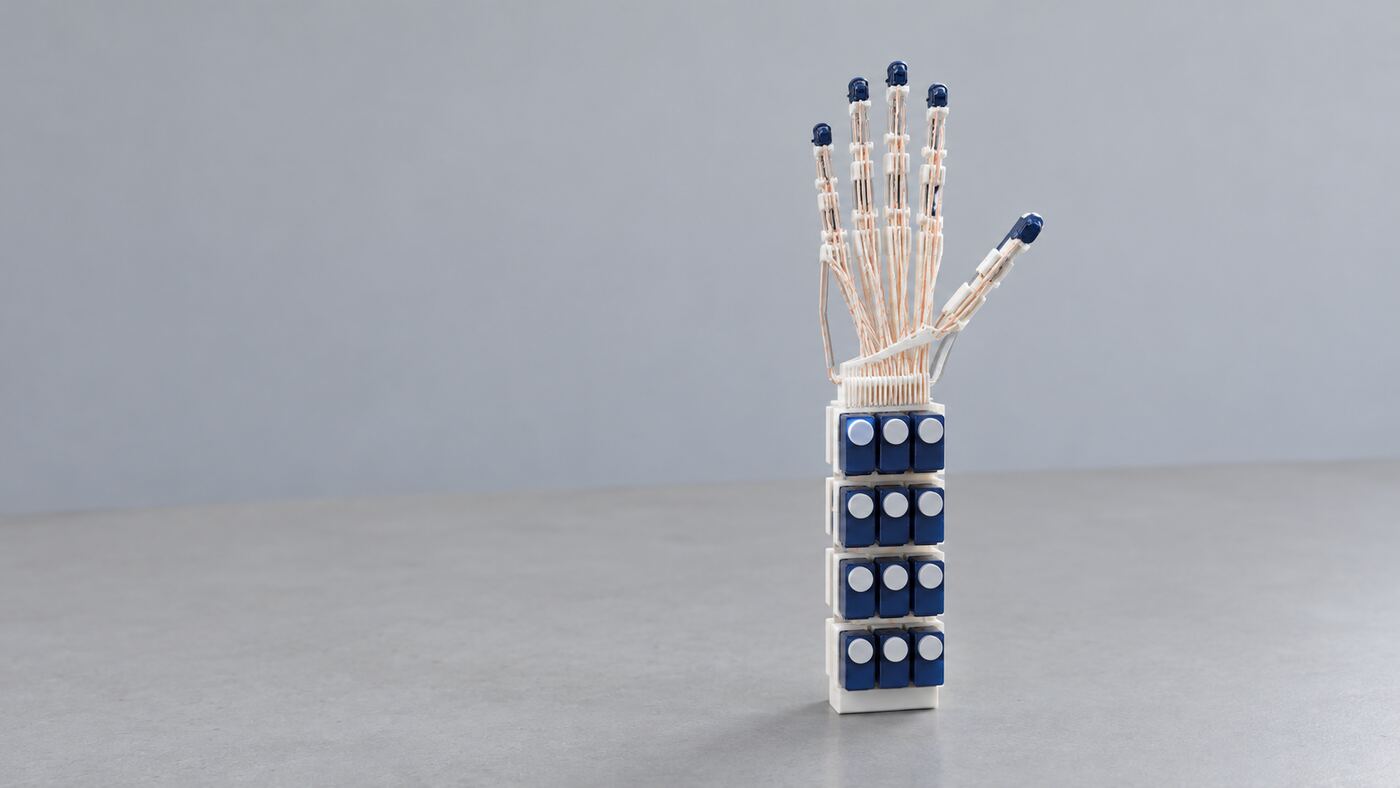
One of our simulated hands: every tendon runs to a motor in the forearm.
Motors in the forearm
Tendons run through the wrist, as in your own arm.
Motors in the hand
A small motor at each joint, and no tendons.
our schematic
Left tendonsBABrett Adcock@adcock_brett · runs Figure
one of the worst engineering decisions I've made, maybe the worst in four years […] Tendons are a complete local maximum, and that only becomes clear in hindsight, after exploring every other possible hand design.
Our takeA verdict, three years on. The cause is not given.
Ships tendons1X1Xfrom its page “NEO’s hands”
force transparency, so the world's reaction flows back through the transmission instead of dying in a gearbox
Our takeAn argument from feel. The tendon material is not given.
The test that would settle it
two hands, one of each kind
the same strength and the same weight
the same job
run until they break, with what failed written down
Not publishedWe looked. our finding
The problem. Something has to turn every hinge, and a hand has very little room. So where do the motors go? There are two addresses: the forearm, pulling the fingers with strings the way your own muscles do, or inside the hand, right at the joints.
The hard part: each address has its own bill
A generic layout, drawn by us. Not any maker’s hand.
Every cord must pass this wrist
This weight rides on the fingers
Left: AI generated, for reference. Not a photograph; nothing here was built.
The claim. The people who build hands disagree in public about where the motors go. Figure, a US humanoid maker, built the forearm kind, tested it in early 2023 and walked away. 1X, another, ships 22 tendon-driven joints and says why. makers’ claims[2] Read the two cards side by side.
The experiment. The test that would settle it is one we could not run and nobody has published. It is easy to describe: two hands, one of each kind, same strength, same weight, same job, run until they break. We did not find that test anywhere in public. our inferenceafter looking So the honest answer to “which is better?” is a shrug with footnotes.
Read the detailwhat each maker says and does not publish, table 3, what papers have measured
Left tendonsBABrett Adcock@adcock_brett · runs Figure
you get more space for packaging actuators since the forearm is larger, potentially higher degrees of freedom, and it's biologically inspired […] one of the worst engineering decisions I've made, maybe the worst in four years […] Tendons are a complete local maximum, and that only becomes clear in hindsight, after exploring every other possible hand design. […] so much better than anything you can do with tendons, it's not even funny
Ships tendons1X1Xfrom its page “NEO’s hands”
force transparency, so the world's reaction flows back through the transmission instead of dying in a gearbox
If the motor stays, where does it go? It has two possible homes. One is the forearm, pulling tendons through the wrist the way your own body does. The other is the hand, at or beside each joint.
Figure tried the first and left it. Adcock says he chose forearm tendons in 2022, for space, for more degrees of freedom and because the body does it that way. The hand was built and tested in early 2023. His judgement three years later, and what he says of the next hand, are the four excerpts on the card above maker’s claimone post.
What that does not contain is a cause. None of the three sources of his that we read names a measured failure, whether friction, wear or stretch, or gives numbers for the tendon hand against any other our inferencefrom reading them.
1X ships the opposite choice. NEO’s hand drives 22 finger and palm joints with tendons from forearm motors, at low gear ratios of about 5:1 to 15:1. Its argument is feel, in the words on the second card. It reports up to 45 N of distal flexion force maker’s claim. It does not publish the tendon material, whether each tendon runs in a sheath, or a test of the whole hand our inferencefrom reading its page.
Tesla’s patent application sides with the forearm: an actuator there tensions a tendon that runs through the palm to a finger bone maker’s claimpublished 16 April 2026, not granted. A second application rearranges the cables across the wrist to limit their moment arms maker’s claim, a cure for a disease we meet in chapter 7.
On the other side, Wuji uses no tendons at all: “self-locking rotary direct drive joints”, four to a finger maker’s claim. Unitree’s Dex5-S has 22 motors in the hand maker’s claim. Sharpa’s Wave has 22 “Proprietary Actuation Modules” and does not say where they sit maker’s claim.
Who puts the motors where
Forearm, tendonsIn the hand
Figure
Forearm tendons, tested in 2023, then dropped: “one of the worst engineering decisions I've made”.
The last column is our reading of each maker’s public pages, not something the maker states.
Papers do measure pieces of what a tendon costs. One finger delivered 33 N through a sheath 0.1 m long and 25 N through one 1 m long and curved differently paper. On a Shadow hand, a larger wrist pulley raised the mean time between tendon failures more than three times paper2019. Tendon trouble can be engineered down. Nobody says how far.
What would settle the argument is not exotic: two hands, one of each kind, at equal force and mass, on the same task, run until they fail, with friction loss, drift, re-tensioning and repair time logged. We found no such test in public our inferenceafter looking.
Every one of its 22 joints has its own small motor and its own set of gears inside the hand, so nothing is pulled by strings.
Our reconstruction from published specs, not the maker’s design.
How it works, in five steps
Our reconstruction
Our reconstruction from published specs, not the maker’s design.
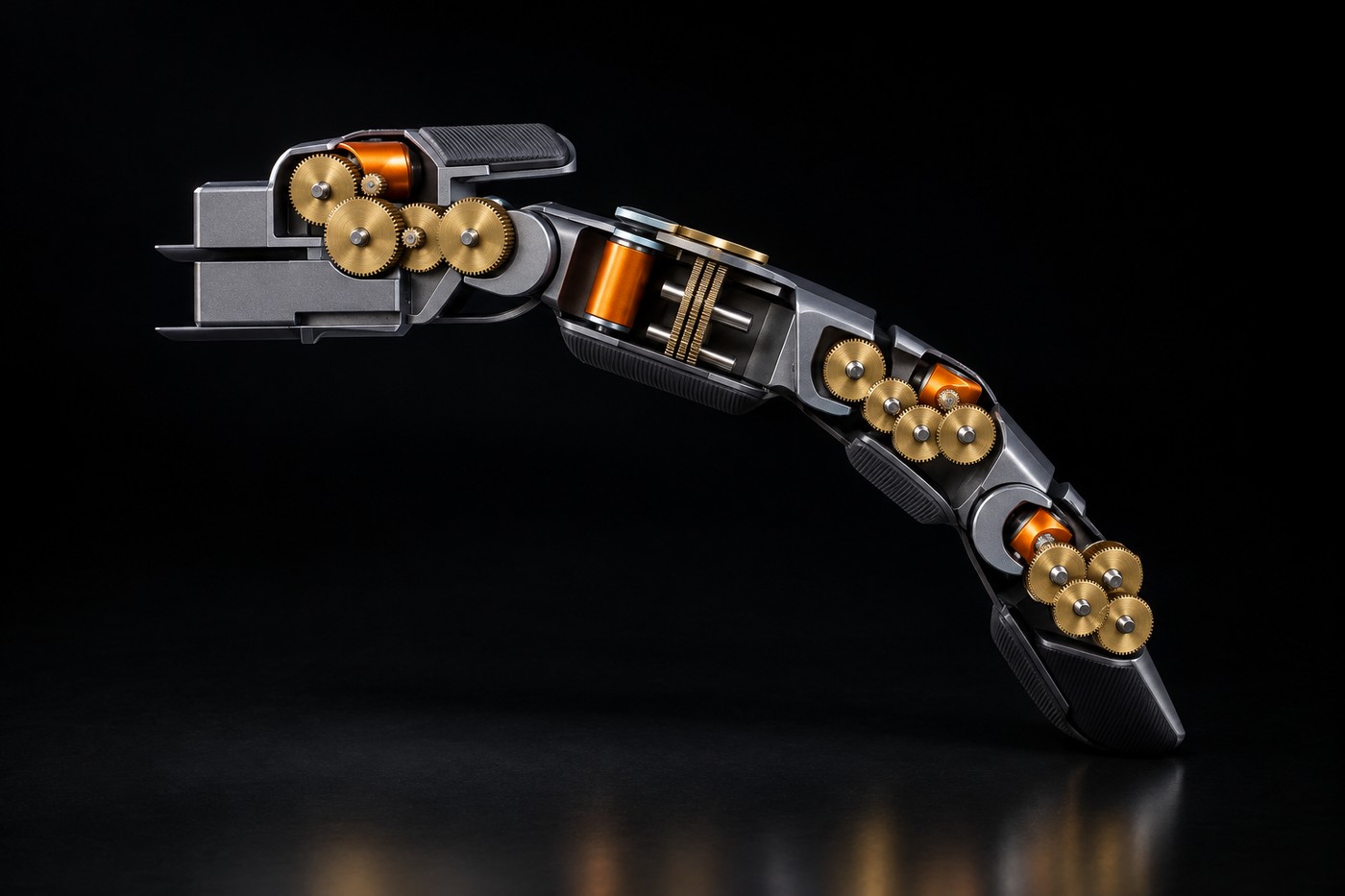
1. One motor for every joint, inside the hand. The hand has 22 joints and 22 small electric motors, one each. The motors sit in the hand itself, next to the joints they move. The maker says this; which finger segment holds which motor is our guess from the published weights. published
2. Small gears make a weak motor strong. A motor this small spins fast and weakly. A gear train is a set of small wheels with teeth that trades speed for strength: many fast turns of the motor become one slow, strong turn of the joint. A maker picture shows these wheels inside a finger. Our 200 turns for one is a guess. seen
3. Two sensors read every joint. Each joint has two angle sensors, one on the motor and one on the joint. They tell the hand where each finger is 1,000 times a second, so it can hold firm or give way. The maker says 'dual encoders'; where they sit is our guess. published
4. One set of electronics commands all 22. Power and commands come in at the wrist: 'bend this joint to this angle, this stiffly'. The maker lists the plugs and the signals. We drew one board in the palm; the real electronics may be spread through the fingers. guessed
5. Why this layout needs no tendons. Many robot hands keep big motors in the forearm and pull the fingers with strings, as your own hand does. Here the last gear of each train sits on the hinge itself and turns the next segment directly. Nothing to route, nothing to tension, nothing to fray. published
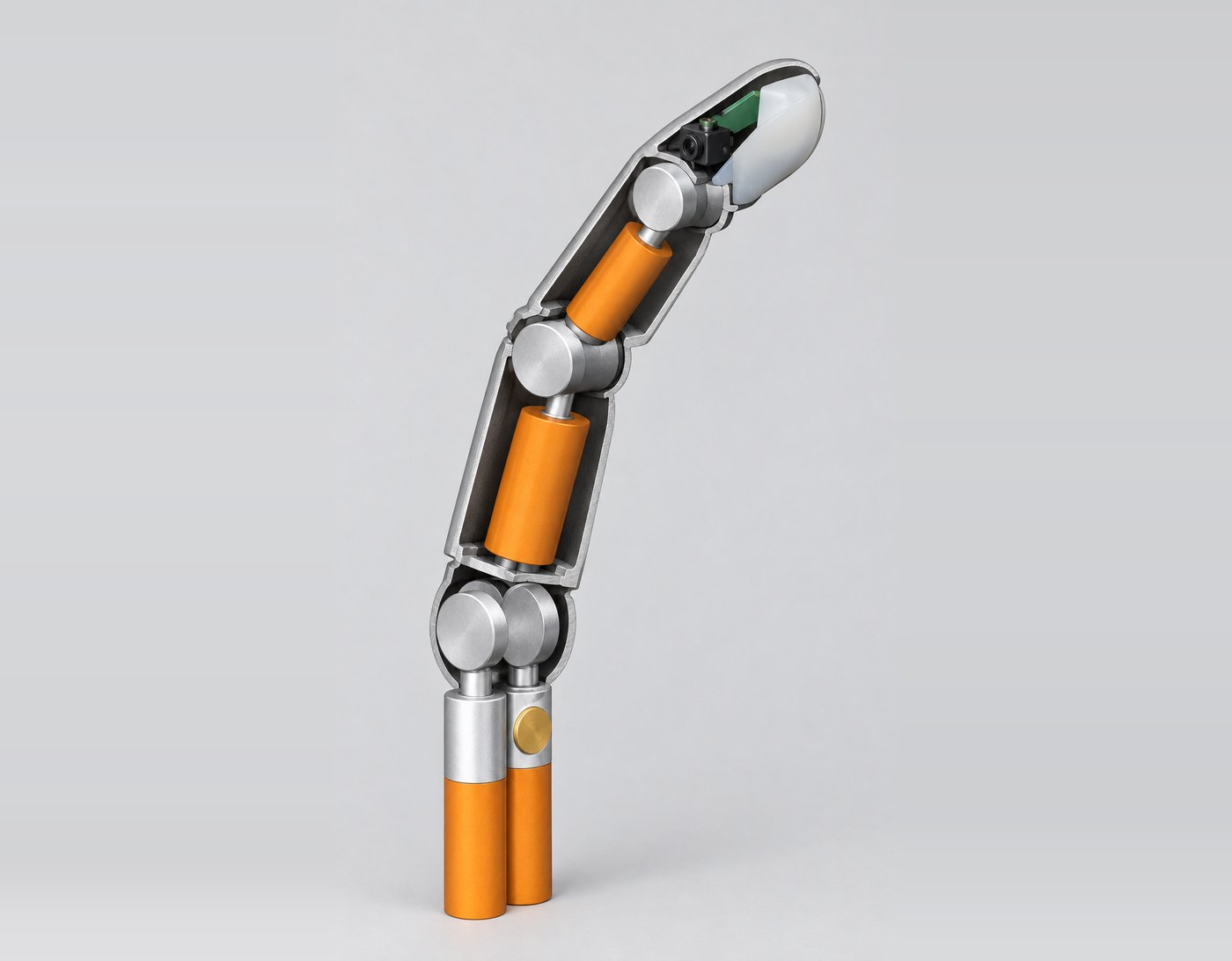
One finger with the near half of its housing cut away: four joints, each with its own motor and gear stack. Guessed: the size and place of each motor, the number and size of the gear wheels, the brass colour of the gears, the cut itself. Published or seen: four joints in this finger, one motor and one gear set at each, the outer shape. AI generated, for reference. Not a photograph; our reconstruction, not the maker's design.
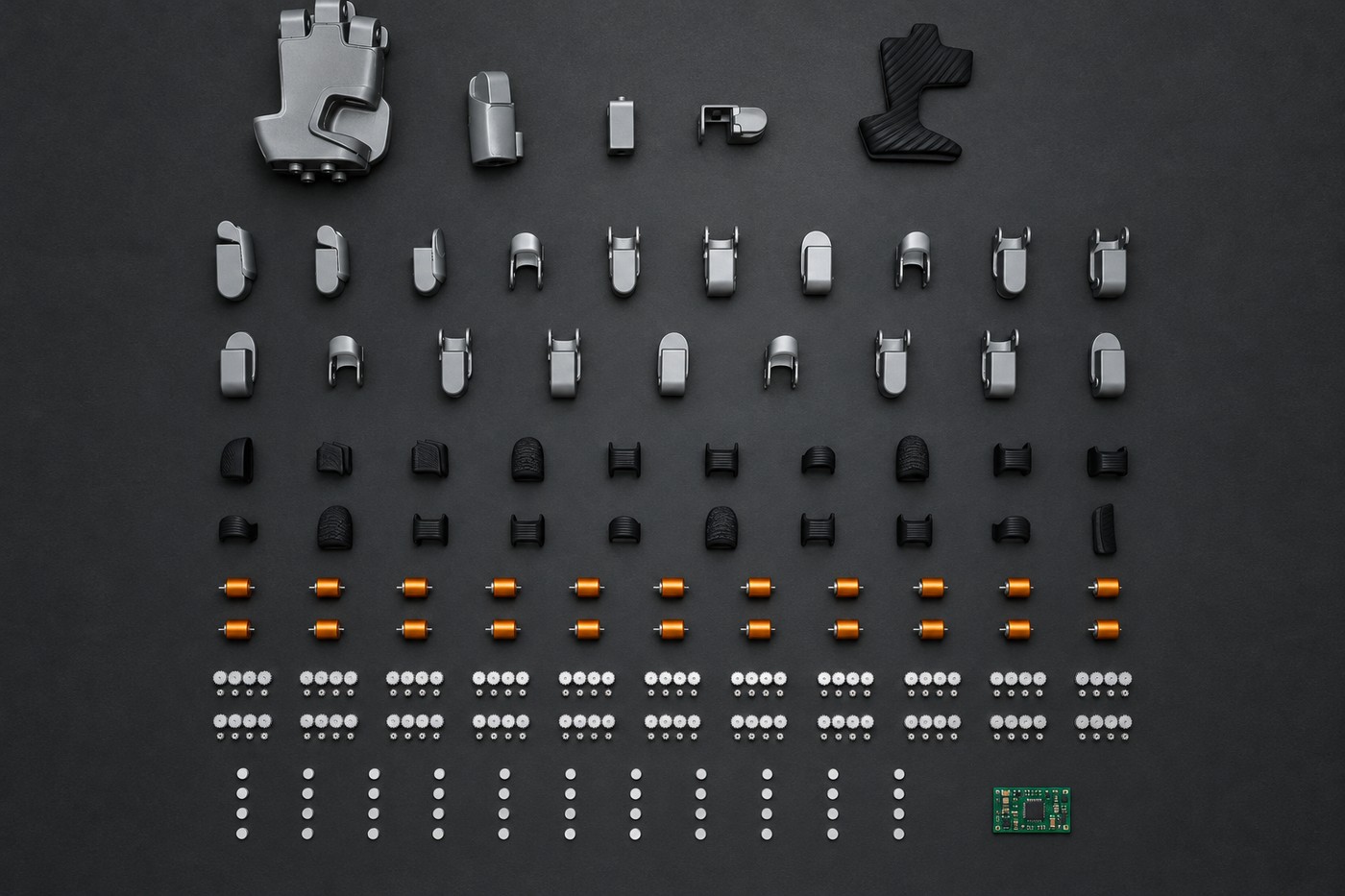
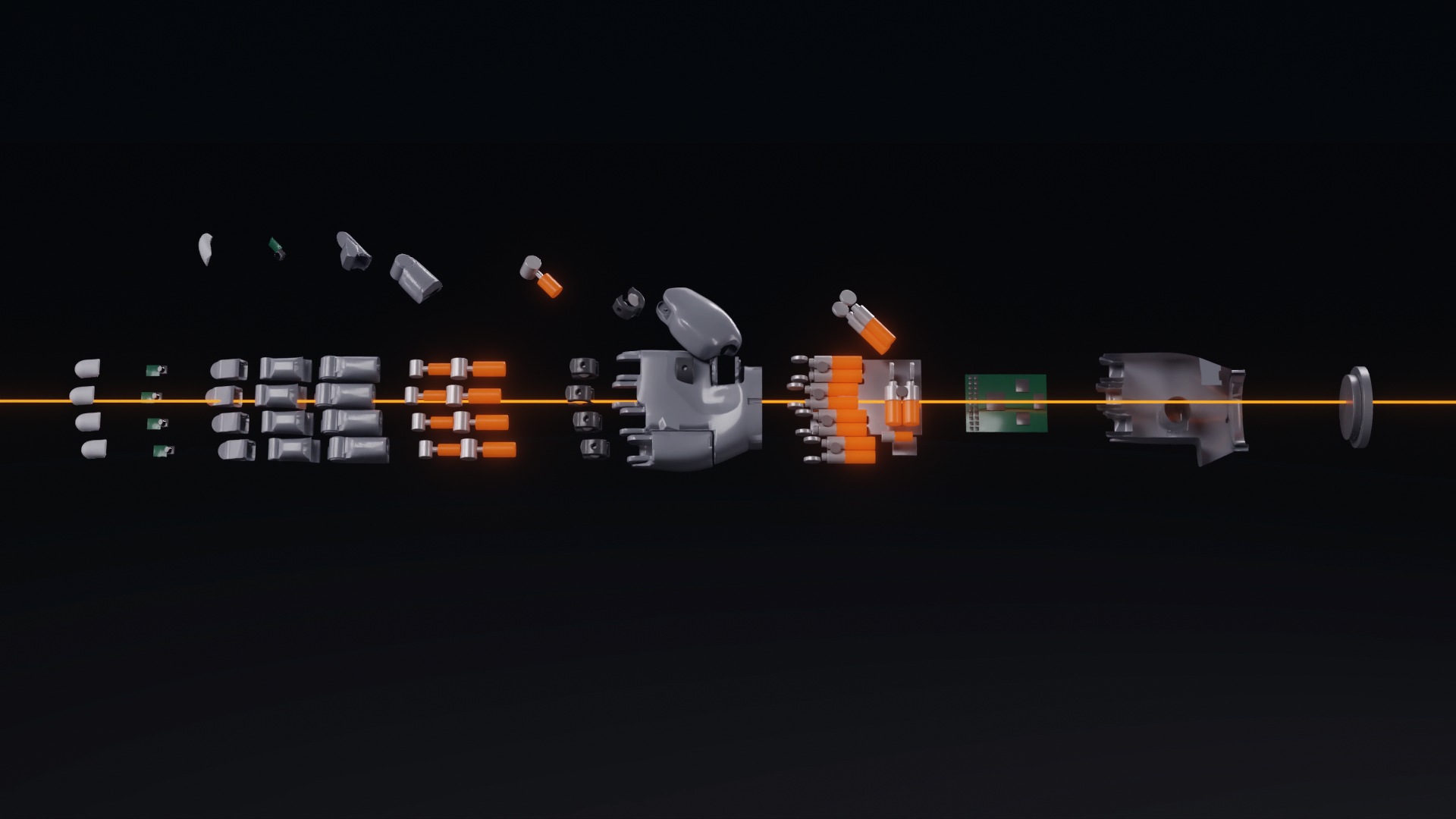
The counts follow our parts list: 23 frame pieces, 21 silicone skins, 22 motors, 22 gear sets, 44 angle sensors, one board. Guessed: what each motor, gear and sensor looks like, four large and four small wheels in a gear set, and the single board. AI generated, for reference. Not a photograph; our reconstruction, not the maker's design.
The parts, in the order they go together
Silicone skins × 21
Soft ribbed pads on the palm and on the inside of every finger segment; they are what touches the object.
published
Frame × 23
The aluminium skeleton: one palm and 22 moving pieces joined by 22 hinges.
published
Gear sets × 22
A set of small toothed wheels at every joint that trades the motor's speed for strength.
seen
Motors × 22
One small electric motor for each joint, sitting in the hand itself.
published
Angle sensors × 44
Two small discs a joint that report its angle, one on the motor and one on the joint.
published
Circuit board × 1
The electronics that take power and commands at the wrist and run the 22 motors.
guessed
published the maker or a paper says soseen visible in the maker’s own pictures or filmsguessed our inference; not confirmed
Where the money goes our estimate
Parts, our estimate$900 to $3,100
List pricefrom $6,350maker
Motors (22)$220 to $700guessed
Gears (22 sets)$176 to $660guessed
Electronics and encoders$172 to $452guessed
Structure$150 to $450guessed
Assembly and test$180 to $850guessed
Margin and unknown$3,250 to $5,450guessed
Every figure is our estimate, built from public prices of comparable parts, not from the maker's books. Cross-check: the maker's stock-exchange filing reports a gross margin of 48.76 % to 60.43 % on its parts business; at that margin this hand would cost $2,510 to $3,250 to build, the top of our range. Hands are not broken out in the filing.
Read the detailthe sources behind this reconstruction
This hand has no cords: each of its 22 joints is turned by its own small motor and gears inside the hand, and each fingertip feels by filming its own soft pad from the inside.
Our reconstruction from published specs, not the maker’s design.
How it works, in five steps
Our reconstruction
Our reconstruction from published specs, not the maker’s design.
1. A motor for every joint. Your finger has three joints that bend, and a knuckle that also swings sideways. This hand copies that with 22 joints, and each joint has its own small motor. All 22 motors are inside the hand. Many other robot hands keep their motors in the forearm and pull the fingers with cords. published
2. Two motors share each knuckle. Two motors stand side by side in the palm under each knuckle. When both turn the same way, the finger bends forward. When they turn against each other, it swings sideways. A small set of angled gears does the mixing. published
3. The next motors ride inside the finger. The motor for the middle joint lies lengthwise inside the first finger link. Its spin is turned by 90 degrees and slowed down by a tiny gearbox that sits on the joint itself. The end joint has the same thing, one size smaller. Slowing a motor down is how a small motor gets a strong push. seen
4. The fingertip feels by looking. Each fingertip is a soft pad with about 1,100 dots on its inside. A tiny camera inside the fingertip films the dots. When the pad touches something it dents, the dots move, and software turns that picture into a force: how hard, which way, and where. published
5. All 22 work at once. Because no joint is tied to another, the hand can curl every finger its own way. Here all 22 motors close a fist. The published limit is 20 N at a fingertip, about the weight of a 2-litre bottle. published
One finger with its shell cut away: two motors under the knuckle, one motor in each finger link with a gearbox on the joint, and the camera behind the soft fingertip pad. The placement of the drives is our guess. AI generated, for reference. Not a photograph; our reconstruction, not the maker's design.
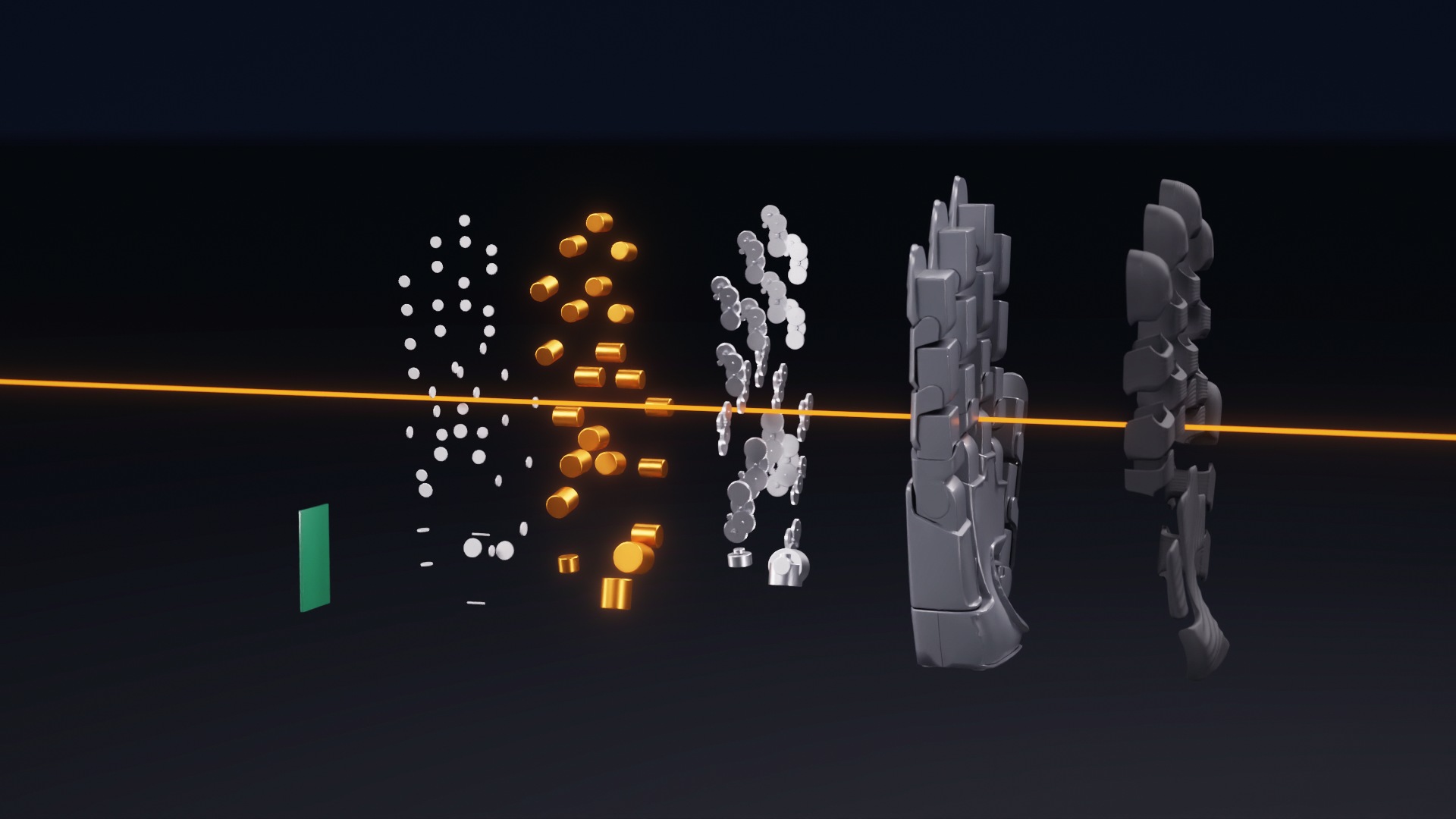
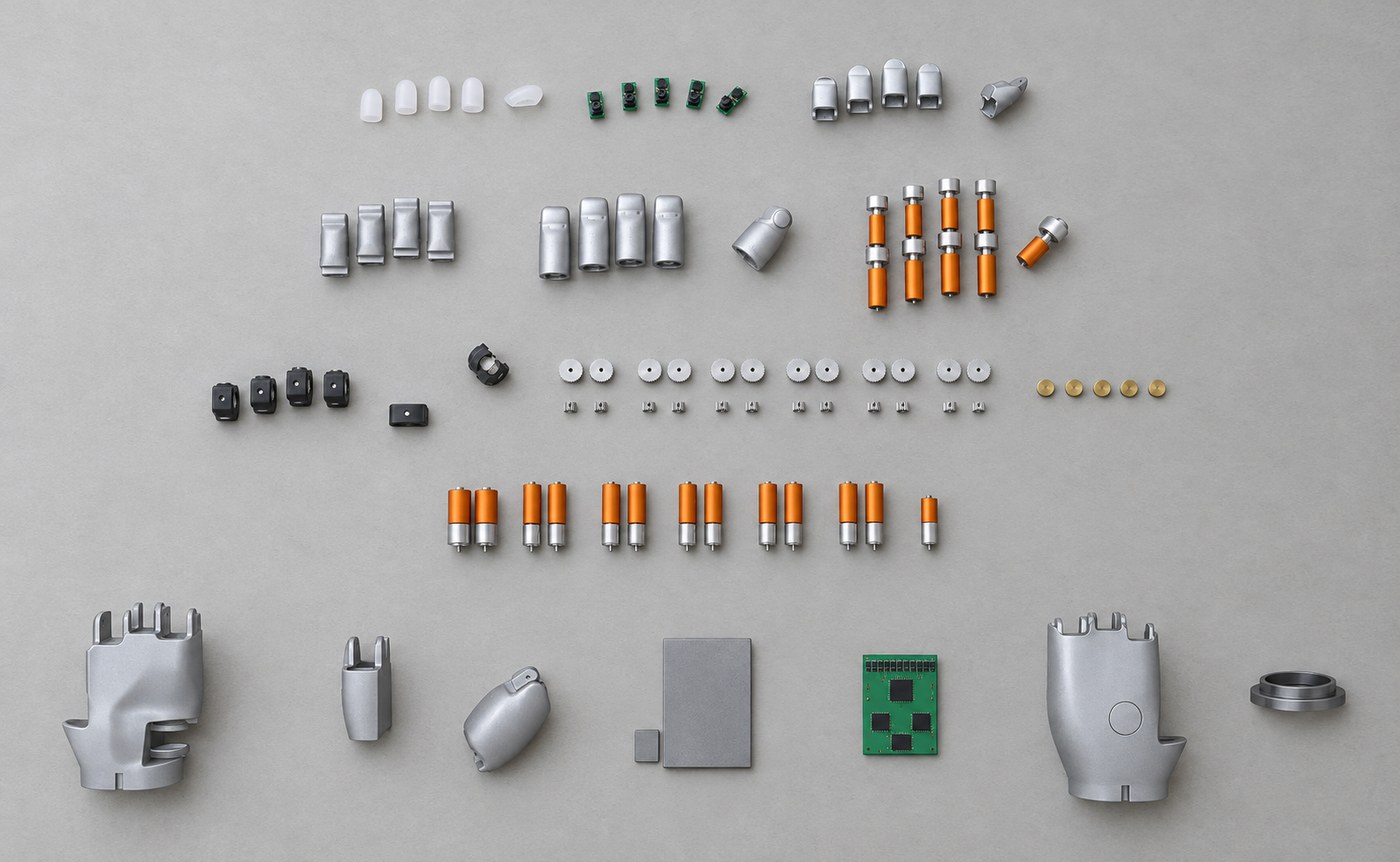
Every part of our reconstruction laid out on a bench: 5 fingertip pads, 5 cameras, 14 finger shells, 9 finger drives, 6 knuckle blocks with 12 gears and 12 pinions, 5 torque sensors, 13 knuckle drives, then the palm covers, two base shells, the chassis, the main board and the wrist ring. The placement of the drives is our guess. AI generated, for reference. Not a photograph; our reconstruction, not the maker's design.
The parts, in the order they go together
Tactile skin × 5
A soft pad on each fingertip that dents where it touches something.
Fingertip camera and board × 5
A tiny camera inside the fingertip films the pad from behind, so a dent becomes a picture.
Fingertip shell × 5
The hard last link of each finger; it carries the sensor.
Middle shell × 4
The middle link of each of the four fingers.
Proximal shell × 5
The first link of each finger and of the thumb.
Finger joint module × 9
A motor lying along the link, a pair of angled gears, and a small gearbox sitting on the joint itself. One bends each middle joint and each end joint.
Knuckle cross and its four angled gears × 6
A small cross at the root of a finger lets it bend forward and swing sideways about one point; four gears round it mix two motors into those two moves.
Palm cover, palm side × 1
The front shell of the palm.
Thumb base and little-finger base shells × 2
Two moving blocks of the palm: the ball of the thumb and the edge under the little finger.
Knuckle module × 12
Two motors side by side under each two-way joint. Both turning the same way bend the finger; turning against each other swing it sideways.
Little-finger root module × 1
One small motor folds the edge of the palm so the little finger can meet the thumb.
Joint torque sensor × 5
A strain gauge at the root of each finger measures how hard the finger pushes.
Chassis plate × 1
A metal plate that the palm's motors bolt to.
guessed
Main board × 1
The electronics: one drive circuit for each of the 22 motors, a processor that also reads the touch pictures, and the network link.
Palm cover, back × 1
The back shell of the hand.
Wrist flange × 1
The ring that bolts the hand to a robot arm and carries power and network.
published the maker or a paper says soseen visible in the maker’s own pictures or filmsguessed our inference; not confirmed
Where the money goes our estimate
Parts, our estimate$1,595 to $6,770
List pricenot published
Motors$330 to $1,760
Gears$440 to $1,540
Drive electronics$200 to $670
Tactile sensors and cameras$200 to $600
Joint torque sensors$75 to $500
Structure$300 to $1,200
Assembly, calibration and test$50 to $500
Our estimate of what the parts and the assembly of one hand cost the maker. It is not a price. The maker publishes no price; the press reports about USD 50,000 for a W01, which the maker calls a custom quote, not a list price. The difference is not profit: it pays for engineers, software, test rigs, scrapped gears, warranty and a production run of unknown size.
Side by side
Unitree Dex5-S
Sharpa Wave W01
Ours, a simulation
Joints
22 (thumb 5, index 4, middle 4, ring 4, little 5)
22
22
Driven joints
22: every joint has its own motor
22, each with its own motor
22
Where the motors sit
Inside the hand, at the joints (maker). Which segment holds which motor is our guess.
all inside the hand: in the palm and inside the finger links (the maker says "inside the hand"; the exact seats come from a patent and our guess)
forearm
Tendons
None
none
yes, 44
Fingertip force
Not published. The maker gives a whole-hand load: 1 kg continuous, 2 kg peak.
20 N
—
Mass
620 g
1.3 kg
—
List price
from $6,350
not published
not a product: a simulation
A dash means not published. Ours is the 22-joint model from this article, which exists only in a simulator.
Read the detailthe sources behind this reconstruction
Parts grow in step with the joints. Postures explode.
Render of a simulation
What it costs to build a hand as joints are added, nobody has published. our inferenceour audit
Our simulated 22-joint hand with its bones made clear: 44 tendons.
Experimentkeep adding joints and count the damage
Fig. 3 · Three kinds of growthcounts against driven joints
tendonsguide pointsin the hardware · measured on our simulated handpairs of jointsin the assembly · arithmeticposturesin the control · a count, not a measurement
Fig. 3Slide the joints up and watch which line leaves the chart. simulation · arithmetic · a count
The problem. More hinges let a hand do more, and every hinge you add sends a bill to three places: the hardware (more parts), the assembly (more strings to thread and keep apart) and the control (more postures to choose between). We think the control gets the biggest bill; that is our view, not a measurement.
The experiment. We took one simulated hand, kept adding driven joints, and counted what each place has to pay. The hardware grows politely, in a straight line: 5 tendons at six joints, 44 at 22. simulation The assembly grows faster, with the square: 15 pairs of joints that can tug on each other at six, 231 at 22. our inferencearithmetic
The hard part: a lot of string, and it all moves together
44 cords pass here in our model simulation
Bend this joint
and these cords tug too simulation
AI generated, for reference. Not a photograph; nothing here was built.
What happened. The control does not grow, it explodes: give each joint just ten positions and 22 joints have 10²² postures. our inferencea count Watch that line leave the chart. What it costs to build, nobody has published: there are no build hours for three sizes of the same hand. our inferenceour audit
Read the detailthe same counts drawn as tendon lines, table 4, how tendons disturb each other, the build times that exist
One of Adcock’s reasons for choosing tendons was “potentially higher degrees of freedom”. A forearm has room for many motors. The question is what each added joint costs. We built one model hand and gave it 6, 11, 16 and then 22 driven joints.
Fig. 3b · The same counts as tendon linesour model, counts only
Fig. 3bThe counts are from our model simulation. The drawing is a schematic of those counts and not the model’s real routing. A filled blue mark is a driven joint, an orange line is a tendon and a black dot is a guide point.
Count first. With six driven joints the model has 5 tendons and 40 guide points, the places where a tendon is held to a bone.With 22 it has 44 tendons, a flexor and an extensor for every joint, and 236 guide pointssimulationthese are route points in our model, not parts counted on a built hand.
5 → 44tendonsour sim
40 → 236guide points in the modelour sim
83 → 3,656places the index fingertip can reach, on a 3 mm gridour sim
0 → 3pinches made, of 6our sim · weak thumb model
What the joints buy is reach. The index fingertip of the six-joint hand can be put in 83 places on a 3 mm grid. With 22 joints it is 3,656. The thumb is the weak part of our model, and even at 22 it reaches only 1 of its 10 targets. It was never redesigned, so read that as a weak model and not as a law.
Table 4 · One model hand at four joint counts
Driven joints
Tendons
Guide points
Index fingertip positions
Thumb touches, of 10
Pinches, of 6
Origin
6
5
40
83
0
0
our sim
11
22
128
601
0
0
our sim
16
32
188
655
0
0
our sim
22
44
236
3,656
1
3
our sim
Fingertip positions are counted on a 3 mm grid. A thumb touch is the thumb tip reaching one of ten target points on the other fingers and the palm.
10 · 8 · 4 · 2tendons change length when one joint turns: thumb swing, knuckle, middle joint, fingertip jointour sim
125entries link joints to tendons in our 22-joint model; 44 if no joint disturbed another’sour sim
15 → 231pairs of joints that could disturb each other, at 6 and at 22 jointsarithmetic
76 %of the time to build one tendon finger went on the tendons: 1,899 of 2,483 secondsour count of one build video
What the joints cost is cross-talk. A tendon to the fingertip passes every joint on the way there, and when one of those joints bends, the line changes length. In the 22-joint model, turning one joint changes the length of up to 10 tendons for the thumb’s swing across the palm, 8 for each knuckle, 4 for each middle joint and 2 for each fingertip joint. If no joint disturbed another joint’s tendons, the table that links joints to tendons would have 44 entries. Ours has 125 simulation.
Now the word itself. Exponential means that each added joint multiplies the difficulty. Here is what can be counted.
Motors, tendons and guide points grow in step with joints. From 11 to 22 driven joints our tendons double, and our guide points nearly do.
Pairs of joints that could disturb each other grow with the square: 15 pairs at 6 joints and 231 at 22 (arithmetic).
Friction in a tendon grows exponentially with how far the tendon bends. That is not the same as the joint count, and it is the subject of chapter 7.
None of these is a law of build effort, and build effort is what the claim is usually about. We looked for a family of hands with assembly hours measured at three or more joint counts and found none (our audit of the sources). The build times that exist come from single builders with no timed method: under 3 hours for MIDAS with 13 driven joints, about 4 for ISyHand with 18 motors, about 7 for RUKA with 11 and under 8 for ORCA with 17 papers[2][3][4]. They do not rise in step with the joint count.
What build logs do show is where the hours go. By our count of one build video, 76 % of the time spent putting a tendon finger together, 1,899 of 2,483 seconds, went on installing, tensioning and knotting tendons our inferencea step count.
Motors are the biggest line on every parts bill that shows the split
From 52.6 % to 81 % of the bill, wherever the bill splits it out. papers[2]
52.6–81 %of a published parts bill is motors, wherever the bill splits it out papers[2][3]and one maker’s parts page
Parts bills of open research hands how much of each bill is motors
DexLink
52.6 % motors$205 of $390 · 16 driven joints
LEAP v2
about 60 % motors$178.96 of about $300 · 8 driven joints · built in under 2 h
ISyHand
73 % motors$950 of about $1,300 · 18 driven joints · about 4 h
LEAP v1
81 % motors$1,440 of $1,772 · 16 driven joints
RUKA v1
split not published$519.94 · 11 driven joints · about 7 h
RAPID Hand
split not published$1,500 · 20 driven joints
ORCA v1
split not publishedunder 2,000 CHF · 17 driven joints · under 8 h
MIDAS
split not publishedunder $3,000 · 13 driven joints · under 3 h
Build times are one builder each, with no timed method. The full table has every origin and footnote.
Prices are falling
What
One maker’s small gearbox: 634, then 594, then 397 RMB on average, 2023 to 2025. maker’s claim And whole hands, across two products: Unitree’s Dex5-1, with 16 driven joints, sells for 16 to 24 thousand dollars at resellers; its Dex5-S, with 22, lists from $6,350. pressmaker’s claim
Why
Volume, as far as we can tell: that gearbox maker went from 1,167 small gearboxes a year to 32,008 while its price fell. maker’s claim That volume is the cause is our reading. our inference
Today
A 22-joint hand lists from $6,350, and a six-motor hand at about $2,641. maker’s claimpress For a hand-size motor we found no dated price series at all. our inferenceour audit
The one dated series: a small gearbox, average price in RMB. maker’s claim · averages over a category
The problem. A hand is only useful if you can afford two for every robot, so we asked where the money goes. We guessed labour: hundreds of tiny parts, strings threaded by hand, somebody squinting.
The experiment. We were wrong about labour, and the proof was already public. Research groups publish parts bills: what the parts cost, before anybody is paid to put them together. In every bill that splits it out, the motors are the biggest line, from 52.6 % to 81 %. papers[2]
What happened. The good news is that the bill is shrinking, as far as anyone can tell. The card has the three things worth knowing: what is going down, why, and where it stands today.
Read the detailtable 6, the prices of hands on sale, what one driven joint costs
A hand has hundreds of small parts, and somebody threads the tendons by hand. It is natural to think the price is labour. A parts bill says where the money goes before any labour is paid, and several research hands publish theirs.
Show the full tableTable 6 · Parts bills of open research hands
g Our arithmetic on about $300. h The paper’s abstract; elsewhere the same paper says under one hour paper. i We could not re-read this page. j The parts sheet without tools; the paper says under $1,300 paper. Build times are one builder each, with no timed method.
In every bill that gives the split, the motors are the largest line, from 52.6 % to 81 %. The press reports the same shape for Chinese commercial hands: drive modules are more than half the cost, and the small coreless motors alone about 41 % press.
Now set the hours beside the bills. The slowest build in the table takes under eight hours. For labour to cost as much as the parts of ISyHand, its builder’s hour would have to cost $325 (our arithmetic: $1,300 over four hours). The hours are soft, but they are far from the range where labour leads.
The claim has a true core. A hand resists automation, which is the point of the 100 screws in chapter 1. That limits how many hands can be made. It is not where the published bills say the money goes.
A price is a different thing from a parts bill. It adds labour, testing, warranty and margin, and for hands on sale it varies widely.
Hands on sale: what one driven joint costs the division is ours
Unitree Dex5-S
$289for each driven jointfrom $6,350 · 22 driven jointsmaker
Inspire RH56H1
$440for each driven joint¥18,000, about $2,641 · 6 driven jointspress
Wuji Hand 2
$975for each driven jointfrom $19,500 · 20 driven jointspress
Unitree Dex5-1
$1,028for each driven joint$16,450 · 16 driven jointspress
OYMotion ROH-LiteS001
¥1,481for each driven joint¥8,888 · 6 driven joints, our inferencemaker
Shadow Dexterous Hand E
£4,000 to £6,000for each driven joint£80,000 to £120,000 · 20 driven jointspress
Show the full tableTable 7 · Prices of hands on sale
The last number column is our division. The two prices marked press in the middle are one US reseller’s listings. Shadow, Sharpa and Wuji publish no list price and quote on request; the Shadow range is a buyer’s guide for new hands. k Our inference from the product’s class.
Fig. 8 · What one driven joint costsUSD
Fig. 8Tap a bar to see its arithmetic and its origin. Blue bars are prices and grey bars are parts bills, which leave out labour, testing and margin. Only hands priced in US dollars are drawn.
Divided by driven joints the spread stays wide. It runs from about $24 of parts in the cheapest research hand, through $289 for the 22-joint hand with the lowest list price, to over $1,000 (our arithmetic on the numbers above). Touch is extra: tactile film is reported to add RMB 3,000 to 5,000 to a hand press.
Fig. 10Drag the slider to set a year of use, then count the rows that reach the dashed line. papers and makers’ claims
The problem. A hand also has to last, and the number that says so is cycles to failure, for the whole hand, under load. Every open-and-close is one cycle, and a hand that wears out in a season is not cheap, whatever its price. It is a boring number, which may be why it is so hard to find.
The claim. Spec sheets say “millions of cycles”, and the sentence describes parts and a wrist. Read it slowly.
1X1X, “NEO’s hands”1X’s own page, 9 July 2026
“have been proven reliable well beyond 2 million cycles under high loads”
Our takeThat sentence is about the wrist joints.
What happened. We put every life number we could find on one chart, and the longest test of a whole hand to a real failure is 494,000 cycles, on a prosthetic hand. paper We checked nine companies, and none publishes a whole-hand life test under load. our inferenceour audit
Read the detailwhat each row measured, what fails first, how many cycles a job needs
About Fig. 10Tap a row to read what was measured and where it comes from. Filled marks are measurements. Hollow orange marks are claims or reports with no test method, and an arrow means “more than”. The grey band is one year at 450 to 1,200 cycles a day; the dashed line is one year at the rate you set.
A hand that costs $6,350 and works for five years is cheap. The same hand worn out in a season is not. Life decides the real price, and it is the number with the least behind it.
The claim comes from spec sheets. 1X says components and whole finger assemblies were tested for millions of cycles, and that the wrist joints “have been proven reliable well beyond 2 million cycles under high loads” maker’s claim. That is a statement about parts and about the wrist. It describes no test of the whole hand. Unitree lists “>100000 fatigue cycles” for one family of hands, with no conditions maker’s claim. Honda reports 450,000 cycles for its hand, and 24,000 at 5 kg maker’s claim.
Papers measure less and say more. The longest runs on research hands are a few thousand cycles, stopped by the clock and not by a failure. ORCA’s abstract reports more than 10,000 cycles and its methods a separate run of 2,250 grasps; the paper does not reconcile the two, and neither ran to failure paper.
The longest run to a real failure that we found is on a prosthetic hand: “494,000 cycles before the tendon breaks” paper. Printed parts fail much earlier: springs at 2,446 ± 499 cycles, soft actuators at 3,439 to 6,410 and a flexure finger at 45,000 papers[2][3].
What fails first is often not the mechanism. In a soft finger with a camera inside, the picture went bad at 4,968 cycles while the mechanics were fine past 15,000 paper.
How many cycles are needed? One prosthetic hand has a battery sized for 1,200 open-and-close cycles a day maker’s claim. At 450 to 1,200 a day a year is about 165,000 to 440,000 loaded cycles, and no printed soft hand we found is within ten times of that our inference. A warehouse asks more: one press report gives the leading hands at one company 300,000 to 500,000 cycles, which it puts at about a monthpress.
We checked nine companies, and none publishes a loaded whole-hand life test or a failure rate (our audit of the sources). For scale, one industrial two-jaw gripper is rated at 5 million cycles maker’s claim. That is the kind of number hands will be held to.
Friction of a string in a printed channel. A 3D printer, a string, a weight and a force gauge. Vary the plastic, the liner and the bend radius. It is the cheapest of the five. chapter 7
And with more than a weekend
Life of one whole hand under load. A hand, a load, a counter and patience. Report the cycles to failure and what failed. chapter 10
Build hours against joint count. One family of hands at three sizes, timed with a stated method. chapter 6
Where we could be wrong
Everything of ours is a simulation, with stiffness and friction that we assumed. One research group had to retune a tendon hand by 20 to 30 % when it moved from simulation to the real thing. paper
Most of our results are one run.
“Nobody has published” means we did not find it. A company may have measured what it does not print.
Stormy is a small team building robot workcells. If you have measured any of these, we would like to read it: stormy.ai.
The film
Watch it in seven minutes
From zero to how a robot hand works, with the numbers we trust.
Things people say about robot hands, and what we foundtwelve common claims, each with what decided it and its sources
This is a solved problem for big companies; small teams have nothing to add.
A public reversal, and no loaded whole-hand life test from nine companies.
Busted. the maker’s own statement; our audit of nine companies
Busted.“The hand is just the last 10 percent of the robot.”the builders’ own words, the count, the 100 screws
Left tendonsBABrett Adcock@adcock_brett · runs Figure
The biggest engineering mistake I made at Figure was building a tendon-based hand
Our takeStrong words, and no measurement attached.
Ships tendons1X1Xfrom its page “NEO’s hands”
The motors live in the forearm, where most of your own grip strength lives– pulling proprietary tendons through the wrist.
Our takeThe opposite bet, and it ships.
50degrees of freedom in two hands with their wristsmakers · our sum
450more would be needed elsewhere for the hands to be a tenthour arithmetic
72.8 %of Unitree’s humanoids left with no five-finger hand, January to September 2025press, from the filing · our arithmetic
100+screws and small parts in Tesla’s hand and forearm, put together by handpress
It sounds right. A humanoid robot is legs, arms, a body and a battery, and the hand is the small bit at the end. So we ran the least glamorous experiment there is: we counted.
Engineers count a hand in degrees of freedom, the separate ways its joints can move. Tesla’s robot hand has 22, plus 3 at the wrist. maker’s claim 1X, another humanoid maker, gives the same split. maker’s claim Two hands with their wrists: 50.
MKMilan Kovac@_milankovac_ · Tesla Optimus
Our new hand/forearm with double the number of degrees of freedom now in action on the bot! There's 22 DoFs on the hand, and 3 on the wrist/forearm.
Our takeDouble it for two hands and you are at 50.
For 50 to be a tenth of the robot, the rest of the body would need 450 more. Nobody we read claims anything like it. our inference
The parts say the same, and so do the builders. The man who runs Figure, a US humanoid maker, calls building a tendon hand his biggest engineering mistake. 1X ships one anyway.
Electrek, on a report by The Information25 September 2026
“over 100 screws and small components that workers still assemble by hand”
Our takeThat is a lot of screws for a last tenth.
Read the detailthe full argument
It is an easy thing to believe. A humanoid robot is legs, arms, a body, a battery and a computer, and the hand is the small part at the end of the arm. Get the robot walking and the hands will follow.
The people who build these robots do not talk that way. Two more of them are on the cards here and in the main text.
EMElon Muskon Tesla’s Optimus robot, in an interview
From an electromechanical standpoint, the hand is more difficult than everything else combined. […] There's nothing you can pick out of a catalog, at any price.
WXWang Xingxingof Unitree, in the outlet’s translation
current hardware, including dexterous hands, is sufficient. The real bottleneck is embodied AI
Not every builder thinks hands are the problem, as the second card shows. Unitree’s filing shows what that means in practice. Of the 3,551 humanoids Unitree sold from January to September 2025, 445 had bought-in hands and 521 had hands made in house pressfrom the filing. By our arithmetic about 2,585 of them, 72.8 %, left with no five-finger hand at all.
Opinions are not a test, so count. A degree of freedom is one independent way a joint can move. Milan Kovac of Tesla’s Optimus team gave the count for its hand in November 2024.
MKMilan Kovac@_milankovac_ · Tesla Optimus
Our new hand/forearm with double the number of degrees of freedom now in action on the bot! There's 22 DoFs on the hand, and 3 on the wrist/forearm.
1X gives the same split for its NEO robot maker’s claim. Two such hands with their wrists make 50. For that to be a tenth of the robot, the rest of the body would need 450 more, and no maker in our reading claims anything like it.
The parts agree. Tesla’s hand and forearm hold “over 100 screws and small components that workers still assemble by hand” pressfrom The Information by way of Electrek.
Busted.“Artificial muscles can replace motors today.”all twelve kinds with one number each, table 2, two motors for comparison
Fig. 2 · Force against time, where both existlog scales
Fig. 2Look at how much of the chart is empty. Tap a balloon to read its number. papers · an inventory, not a ranking
We love this idea. An artificial muscle is a material that shortens when you tell it to, like the real thing: no gears, no magnets. Some run on air, some on heat, some on thousands of volts.
We went through twelve kinds, took one honest number from each, and tried to draw the obvious chart: force against speed. Look at it. It is mostly empty, and that is the finding.
Only one kind reports both a fingertip force and a time: a wire that shrinks when it is heated. It is also the strongest of the twelve: 6.5 newtons at the fingertip. paper Then it needs about 13 seconds to cool down and let go. A long time to hold a cup you meant to put down.
Printed finger with shape-memory wiresResults in Engineering, 2026As our notes record it
6.5 N at the fingertip at 8 V; about 13 s to re-open
Our takeStrong, then slow. Cooling sets the speed.
None of the twelve matches a small electric motor on force, speed, life and control together. our inference So for now we keep the motor.
Read the detailthe full argument
About Fig. 2Each balloon is a row of table 2; A and B are the two motors. Tap one. A family is on the chart only if our reading holds both a fingertip force and a time for one stroke. With no time it sits on the left rail, with no force on the bottom one. The numbers come from different rigs, so this is an inventory and not a ranking.
Something has to pull the tendon. Today it is a small electric motor with a gearbox. The alternative, the artificial muscle, makes one promise: a material that shortens when it is told to, like the real thing, with no gears and no magnets.
We went through twelve families and took one honest number from each, measured on a finger or a hand where such a number exists.
Twelve families, one honest number each the numbers come from different rigs: an inventory, not a ranking
1
Air muscle (McKibben)
1.95 Nat the fingertip at 0.2 MPaneeds a pump and valvespaper
2
Air bellows, origami
69 %contraction carrying 500 g at 99.8 kPa of vacuumlab vacuum; small pumps reach about 41 kPapaper
3
Electrohydraulic pouch (HASEL)
0.53 Nat the fingertip at 5.5 kVkilovolts; force falls from 25.3 N to 2.0 N over 6 mmpaper
4
Dielectric elastomer, low voltage
0.1 Nblocked force at 200 V, ten layerstiny forcepaper
5
Electrostatic film and clutch
1.02 Nat 600 V241 N/m², so 41.5 cm² for each newtonpaper
6
Electric fiber pump
0.4 sfor 40 mm of stroke at 8 kVunder 2.5 % efficientpaper
7
Shape-memory wire
6.5 Nat the fingertip at 8 Vabout 13 s to re-openpaper
8
Twisted coiled nylon
0.022 %electrical efficiencyslow and wastefulpaper
9
Liquid crystal elastomer
43.6 %contraction at 27 W for each tendon110 to 160 °C; 102 s to coolpress
10
Carbon nanotube yarn
3.85 %stroke at 12.5 MPa and 0.1 Hzin a gel cell; life in open air unknownpaper
11
Ionic polymer, electric gel
0.14 Nabout, at best; about 2 % strokemust stay wetpaper, by way of a survey
e From a survey in our notes; we did not re-open the primary paper. Row 10 is read from a figure in a patent. Row 9 is a trade magazine’s account of a paper.
For reference, two motors. A micro gearmotor 10 by 12 mm across, with a 250:1 gearbox, would give 0.85 N continuously at a fingertip 92 mm from the knuckle it sits at (our inference, from the datasheet and our arithmetic). A 16.4 g hobby servo stalls at 1.069 N·m and turns 60° in 0.159 s paperwhich used it in a hand.
The natural way to compare all of these is a chart of force against speed. We tried to draw one.
The chart is mostly empty, and that is the finding. Of the twelve families, one has both a fingertip force and a time in what we read. The others report one or the other, or a different quantity altogether.
Each family wins something. Air muscles are strong at the muscle, 38.05 N at 0.5 MPa, but the fingertip of the same group’s printed hand gave 1.95 N at 0.2 MPa, and the hand needed pumps and valves that its authors call bulky paper. The pressures differ, so the ratio of the two is not an efficiency. An electrohydraulic stack made 25.3 N while the fingertip of its hand made 0.53 N at 5.5 kV paper. Shape-memory wire gave the strongest fingertip in the table, 6.5 N, and then took about 13 s to cool and let go paper. In a separate test such wire lasted 6,329 ± 3,535 cycles at 300 MPa paper.
None of the twelve, in our reading, matches a small motor on force, speed, life and control together our inference. We simulated several families ourselves, but those runs used different grasps and rigs and only two or three passed our own check for being comparable, so we publish no ranking from them.
So for now we keep the motor. That is a statement about today and does not make muscles a dead end. It does move the question. If the motor is good enough, the hard part must be everything between the motor and the fingertip.
Plausible.“Motor prices are not coming down.”table 8, a slider for the yearly change, whole-hand prices, China’s volumes
The price series that exist each line is drawn to its own scale
The gearbox prices are averages over a category, so part of the fall is a change of mix.
If motors and their gearboxes are most of the bill, the future price of a hand is the future price of small motors. So we went looking for a proper price history: the same part, from the same seller, on three dates. For a hand, a gearbox, a screw or a hand-size motor, we found none. our inferenceour audit
What does exist does not agree with itself. One gearbox maker’s average price fell 37.4 % in two years, while it went from selling 1,167 small gearboxes a year to 32,008. maker’s claim
Laifual, Hong Kong prospectus22 June 2026As our notes record it
Small harmonic gearbox, average price in RMB: 634 → 594 → 397, 2023 to 2025
Our takeA real series. For the gearbox, not the motor.
The one small motor unit we could follow got 15.1 % dearer at one shop. maker’s claima retailer
Raw materials go both ways. We would love to draw a curve through that. Seven short series will not hold one.
Read the detailthe full argument
If motors and their gearboxes are most of the bill, the future price of a hand is mostly the future price of small drives. The gloomy view is that these are mature parts with nothing left to squeeze. The hopeful view points at China.
We looked for a proper price series: the same part from the same seller on at least three dates. We did not find one for any hand, gearbox, screw or hand-size motor (our audit of the sources). What exists is thinner.
Show the full tableTable 8 · The price series that exist
The gearbox maker is Laifual, from its Hong Kong prospectus; its prices are averages over a category, so part of the fall is a change of mix. The −28.2 % and −10.0 % are our arithmetic. The hobby servo now sells for $27.50 in the maker’s store, which is a different kind of price. The yen row is one retailer’s listing, which we file under maker. The 2025 metal prices are estimates, and “paper” there is a government survey.
So the gearbox in front of the motor is falling fast. That maker sold 1,167 small gearboxes in 2023 and 32,008 in 2025, and its average price fell by more than a third. The one small servo we could follow got dearer. Raw materials go both ways.
With no proper series we cannot fit a curve. We can let you pick a rate and see what it would mean.
Fig. 9 · Pick a yearly changearithmetic, not a forecast
Fig. 9The blue points are the gearbox prices of table 8 maker’s claim. The dashed line and the orange bars are your rate and nothing more. The −21 % is the average yearly fall of that series and the −55 % is the fall implied by one maker’s statement below (both our arithmetic).
Whole hands have fallen too, as far as anyone can tell. Unitree lists a 22-joint hand at $6,350, while its Dex5-1, with 16 driven joints, is $16,450 at a reseller: more joints for well under half the price (our inference; two different products, not one product over time). One unnamed maker in Shenzhen told Chinese state television that hands averaged ¥50,000 two years earlier and are “basically under ¥10,000” nowpressone maker’s statement, not a market index.
Volume, automation and competition push prices down. Miniature precision, the cost of proving cycle life, magnets, export controls and tariffs push them up our inference. And the volume is in China: about 19,200 hands sold in 2025, with forecasts of about 70,200 for 2026 and over 430,000 for 2030 press.
Plausible.“You can print a hand already assembled.”the printed-hand papers, the patents a printed hand would meet, what printing leaves alone
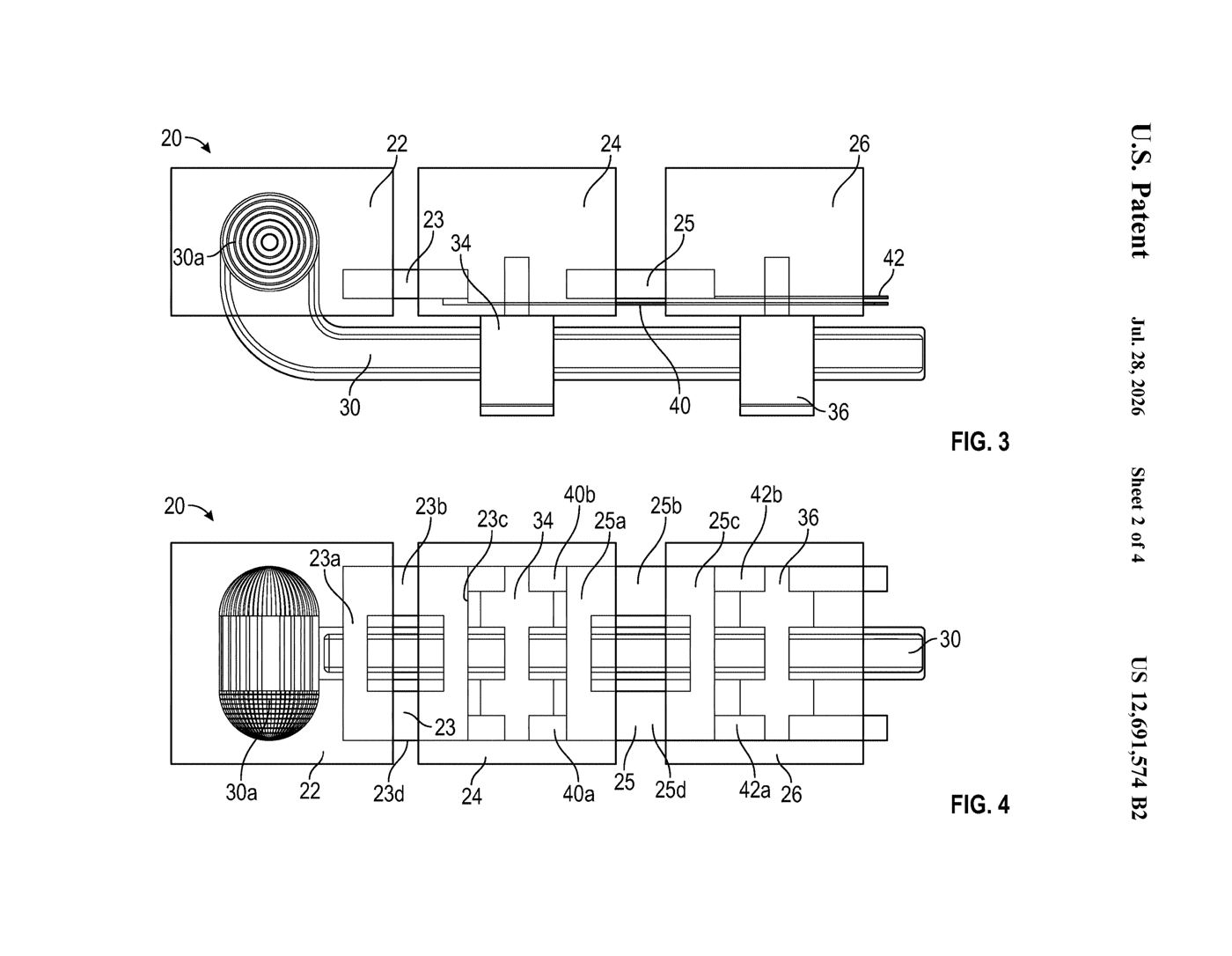
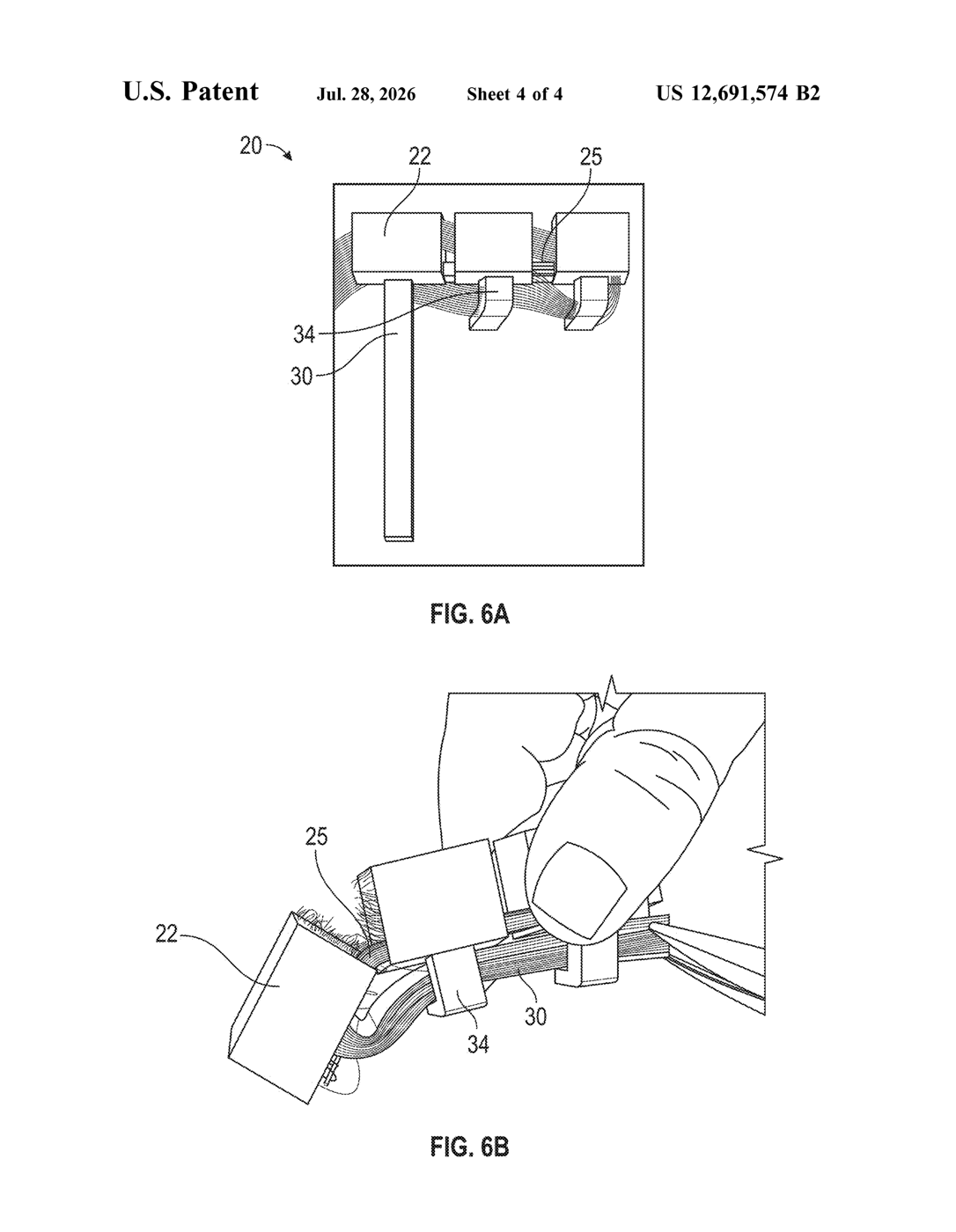
Two sheets from US patent 12,691,574 B2, granted to the University of California on 28 July 2026. Public patent drawings; the first is turned to read upright.
This one we wanted to be true. If threading tendons is most of the work, let a 3D printer make the hand with the tendons already inside. When it wears out, print another.
Part of that has really been done: in 2023 a group at ETH Zurich, working with a company called Inkbit, printed bones, ligaments, tendons and sensor channels in a single job. paper
Then read the small print. Their 2025 hand still needed 22 air muscles that were made separately and attached, plus outside air and valves. paper None of the patents and papers we screened shows a muscle, a tendon and a sensor coming out of one print. our inferenceour audit
Printing does remove parts, roughly 85 to 93 % of them by our count. our inferencean estimate It leaves friction, wear and repair exactly where they were.
Read the detailthe full argument
If tendon work is most of a build, and parts wear out in thousands of cycles, a printer looks like the answer twice over. Print the hand in one piece with the tendons already inside. When it wears out, print another.
Part of this has been done. In 2023 a group at ETH Zurich, with the company Inkbit, printed bones, ligaments, tendons and sensor channels in a single job paper. A pneumatic hand printed in one step appeared in 2022, with its air supply and electronics outside it paper.
Now the words “already assembled”. The ETH hand of 2025 still needed 22 air muscles that were made separately and attached, with outside air and valves paper. None of the patents and papers we screened shows a muscle, a tendon and a sensor made in one print job (our audit of the sources). And on a desktop printer, putting a tendon in still means pausing the print and using your hands maker’s claima printer maker’s guide, and our reading of it.
One patent comes close on the sensing side: links, an elastic joint and a conductive sensor made in one multi-material print maker’s claima patent. Others cover pieces that a printed hand might use and would have to license, such as the electrohydraulic pouch maker’s claima patent, a printed vacuum muscle maker’s claima patent and printed fingers with sliding tendons maker’s claima patent application.
What does printing change, then? Mostly the part count. Printing in place removes roughly 85 to 93 % of the parts of an open hand design, most of them fasteners and pins. By our count of build steps it saves only about a third of the labour unless the tendons are captive too (our estimate from step counts on four hands, not a measurement).
And what does it leave alone? Friction, because a printed channel is not a bearing: ORCA’s builders run their tendons over metal pins and PTFE tubes and keep them off bare printed plastic paper. Life, the subject of chapter 10. Repair, since one buried tendon can mean replacing a whole finger our inference. And the fuse: the brackets of LEAP v1 are designed to break in a crash and protect the rest of the hand maker’s claim, which a one-piece print cannot do.
Busted.“This is a solved problem for big companies; small teams have nothing to add.”what is public, who publishes measured work, where we would start
Build hours against joint count. One family of hands at three or more joint counts, with a timed method. Of four open hands we audited, none gives both a full part count and a timed build. (Chapter 6.)
Loaded life of a whole hand. Cycles to failure under a stated load, and what failed. Of five hand papers we audited, none gives both a price and loaded cycles to failure. (Chapter 10.)
Friction of a line in a printed channel, by material, liner and bend radius. (Chapter 7.)
Tendons against motors in the hand at equal force, mass and duty: creep over the service life, the effect of wrist angle, how often the tendons are re-tensioned and how long a repair takes. (Chapter 5.)
Joint count against task success, with the task and the training held fixed. Of four papers we checked, none isolates it. (Chapters 2 and 6.)
You would think the big companies have measured all of this and are simply not saying. Some of it, surely. But one of them reversed the most basic choice in its hand, in public, three years after testing it. maker’s claim
And five plain measurements kept tripping us up, chapter after chapter, because nobody has published them. They are in the list.
None of the five needs a factory. If we started tomorrow we would start with friction, because our own knuckle result hangs on it.
Read the detailthe full argument
It would be fair to assume that the companies building humanoids have measured everything in this article and simply do not say. Some of it they surely have. But look at what is public.
One of them changed its mind about the most basic choice in a hand, in public, three years after testing it. Most of one large maker’s robots leave without five-finger hands. And one trade report sets demand at about 70,000 hands a year against fewer than 20,000 made pressChina, 2026.
Then there is what nobody has published. Each item in the list is a gap we ran into in a chapter above.
The counts in that list are our own audits of the sources. None of the five needs a factory. The third needs a printer, a line, a weight and a force gauge. The second needs one hand, a load, a counter and patience. They are measurements that a small lab, a student or a hobbyist can make, and that a company has little reason to publish.
The published work on printed and artificial-muscle hands with measured numbers comes from a short list of groups: ETH Zurich with Inkbit, SJTU, USTC, Artimus with Bristol and a few labs in China. That is our impression from reading. We did not count the field.
If we were starting on one of these tomorrow, we would start with the friction strip. It is the cheapest of the five, and our own knuckle result hangs on it. If you have measured any of them, we would like to read it. If you want to measure one, we would like to compare notes. You can find us at stormy.ai.
Our own modelsWhat we built: three hands that exist only in a simulatoreach model in numbers, more renders, every limit
View F · the graspRender of a simulationView J · the 22-joint hand, posing
View E · the knuckle as a printable partNot printedFor scaleLeft to right, all at one scale: the outline of a fingertip 14 mm wide, as on our model hand; a 0.4 mm tendon, the size ORCA uses paper; and the 21 × 52 mm face of our knuckle part (our model; drawn, not built).
Time to show our own homework. We built three robot hands, and all three exist only inside a physics simulator called MuJoCo. Nothing was printed.
The first has six motors in the forearm, 16 joints and five tendons. We handed it a 150 g bar, let go, and shook it. The bar slipped 6.6 mm and stayed. simulationone run
The second has 22 driven joints and can strike poses. We have not tested what it can hold.
The third is a single knuckle, drawn for a 3D printer and not printed. And repeatable is not the same as right: a second run reproduced all 1,025 of our measures exactly, which only shows that the code gives the same answer twice. simulation
Simulation onlyNo part of these three hands has been built, printed or tested on hardware.
Read the detailthe full argument
Four of the claim checks above, in chapters 2, 3, 6 and 7, lean on our own models. All three models exist only in simulation, in MuJoCo 4.0.1. No part has been printed, and the pictures are path-traced renders of the simulated poses, not photographs.
The six-servo hand
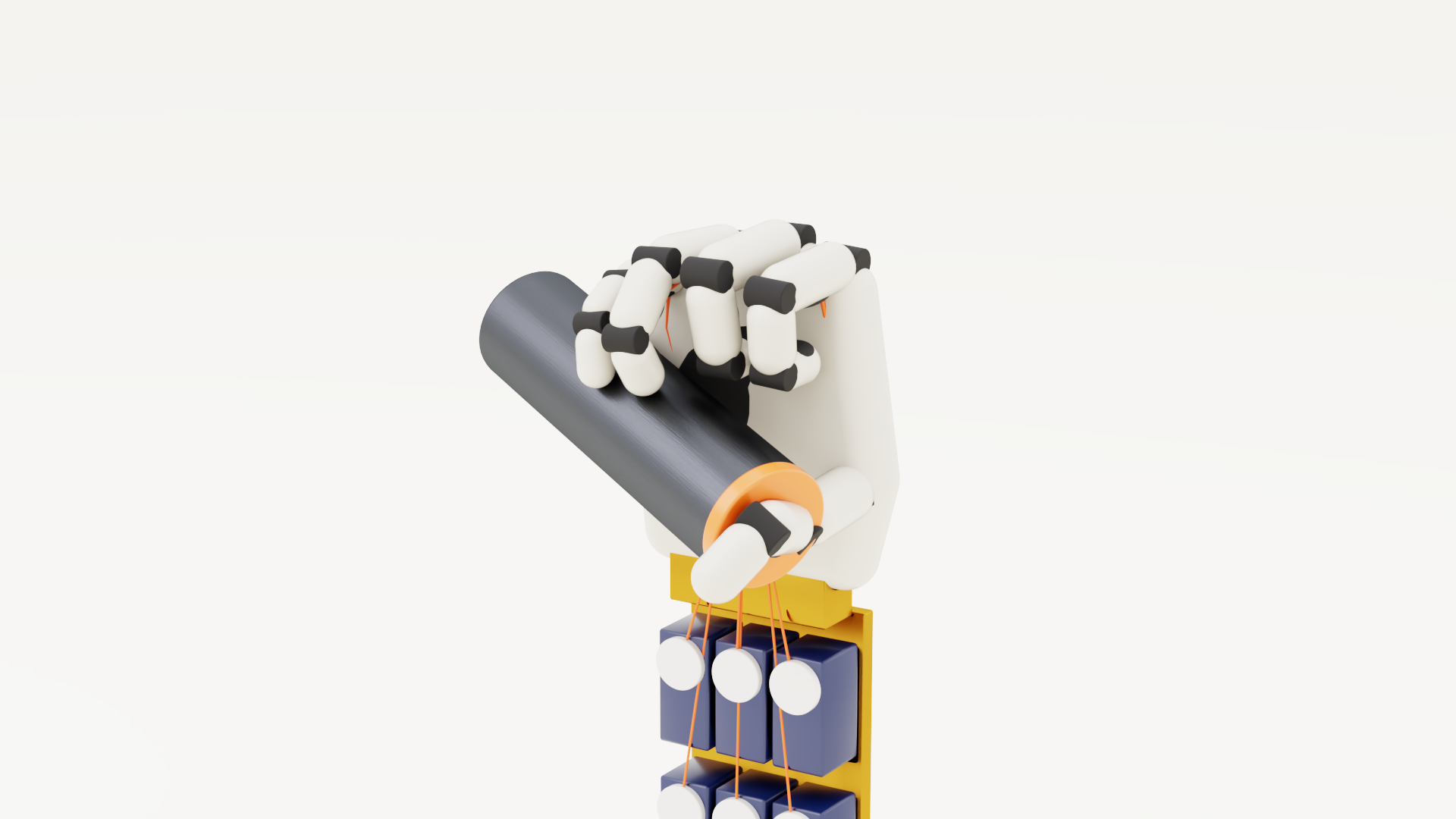
It has 16 joints, which are 15 finger hinges and one that swings the thumb across, with 5 tendons and 6 motors in the forearm. In a fist its index finger closes to 93.0°, 95.8° and 78.6° at its three joints. It took a 150 g bar, we let go of the bar and shook the hand, and the bar stayed. It slipped 6.6 mm and ended with 8 points of contact, at 16 N in the finger tendons and 12 N at the thumb. A second run in a different setup gave 6.5 mm simulation.
View G · fistView H · holding 150 g
The 22-joint hand
It has 22 driven joints, 44 tendons and 236 guide points, and gave the counts and the reach test of chapter 6. It can pose. We have not tested what it can hold.
View K · fist, bones made clear
Renders of our 22-joint model. The tendons are orange and the joints are pale blue; the blocks below are 44 motors.
The knuckle
This is the on-axis design of chapter 7, drawn as a part that could be printed: three bodies printed in place, 21 × 52 × 20 mm and 16.2 g of PETG plastic, with one pause at a height of 10 mm to lay in the knuckle’s own tendons. It has not been sliced or printed simulationwith a check of the drawing.
The limits
Simulation only. There is no hardware.
Stiffness and friction are assumed. The friction of a line in a printed channel, on which the knuckle result depends, we have not measured.
Mostly one run each. The bar test is one object and one grasp.
The reach test asks where fingers can go and not what they can hold, and the model’s thumb is weak.
In the renders the tendons are straight tubes between guide points, and in the grasp film the bar hangs in the air until the fingers close.
We wrote a bench of seven tests for comparing hand designs and did not complete it for any design, so we report no comparison.
Repeatable is not the same as right. An independent second run of one of our hand simulations reproduced all 1,025 of its measures exactly simulation, which shows only that the code gives the same answer twice. One paper found that a tendon hand needed its cable scales retuned by 20 to 30 % when an unchanged policy was moved onto hardware paper.
Four busted, eight plausible, none confirmed. Most are “plausible” because most of the evidence is a simulation, one run or a maker’s word. That count is the honest summary of the field as we found it: many confident claims and few published measurements.
Sources
Read the detailevery source, grouped by the chapter that uses it
Grouped by the chapter that uses them. We opened the pages in November 2026. Where a link is missing, our notes hold none. Statements marked “measured by us in simulation” and “our inference” rest on our own models and arithmetic and have no outside source.
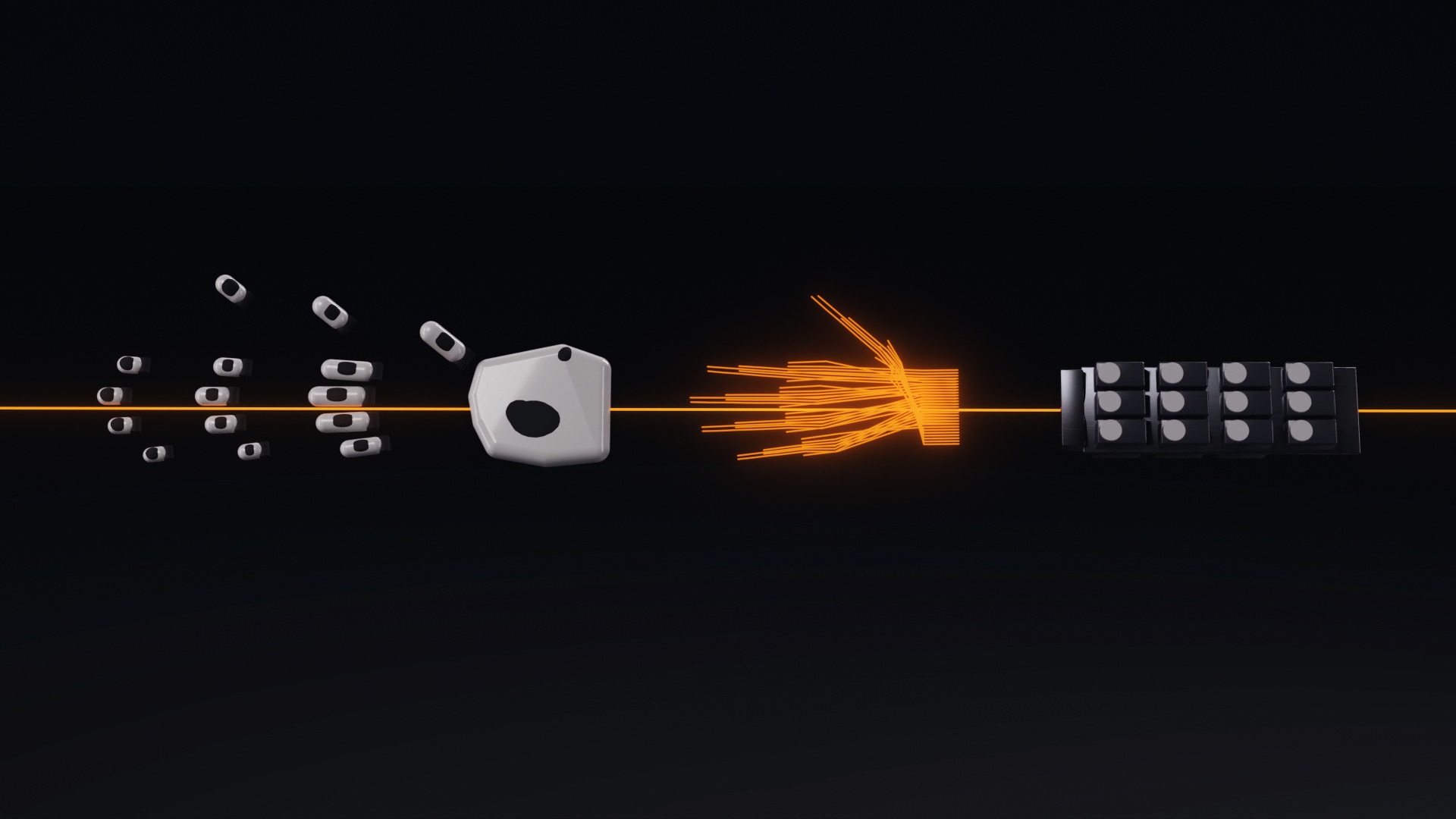
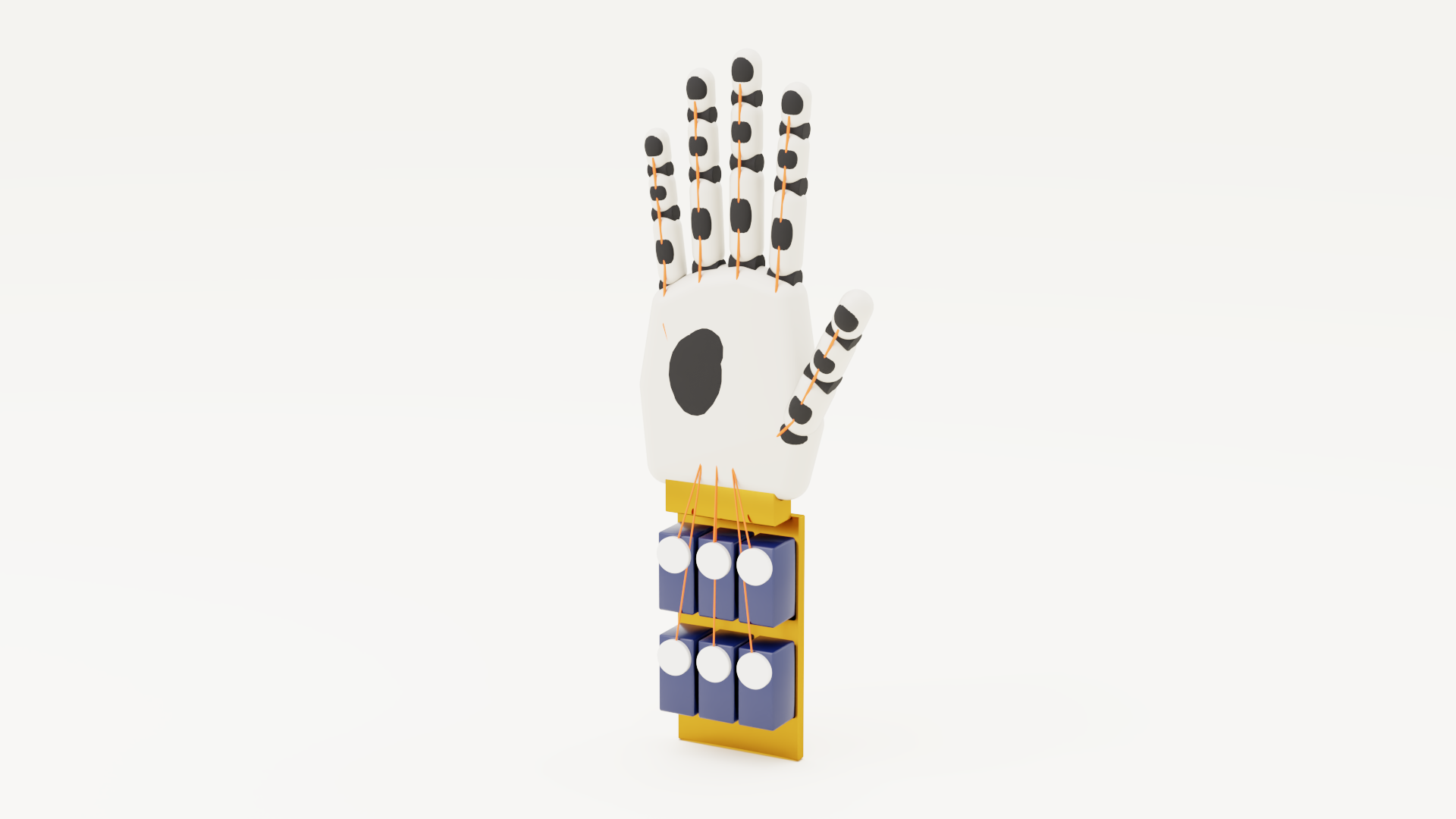
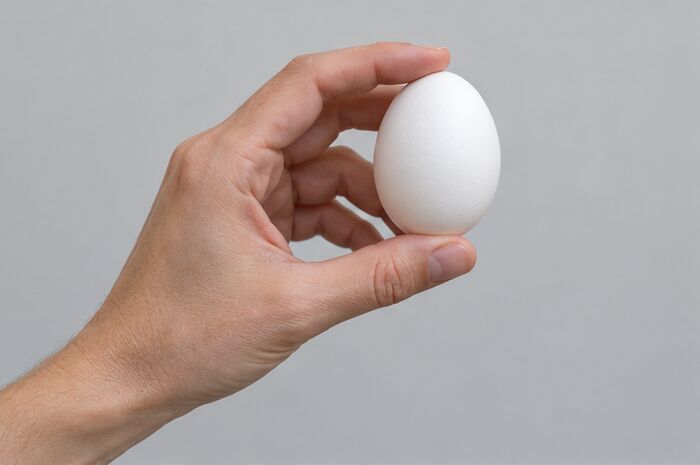 1. gentle
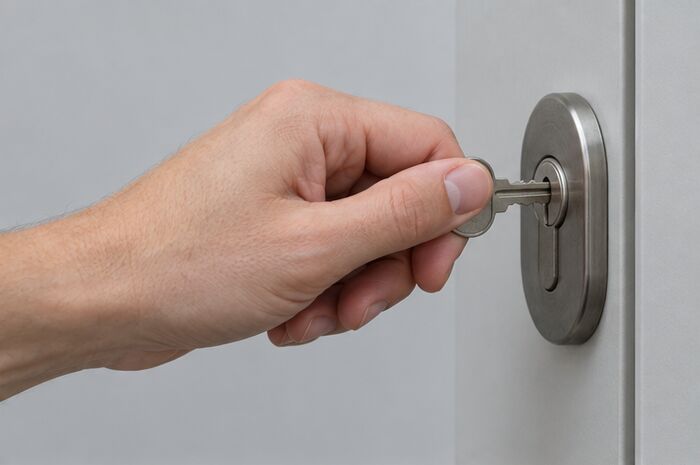 2. exact
 3. strong
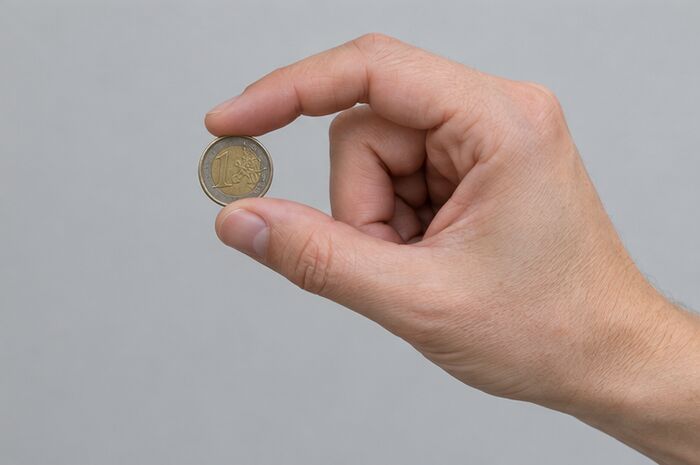 4. feels